
Led first by the priest Mattathias and then by his son Judas Maccabeus ("the hammer"), Jewish forces wage a sustained guerrilla and open war against Seleucid rule, eventually securing religious freedom and, later, political independence.
No canonical Scripture reference (historical context outside the Protestant canon)
Further context
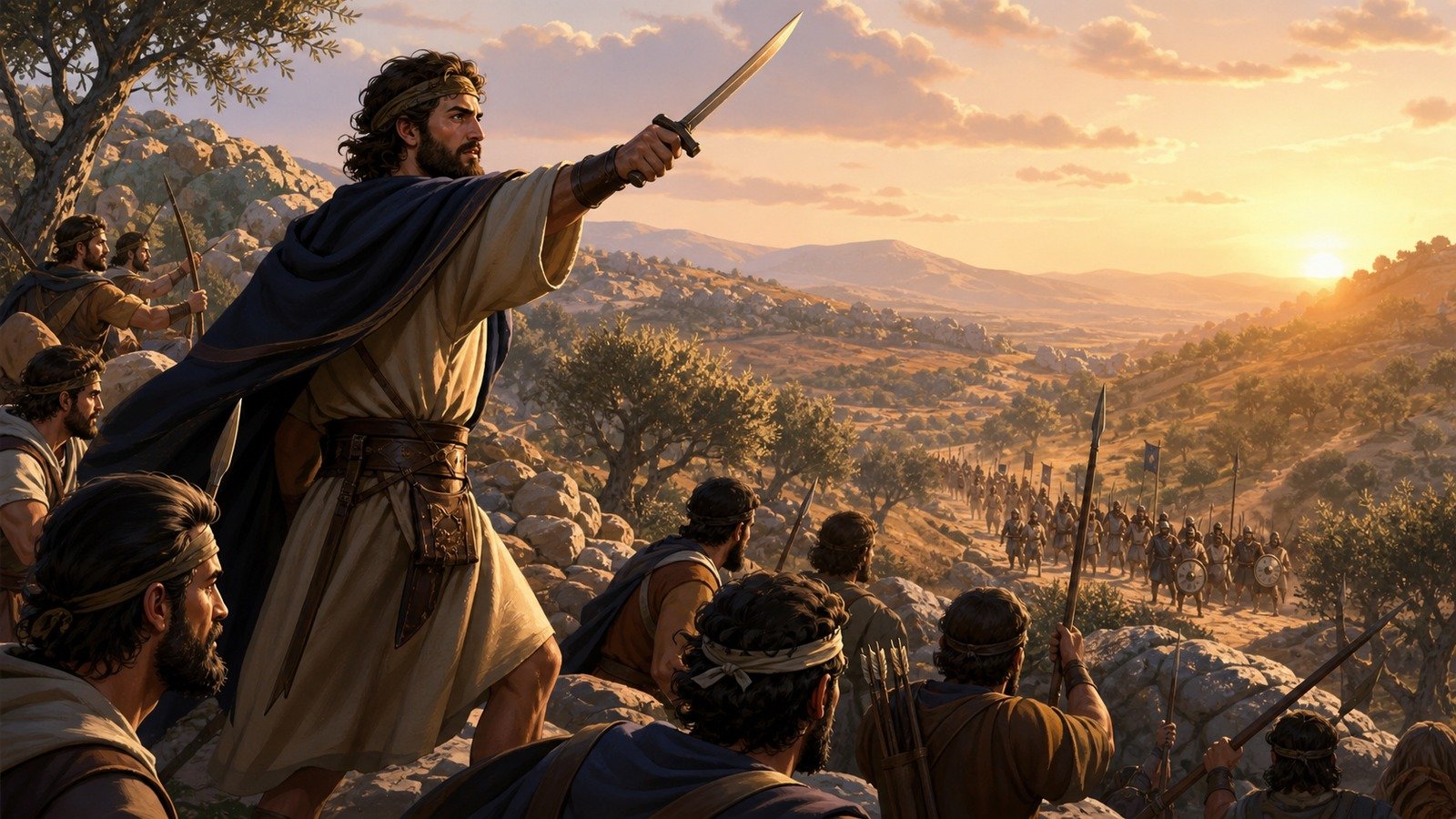
3 min readThe revolt starts in a village. Royal officers arrive at Modein, about thirty kilometres north-west of Jerusalem, to enforce the sacrifice, and an elderly priest named Mattathias refuses. When another Jew steps forward to comply, Mattathias kills him at the altar and then kills the officer, tears down the altar and calls out: let everyone who is zealous for the law and supports the covenant follow me. He and his five sons take to the hills.
The name Maccabee belongs to the third son, Judas, and most plausibly means the hammer.
The first year nearly ends it. A group of about a thousand who had fled to caves is attacked on the Sabbath and refuses to fight or even to block the entrances, and all of them are killed. The survivors then take a decision that changes Jewish practice permanently: whoever comes against us on the Sabbath, we will fight, so that we do not all die as our brothers died in the caves. Self-defence on the Sabbath becomes permissible, and the ruling holds.
Judas fights a guerrilla campaign in terrain he knows against a professional army that has to come to him, and wins four engagements in succession, twice against forces several times his size. Two Seleucid governors are defeated in the field. The empire is also fighting on its eastern frontier at the time, which is a substantial part of why a peasant revolt in a hill province was able to hold.
Three years after the desecration he takes Jerusalem, except for the citadel, and cleanses the temple.
The war does not stop there. Mattathias had died in the first year, and Judas is killed in battle in 160 BC against a much larger force, having refused to withdraw. His brothers Jonathan and then Simon continue, and the fighting runs on for another two decades in a shifting mixture of warfare, diplomacy and Seleucid dynastic politics, with the brothers backing rival claimants to the throne in Antioch in exchange for concessions.
Judas is also recorded as sending an embassy to Rome and concluding a treaty of friendship, which is the first formal contact between the Jewish nation and the power that eventually rules it.
What the revolt achieves is the survival of Judaism at the moment when an empire had decided to end it. What it also produces, within two generations, is a dynasty of priest-kings running a small state by the same methods as everyone else in the region, and a set of internal divisions that the Gospels open in the middle of.
The rising begins with an elderly priest named Mattathias at Modein refusing to sacrifice, killing a Jew who stepped forward to do it and the royal officer with him, and pulling down the altar.
His five sons take over, and the third of them, Judas, is nicknamed Maccabeus, which probably means the hammer, and the name attaches to the whole family and the whole revolt.
The military problem they faced was serious. Seleucid armies included heavy infantry in phalanx formation, cavalry and war elephants, and the rebels had none of those things. They fought in the hills, at night, in small units, and they won repeatedly against much larger forces.
One episode from the first year fixed the terms permanently. A group who had fled to the caves were attacked on the Sabbath and refused to fight, and a thousand of them were killed. The leadership then ruled that defensive war on the Sabbath was permitted, and the ruling held.