

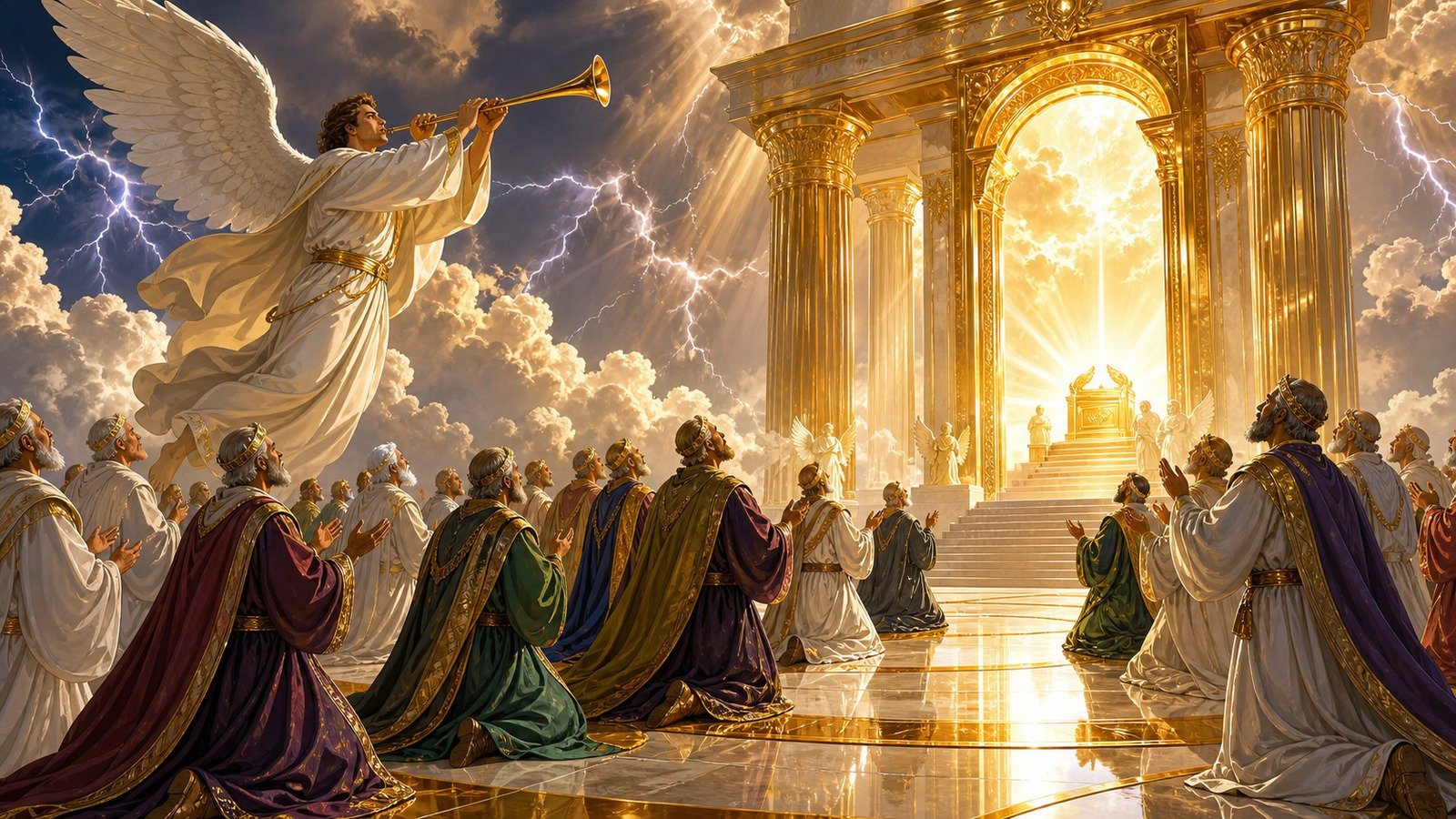
The seventh trumpet sounds, and loud voices in heaven declare that "the kingdom of the world has become the kingdom of our Lord," while the twenty-four elders fall down in worship and God's Temple in heaven is opened.
Further context
2 min readThe seventh angel sounds, and what follows is not another disaster.
There were loud voices in heaven, which said: the kingdom of the world has become the kingdom of our Lord and of his Messiah, and he will reign for ever and ever.
The tense is the point. It is stated as something that has happened rather than something about to happen, in the middle of a book where the beast has not yet appeared and most of the trouble is still ahead. That grammatical fact is one of the reasons many readers take the book's sequences to be overlapping rather than consecutive.
The singular is also worth noticing. The kingdoms of the world, plural, is the familiar phrasing from Handel's setting, and the older manuscripts have the singular: the whole arrangement, taken as one thing, has changed hands.
The twenty-four elders fall on their faces and worship, saying: we give thanks to you, Lord God Almighty, who is and who was, because you have taken your great power and have begun to reign.
The usual formula in the book is who is, and who was, and who is to come. Here the third clause is dropped, because the coming has happened.
Then a summary that holds together things usually kept apart: the nations were angry, and your wrath has come. The time has come for judging the dead, and for rewarding your servants the prophets and your people who revere your name, both great and small, and for destroying those who destroy the earth.
The last phrase is the only place in the Bible where destruction of the earth itself is named as a ground of judgement, and it has been quoted a great deal in the past fifty years.
Then God's temple in heaven is opened, and within it is seen the ark of his covenant.
The ark had disappeared with the destruction of the first temple around 586 BC. Where it went is unknown; a Jewish tradition says Jeremiah hid it in a cave, and the innermost room of the second temple stood empty. Roman soldiers entering it in AD 70 found nothing.
What the vision shows is that the empty room was not the last word.
And there came flashes of lightning, rumblings, peals of thunder, an earthquake and a severe hailstorm.
The elders' song is the last time they appear as a group in the book, and their words summarise everything that has been unfolding: power taken, reign begun, dead judged, servants rewarded.
Handel set those words in 1741, and the tradition of standing for them dates from a London performance at which George II is said to have risen, though the story is not attested until decades afterwards.
The seventh trumpet is not followed by a description of the end. The book carries on for eleven more chapters, which is the clearest single indication that its sequences are not a chronology.
The ark's disappearance left the innermost room of the second temple empty, and Pompey, entering it in 63 BC, is reported by Josephus to have been astonished to find nothing there at all.