

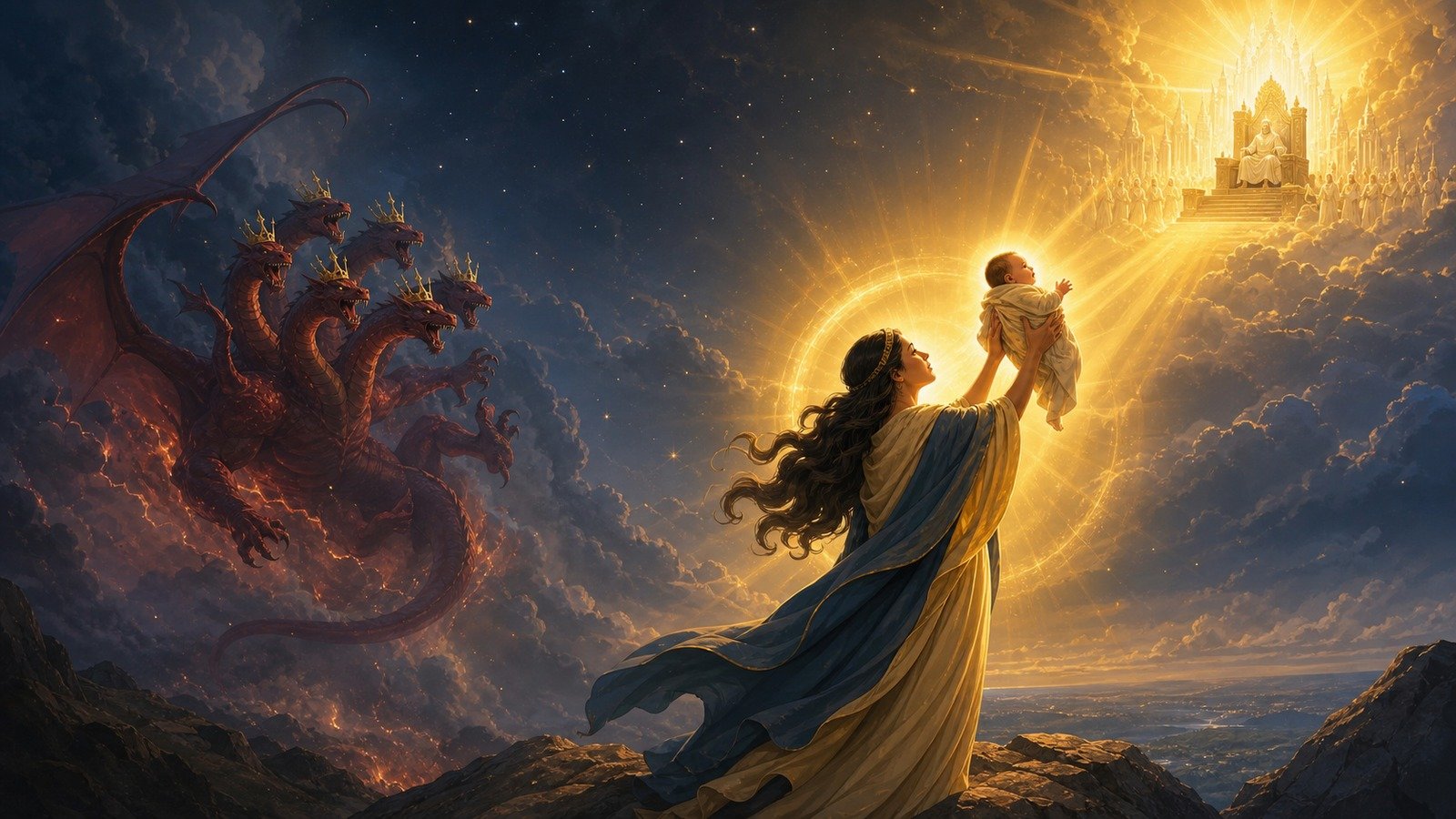
A woman "clothed with the sun" gives birth to a son destined to rule the nations while a great red dragon waits to devour him; the child is snatched up to God's throne, the dragon is thrown down from heaven, and it turns to pursue the woman and her offspring.
Further context
2 min readA great sign appears in heaven: a woman clothed with the sun, with the moon under her feet and a crown of twelve stars on her head. She is pregnant and cries out in the pain of giving birth.
The imagery comes from Joseph's dream, where the sun, moon and eleven stars bow to him, and the woman has been identified as Israel, as the church, and as Mary. The first reading fits the twelve stars and the birth; the third has shaped a great deal of Christian art; and the three are not mutually exclusive in a book that works by layering.
Then a second sign: an enormous red dragon with seven heads and ten horns and seven crowns on its heads. Its tail sweeps a third of the stars out of the sky and flings them to earth. It stands in front of the woman so that it might devour her child the moment he is born.
The child is born, a son who will rule all the nations with an iron sceptre, and is snatched up to God and to his throne. The woman flees into the wilderness to a place prepared for her, where she is cared for twelve hundred and sixty days.
The entire life of Christ passes between two clauses. Birth, then throne, and nothing in between, which is not carelessness but perspective.
Then war breaks out in heaven. Michael and his angels fight against the dragon, and the dragon is hurled down, and he is identified plainly: that ancient serpent called the devil, or Satan, who leads the whole world astray.
A voice announces the reason for his defeat, and the mechanism is the strangest thing in the chapter: they triumphed over him by the blood of the Lamb and by the word of their testimony; they did not love their lives so much as to shrink from death.
The accuser is thrown out because people who were killed refused to recant.
Woe to the earth and the sea, because the devil has gone down to you! He is filled with fury, because he knows that his time is short.
He pursues the woman, is thwarted, and goes off to wage war against the rest of her offspring, those who keep God's commands and hold fast their testimony about Jesus.
The war in heaven is not a story about the origin of evil, though it has often been read as one. Satan is thrown down after the child is caught up, which places it after the crucifixion rather than before the creation.
The twelve hundred and sixty days of the woman's protection is the same limited period as the beast's authority, and the two are being described as the same span from opposite sides.
The dragon's seven heads and ten horns are the same as the beast's in the following chapter, which makes the relationship between them explicit before either is explained.
The dragon is given four names in one sentence: the great dragon, the ancient serpent, the devil and Satan. Devil means slanderer in Greek and Satan means accuser in Hebrew, and both are job descriptions rather than proper names.