

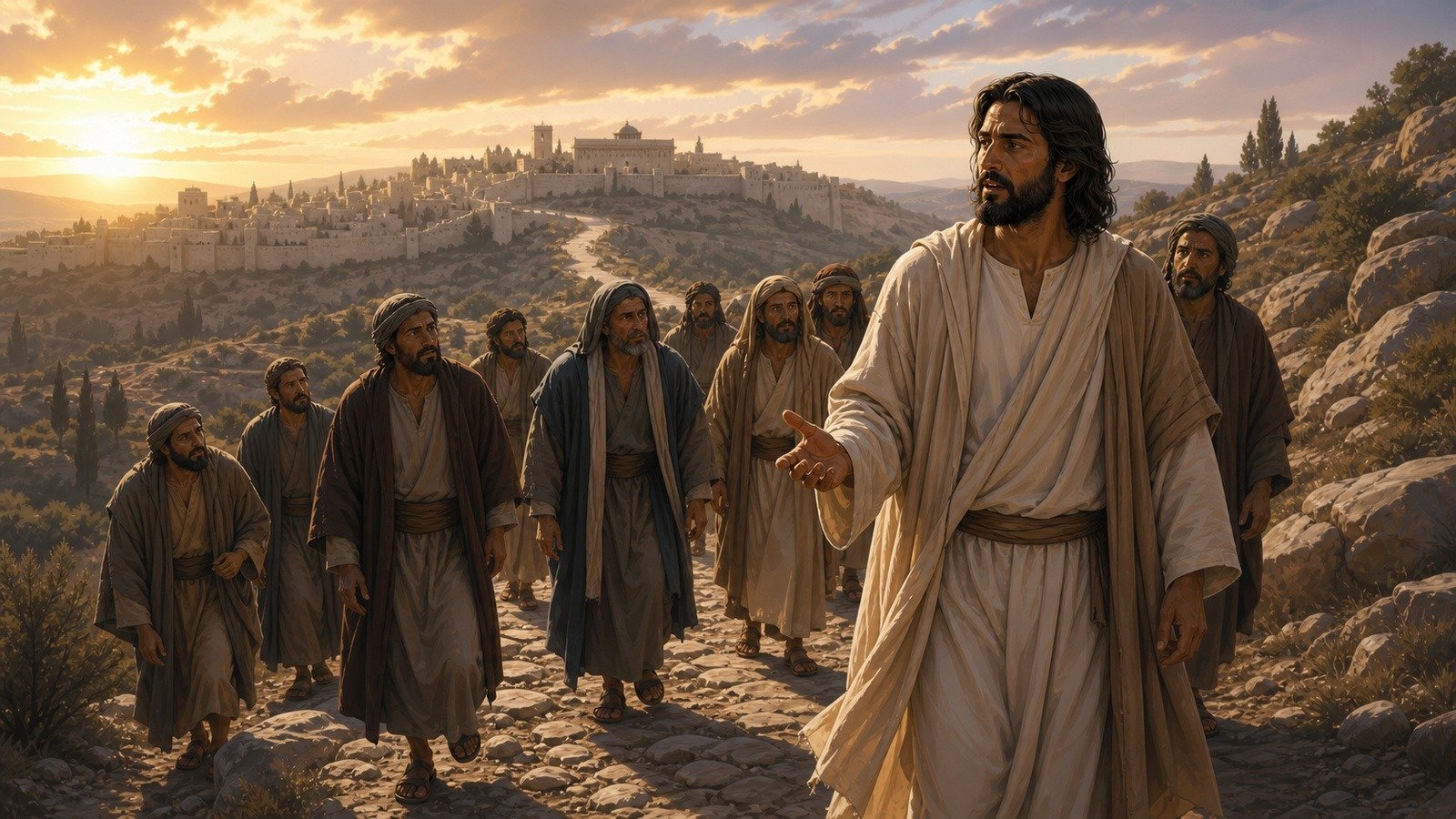
Jesus gives his most detailed prediction yet of his coming death by crucifixion and resurrection, on the road up to Jerusalem, naming the mockery, flogging and death that await him.
Further context
3 min readJesus and the Twelve are on the road going up to Jerusalem, and one detail sets the scene before anything is said. He is walking ahead of them, and the disciples are astonished, while those who follow are afraid.
Going up is literal as well as conventional. The road from Jericho climbs about a thousand metres in a day's walk, and Jerusalem sits on a ridge, so pilgrims spoke of going up to it regardless of direction.
He takes the Twelve aside and tells them what is going to happen, and this time he itemises it rather than summarising.
We are going up to Jerusalem, and the Son of Man will be delivered over to the chief priests and the teachers of the law. They will condemn him to death and will hand him over to the Gentiles, who will mock him and spit on him, flog him and kill him. Three days later he will rise.
Two stages of handing over are described: from the Jewish authorities to the Roman ones. That is exactly the procedure that followed, since the council could try a man on a religious charge but could not execute him, and needed the prefect to do it.
Mockery, spitting and flogging are each named separately, and each happened. Flogging under Roman practice was done with a whip of leather thongs weighted with bone or metal, and men died under it; it was normal before crucifixion, partly to shorten the ordeal.
Matthew's version adds the method by name: to be crucified. That is the first time the word is used of what is coming.
Luke adds two things. First, that everything written by the prophets about the Son of Man will be fulfilled. Second, a note about the effect on the listeners: the disciples did not understand any of this. Its meaning was hidden from them, and they did not know what he was talking about.
Three separate statements are made about their incomprehension in one sentence, which is more emphasis than the point ordinarily needs.
Whether that failure is stupidity, or something closer to the mind refusing information it cannot use, is worth weighing. They had been told twice already. What follows within a few verses is a request from two of them for the best positions in the coming kingdom, which suggests they had heard the word Jerusalem, understood that something decisive was about to happen there, and filled in the rest from their own expectations.
The pattern across all three predictions is the same. He states what is coming, they demonstrate that they have not taken it in, and he teaches about service and the last being first.
The road up from Jericho is the same one that appears in the story about the man beaten by robbers, and it was walked by pilgrims in groups for that reason. Passover was close, so the road would have been busy.
Walking ahead of a group is not how a teacher travelled. Rabbis were followed, and disciples walked behind, so the arrangement is normal; what is noted is the effect of it. Something in the way he was walking that day frightened the people behind him, and the two words used, astonished and afraid, describe men who could see that he was going somewhere on purpose and could not bring themselves to ask what it was.