

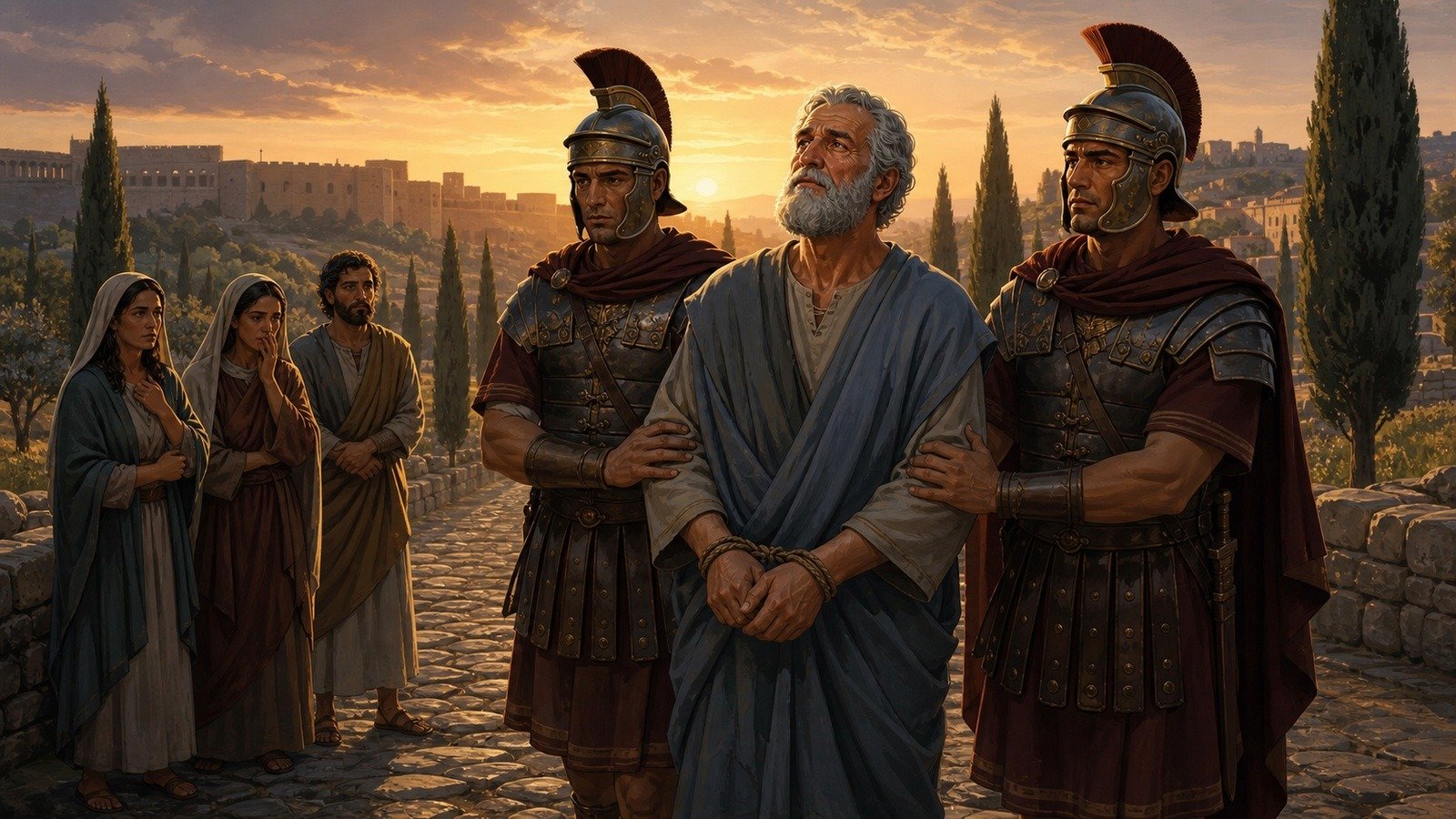
Early Christian tradition, including a saying attributed to Jesus in John's Gospel about Peter's death by another's hands, holds that Peter was also executed in Rome under Nero, with later tradition specifying crucifixion, reportedly upside down at his own request.
No canonical Scripture reference (early church tradition, not narrated in the New Testament)
Further context
2 min readThe New Testament does not describe Peter's death either, but it does contain something close to a prediction of it.
In the scene by the lake in Galilee, after the threefold question about love, he is told: when you were younger you dressed yourself and went where you wanted; but when you are old you will stretch out your hands, and someone else will dress you and lead you where you do not want to go. The writer adds a comment: Jesus said this to indicate the kind of death by which Peter would glorify God. That was written down decades after the fact, by someone who knew how it had ended.
Stretching out the hands was a recognised way of referring to crucifixion in early Christian writing.
Clement of Rome, around AD 96, says that Peter endured not one or two but many trials and, having borne his testimony, went to the place of glory that was his due. He names him alongside Paul.
Ignatius of Antioch, writing to the Romans about AD 107 on his own way to execution, appeals to them in a way that assumes both apostles had been among them.
The tradition that he was crucified upside down, having asked not to die in the same manner as his master, comes from a second-century account of Peter's acts, which is a work of pious fiction containing a good deal else that nobody believes. That it is late and legendary does not make it false, and it does not make it evidence.
The location traditionally given is the Vatican hill, in Nero's circus, which stood roughly where the basilica stands now.
Excavations under St Peter's between 1940 and 1949 uncovered a Roman cemetery of tombs and mausolea running along the slope, and beneath the high altar a simple monument of about AD 160 matching the description of the memorial mentioned by the writer Eusebius quotes. Bones were found nearby, and a wall carrying graffiti including a fragment reading Peter is here. Whether the bones are his cannot be established, and Paul VI announced in 1968 that they had been identified in a manner considered convincing.
The archaeology establishes that Christians in the second century believed his grave was on that hill.
The saying in the Gospel about stretching out the hands is the only prediction of an apostle's death recorded in the New Testament, and it is followed immediately by two words: follow me.
What the excavations under the basilica establish and do not establish is worth keeping distinct. They establish a first-century cemetery, a second-century memorial and second-century graffiti invoking Peter. They do not establish whose bones are in the wall.
Peter appears in the New Testament more than any other disciple, is corrected more often than any of them, and denies knowing Jesus three times in one night. That the movement's traditions preserved all of that about the man they regarded as its leading figure is a reasonable argument for the reliability of the traditions.
His two letters, whatever the questions about the second, are addressed to congregations across northern Asia Minor, hundreds of kilometres from anywhere he is recorded working.