

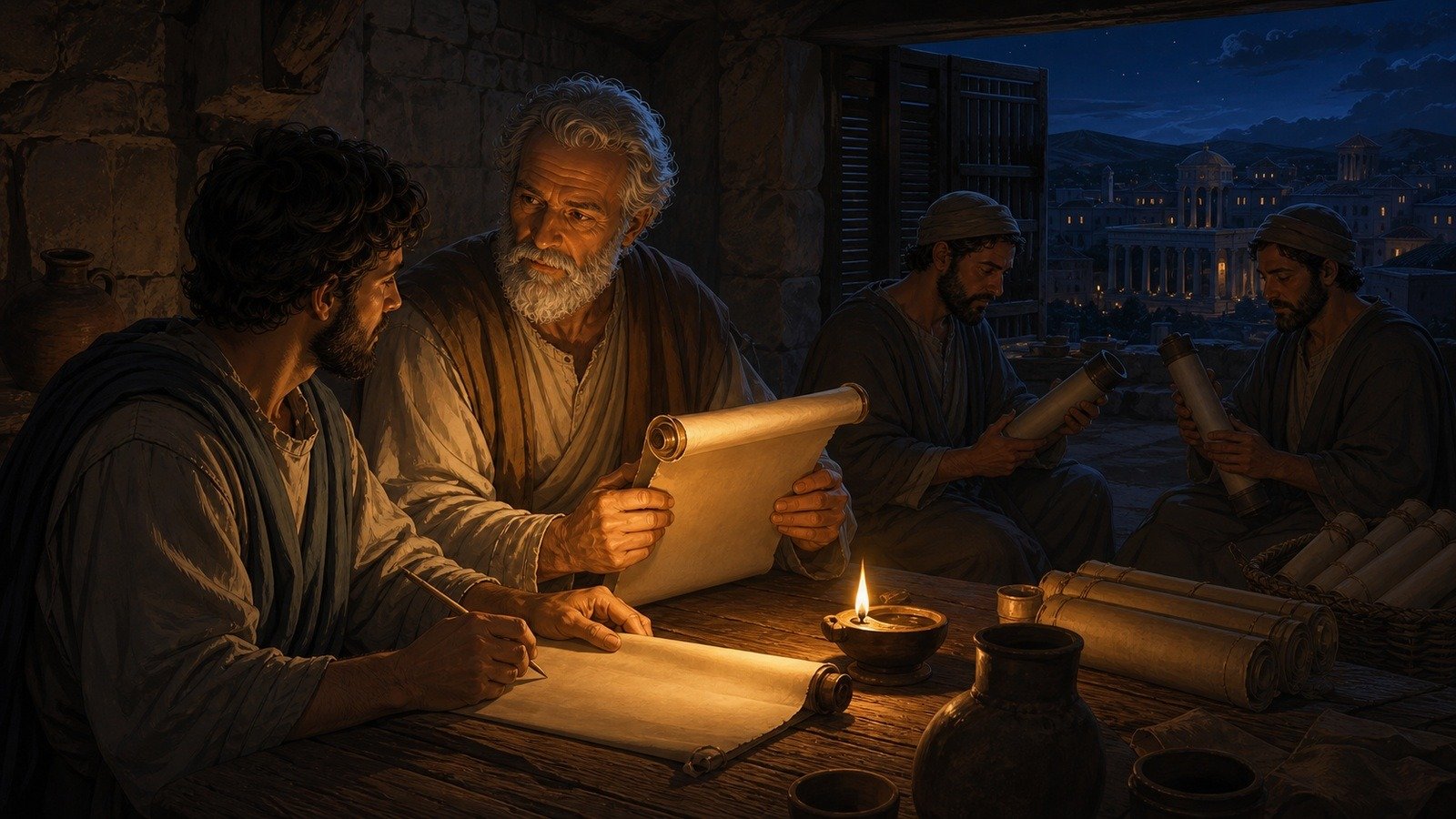
Warning against false teachers and mockers who doubt Christ's return, this letter has the most disputed authorship question of any New Testament document; many scholars date it well after Peter's traditional death, seeing it written in his name and legacy, while others defend it as genuinely his final letter.
Further context
2 min readThe writer names himself Simon Peter, a servant and apostle of Jesus Christ, says he was an eyewitness of the majesty on the sacred mountain, refers to a previous letter, calls Paul our dear brother, and says he knows his own death is imminent.
Nothing in the New Testament has a more contested authorship, and the arguments are worth setting out honestly because the letter itself is short and the dispute has shaped how it is read.
Against Peter's authorship: the Greek is elaborate and rhetorical, quite unlike the first letter; the second chapter overlaps so extensively with the letter of Jude that one is clearly using the other; the writer refers to Paul's letters as a collection alongside the other Scriptures, which implies a stage of development usually placed well after the 60s; and the letter is the least well attested of any New Testament book in the early centuries, with Eusebius listing it among the disputed writings and Origen noting doubts about it.
For Peter's authorship: a different secretary would produce a different style, which the first letter itself acknowledges by naming Silas; borrowing from a shorter existing document was normal practice; and the writer's claims about himself are specific and personal rather than the vague credentials a forger usually supplies.
A number of scholars conclude it was written in Peter's name by a follower after his death, which was an accepted literary practice in some circles at the time and is regarded by others as straightforward deception. The disagreement is real and the honest position is to state it.
What the letter is about is false teachers, and the description of them is savage: springs without water, mists driven by a storm, experts in greed, who mouth empty, boastful words and appeal to the lustful desires of the flesh.
Behind their teaching is a specific objection, quoted directly: where is this coming he promised? Ever since our ancestors died, everything goes on as it has since the beginning of creation.
The answer given is that with the Lord a day is like a thousand years, and a thousand years are like a day, and that the delay is patience rather than indifference.
The letter's reference to Paul's letters, and the remark that they contain some things that are hard to understand which ignorant and unstable people distort, is the earliest indication that Paul's correspondence was circulating as a collection and being treated as Scripture.
That sentence is also the earliest recorded complaint that Paul is difficult, which has been the majority view ever since.
The letter's opening claim to have been on the sacred mountain refers to the transfiguration, and it is the only place outside the Gospels where that episode is described by someone claiming to have been present.
How a document could be written in a dead man's name and still be regarded as truthful is a question about ancient literary convention rather than about honesty as such, and the two sides of it have never been reconciled.