

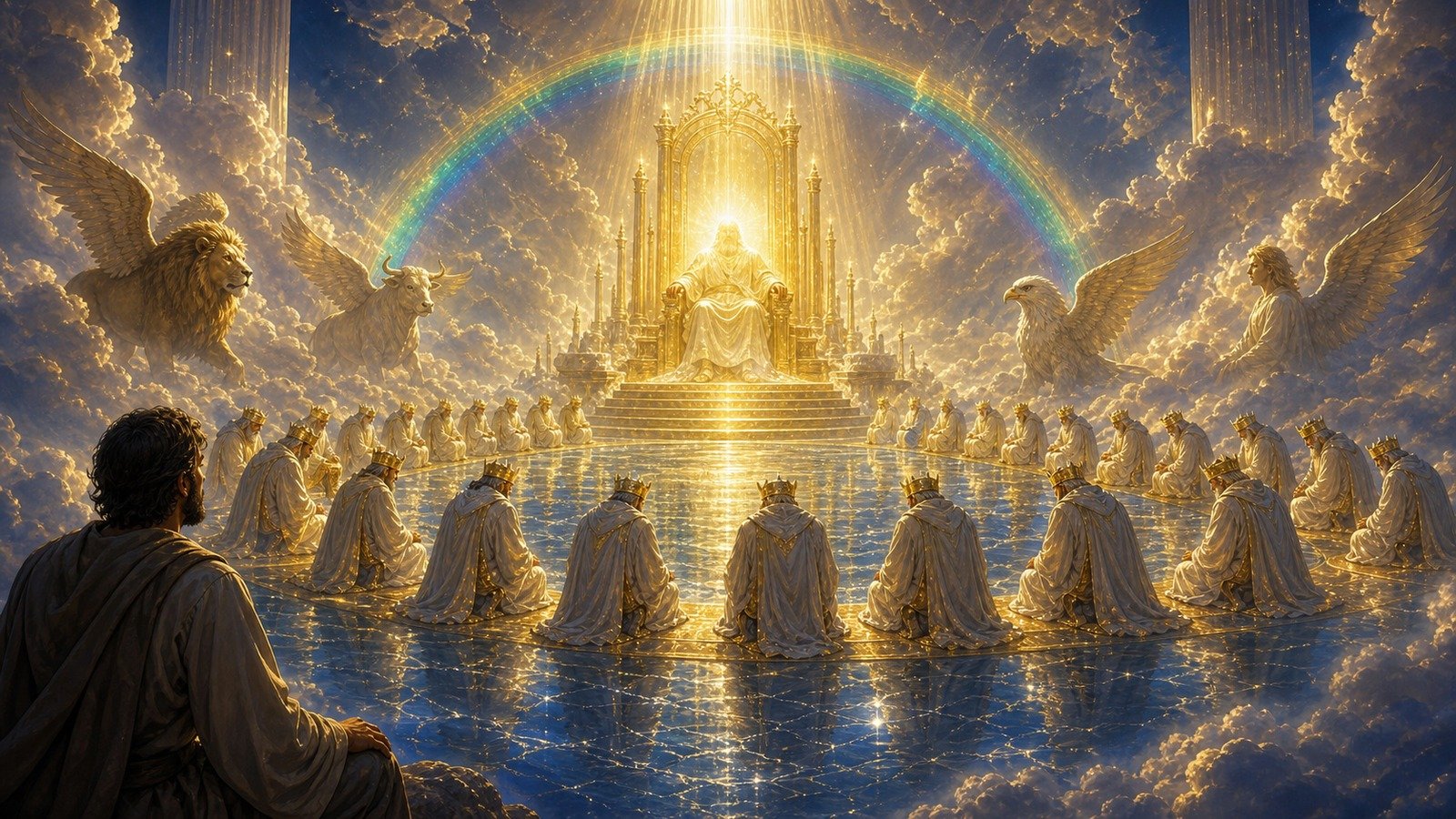
John is taken up "in the Spirit" to see a throne surrounded by twenty-four elders and four living creatures, all continually worshipping the one seated on the throne as holy and worthy of glory.
Further context
2 min readAfter the seven messages the scene changes completely. John sees a door standing open in heaven and hears the voice that had spoken before saying, come up here, and at once he is in the Spirit.
What he describes is a throne room, and the description is almost entirely indirect. There is no attempt to describe the one seated on the throne. Instead there is an appearance like jasper and ruby, a rainbow resembling an emerald encircling the throne, and flashes of lightning, rumblings and peals of thunder coming from it.
That reticence is deliberate and it follows the older prophets. Ezekiel by the Kebar river piles up the same qualifications, describing the appearance of the likeness of the glory of the Lord, and Isaiah in the temple sees only the hem of a robe filling the building.
Around the throne are twenty-four other thrones with twenty-four elders seated on them, dressed in white and wearing gold crowns. Who they are is unexplained. The usual proposals are the twelve tribes together with the twelve apostles, an order of angelic beings, or a heavenly counterpart to the twenty-four divisions of priests who served in the temple by rota.
Before the throne are seven blazing lamps, and what looks like a sea of glass, clear as crystal.
In the centre, around the throne, are four living creatures covered with eyes in front and behind: one like a lion, one like an ox, one with a face like a man, one like a flying eagle, each with six wings. They combine features of Ezekiel's creatures and Isaiah's seraphim, and they never stop saying: holy, holy, holy is the Lord God Almighty, who was, and is, and is to come.
Threefold repetition in Hebrew is the superlative, and the only attribute of God repeated that way anywhere in the Bible is holiness.
Whenever the creatures give glory, the elders fall down and lay their crowns before the throne, saying: you are worthy, our Lord and God, to receive glory and honour and power, for you created all things, and by your will they were created and have their being.
The scene is worth reading against its setting. It was written for congregations in cities full of imperial temples, where a court ceremonial existed in which subjects prostrated themselves before a man addressed as lord and god. This is a description of the real throne room, and everything else is provincial.
The four living creatures were taken by early Christian writers as symbols of the four Gospels, and the pairings became standard in art: the man for Matthew, the lion for Mark, the ox for Luke and the eagle for John. Nothing in the vision suggests it.
The throne room scene is the source of a great deal of Christian hymnody, and the words of the living creatures are sung in most liturgies in the world every week.
The one seated on the throne is never named in the scene and never speaks, and both facts are consistent with the older tradition of describing what surrounds God rather than God.