

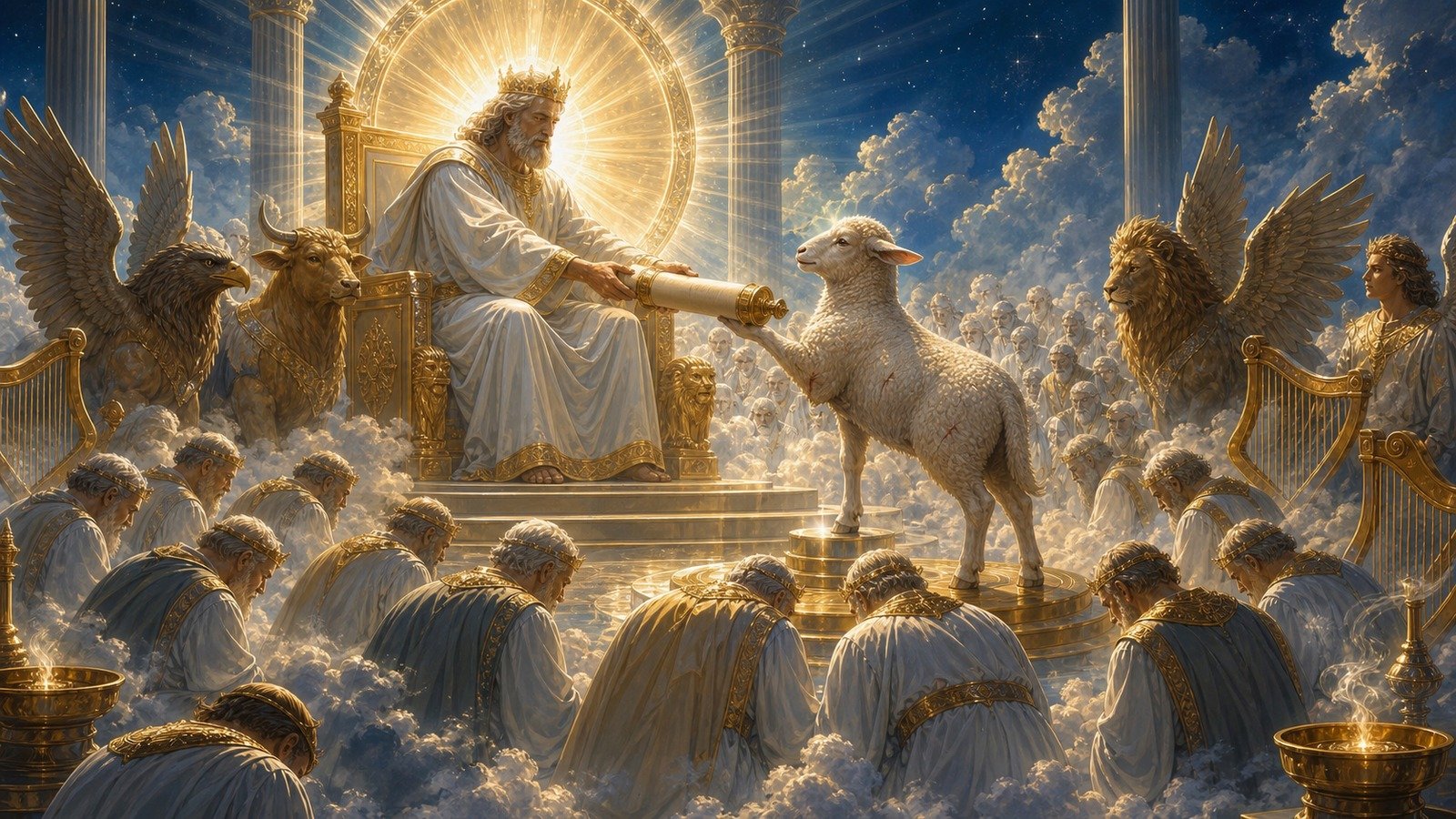
A sealed scroll appears that no one is found worthy to open, until a Lamb "looking as if it had been slain" steps forward to take it, prompting the assembled creatures and elders to sing a new song of worship.
Further context
2 min readIn the right hand of the one seated on the throne is a scroll with writing on both sides and sealed with seven seals.
A document written on both sides was unusual, since papyrus was normally written on one, and it indicates something full. Sealed documents in the Roman world were most often wills and legal deeds, closed with wax impressions that only the appropriate party could break.
A mighty angel proclaims in a loud voice: who is worthy to break the seals and open the scroll? But no one in heaven or on earth or under the earth could open it or even look inside it.
John weeps and weeps, which is an unusually personal intrusion in a book of visions, and why he takes it so hard goes unexplained. What can be observed is that a sealed scroll nobody can open means history stops where it is.
Then one of the elders says: do not weep! See, the Lion of the tribe of Judah, the Root of David, has triumphed. He is able to open the scroll and its seven seals.
Both titles are royal and military. The lion of Judah comes from the blessing Jacob gave his sons; the root of David from Isaiah's promise of a shoot from the stump of Jesse.
Then John turns to look at the lion, and this is the point on which the whole book turns.
Then I saw a Lamb, looking as if it had been slain, standing at the centre of the throne.
He is told to look at a lion and sees a slaughtered lamb. The word used is a diminutive, a little lamb, and the participle describing it means having had its throat cut. It is standing, which is the other half of the picture.
Everything the book says afterwards about conquest, judgement and victory has to be read through that substitution. The one who overcomes does so by having been killed.
The Lamb takes the scroll, and the four living creatures and the twenty-four elders fall down, each holding a harp and golden bowls full of incense, which are the prayers of God's people.
Then the circle widens: thousands upon thousands of angels, and then every creature in heaven and on earth and under the earth and on the sea, singing to the Lamb who was slain.
The Lamb has seven horns and seven eyes, which are the seven spirits of God sent out into all the earth. Horns mean power and seven means completeness, so the picture is of a slaughtered animal with total power and total sight, which is not a stable image and is not meant to be.
Lamb is the most frequent title for Christ in the book, used about thirty times, and almost the only one used consistently.
Every element of the scene has been set up beforehand: the throne, the elders, the creatures, the incense. The one thing not set up is the substitution of a lamb for a lion, and it is the only thing that matters.