

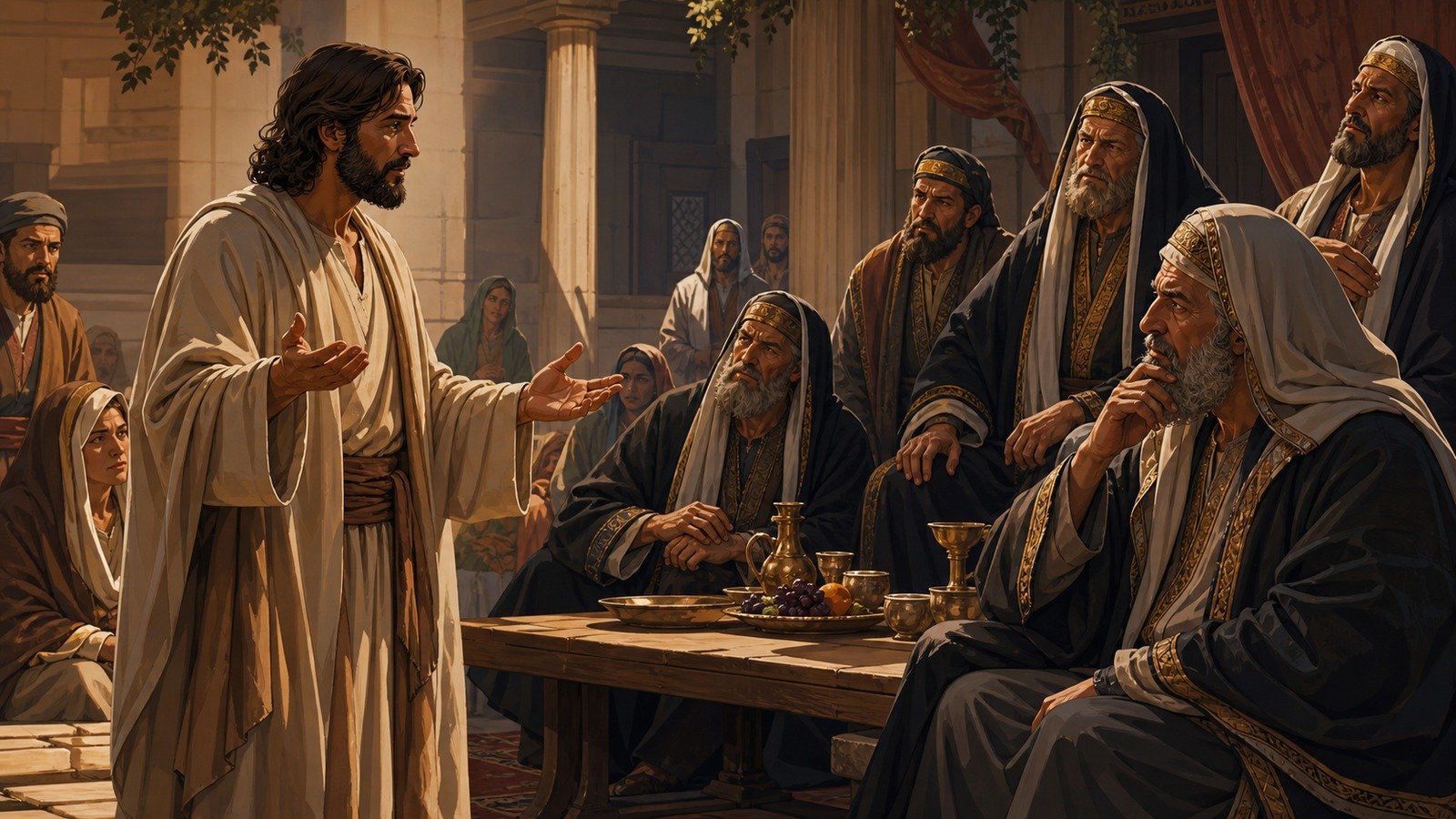
Jesus pronounces a series of sharp "woes" against religious leaders for prioritising external ritual and status over justice, mercy and genuine faithfulness, among his most confrontational recorded teaching.
Further context
3 min readSeven denunciations, delivered in public, and they are the most sustained attack on named opponents anywhere in Jesus' recorded teaching.
Two things need saying before the content. The Pharisees were not, by the standards of their time, bad men. They were the serious ones: committed to the law, respected by ordinary people, and their movement was the ancestor of the rabbinic Judaism that survived the destruction of the temple. Much of what he taught is closer to their positions than to any other party's. That proximity is part of why the quarrel is so sharp.
And this material has been used against Jewish people for centuries in ways that would have appalled everyone in the room, all of whom were Jews, including the speaker. It is an internal argument, of the kind the prophets had been conducting for eight hundred years.
The opening is a concession: the teachers of the law and the Pharisees sit in Moses' seat, so you must be careful to do everything they tell you. But do not do what they do, for they do not practise what they preach.
Then the specifics, and they are physical. They make their phylacteries wide and the tassels on their garments long. Phylacteries were small leather boxes containing scripture, bound to the arm and forehead for prayer, and tassels were commanded on the corners of a garment as a reminder. Both were obedience. Enlarging them so they could be seen across a courtyard is the charge.
They love the place of honour at banquets and the most important seats in the synagogues, and to be greeted with respect in the marketplaces.
The woes themselves cover shutting the kingdom in people's faces; travelling over land and sea to win a single convert; and an elaborate system distinguishing oaths sworn by the temple, which were not binding, from oaths sworn by the gold of the temple, which were. That last is not caricature. Rabbinic discussion of which oath formulas bound and which did not is extensive, and it began as an attempt to stop people swearing carelessly.
You give a tenth of your spices, mint, dill and cumin, but you have neglected the more important matters of the law: justice, mercy and faithfulness. You should have practised the latter without neglecting the former. Tithing garden herbs was scrupulous beyond requirement, and the criticism is not of the scruple but of what it displaced. Then the image: you strain out a gnat but swallow a camel.
Whitewashed tombs is the harshest. Tombs were limewashed before Passover so pilgrims would not touch them accidentally and become unclean, so the white marked something to avoid.
It closes not in anger but in grief. Jerusalem, Jerusalem, you who kill the prophets. How often I have longed to gather your children together, as a hen gathers her chicks under her wings, and you were not willing.
Where and when this was delivered differs between the two fullest versions, one placing it in the temple courts during the final week and the other over dinner in a Pharisee's house, and the material may well have been said more than once.
The seven denunciations are constructed as a formal series, and the word rendered woe is not a curse but a lament, the cry used by the prophets over cities about to fall. Reading it as a shout of anger misses what the closing lines make plain, where the same voice turns to the city and speaks about gathering children under wings.