

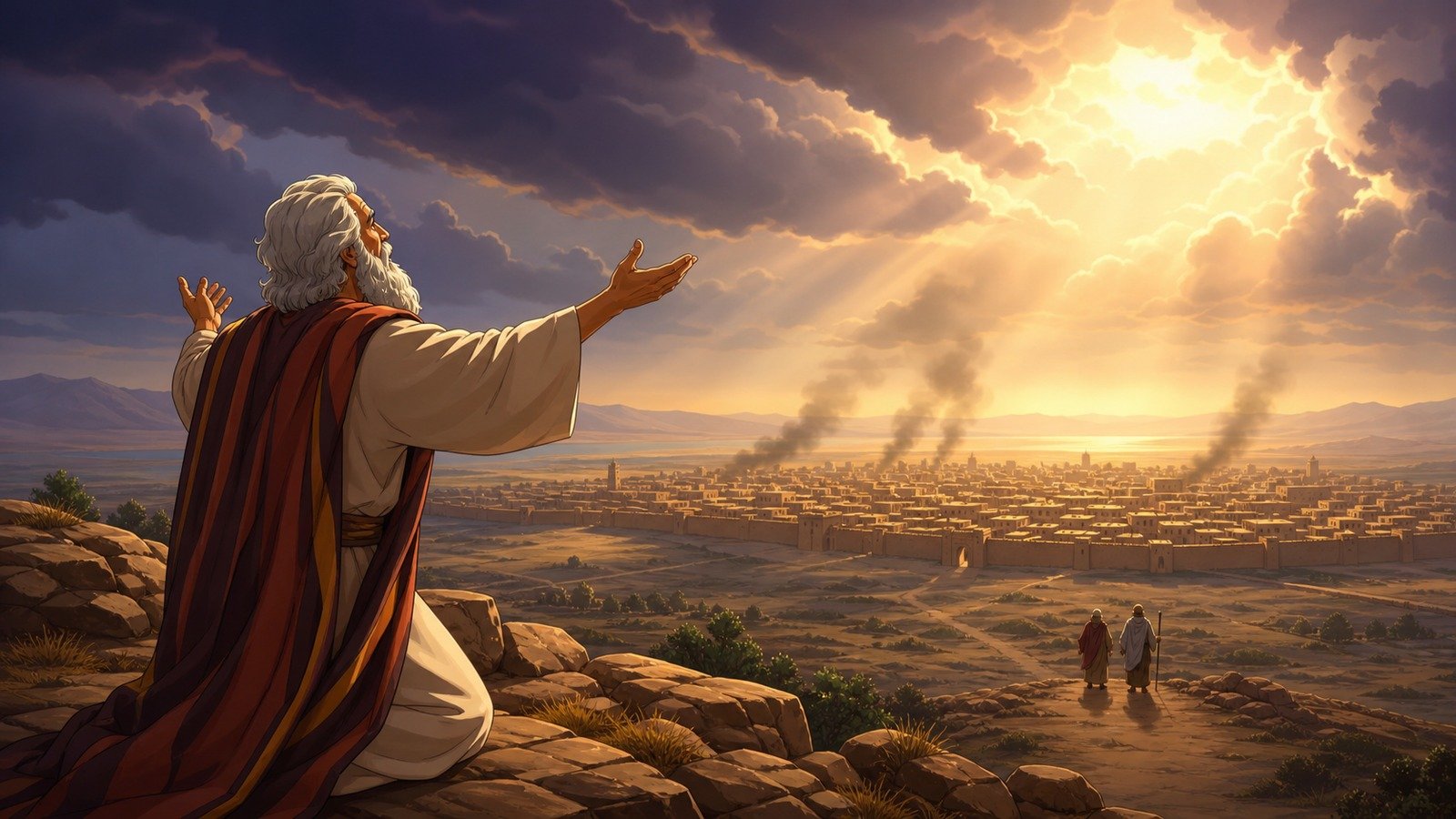
Told that Sodom faces judgement, Abraham bargains with God on the city's behalf, successively lowering the number of righteous people that would be needed to spare it, down to just ten.
Further context
3 min readThe visitors get up to leave, Abraham walks with them, and then something unusual happens: God deliberates aloud about whether to tell him what is coming. Shall I hide from Abraham what I am about to do, given that he will become a great nation and that all nations on earth will be blessed through him? The reason for informing him is the promise itself.
The charge against the cities is described with a specific word. The outcry against Sodom and Gomorrah is said to be great, and the Hebrew noun (tsa'aqah) is the one used for the cry of the oppressed, the same word used later of Israel's cry under slavery in Egypt. Somebody is being wronged, and the sound of it is what has reached God.
Abraham then does something the Bible rarely shows anyone doing. He argues. His opening move is a question about God's own character: will you sweep away the righteous with the wicked? Suppose there are fifty righteous people in the city. Far be it from you to do such a thing, to treat the righteous and the wicked alike. Will not the Judge of all the earth do right?
The negotiation proceeds by stages and each stage is prefaced with an apology for continuing. Forty-five. Forty. Thirty. Twenty. Ten. Every time the answer is the same, and every time he lowers the number.
What he is asking for is worth stating precisely, because it is almost always misremembered. He does not ask for the righteous to be rescued and the city destroyed. He asks for the whole city to be spared for the sake of the righteous inside it. The principle being tested is whether a small number of innocent people can hold back judgement from everyone around them.
He stops at ten. Why he stops there is unknown, and whether he could have gone lower is never addressed. God goes his way and Abraham returns home.
What happens next answers the question in the negative, since ten are not found, and also complicates it, since Lot and his daughters are taken out of the city before anything happens to it. The righteous are not swept away with the wicked, which is exactly what Abraham asked about, even though the city is not spared.
Later Scripture identifies what the outcry was about. Ezekiel states the charge directly: Sodom and her daughters were arrogant, overfed and unconcerned, and did not help the poor and needy. He then adds that they were haughty and did detestable things, without itemising them, and the following episode adds a further element. Christians have long differed over how the various strands of that description relate to one another, and the disagreement is between people reading the same sentences.
What Abraham is doing here has no real precedent in the ancient world's religious literature. Bargaining with a deity was ordinary enough, but bargaining on behalf of a foreign city that has done nothing for you, on the grounds that the deity's own standard of justice requires it, is not. He does not mention Lot once. He does not ask for an exception for his family. The whole conversation is conducted on a principle, and the principle is that the one handing down the sentence should be held to his own character.
The negotiation also establishes something that runs forward through the rest of the Hebrew scriptures. Abraham has been told that all nations on earth will be blessed through him, and the first recorded thing he does after being told is to argue for the survival of a city with a reputation so bad that his nephew's neighbours are about to prove it. Standing between a population and a judgement becomes what prophets do, and this is where it starts.