

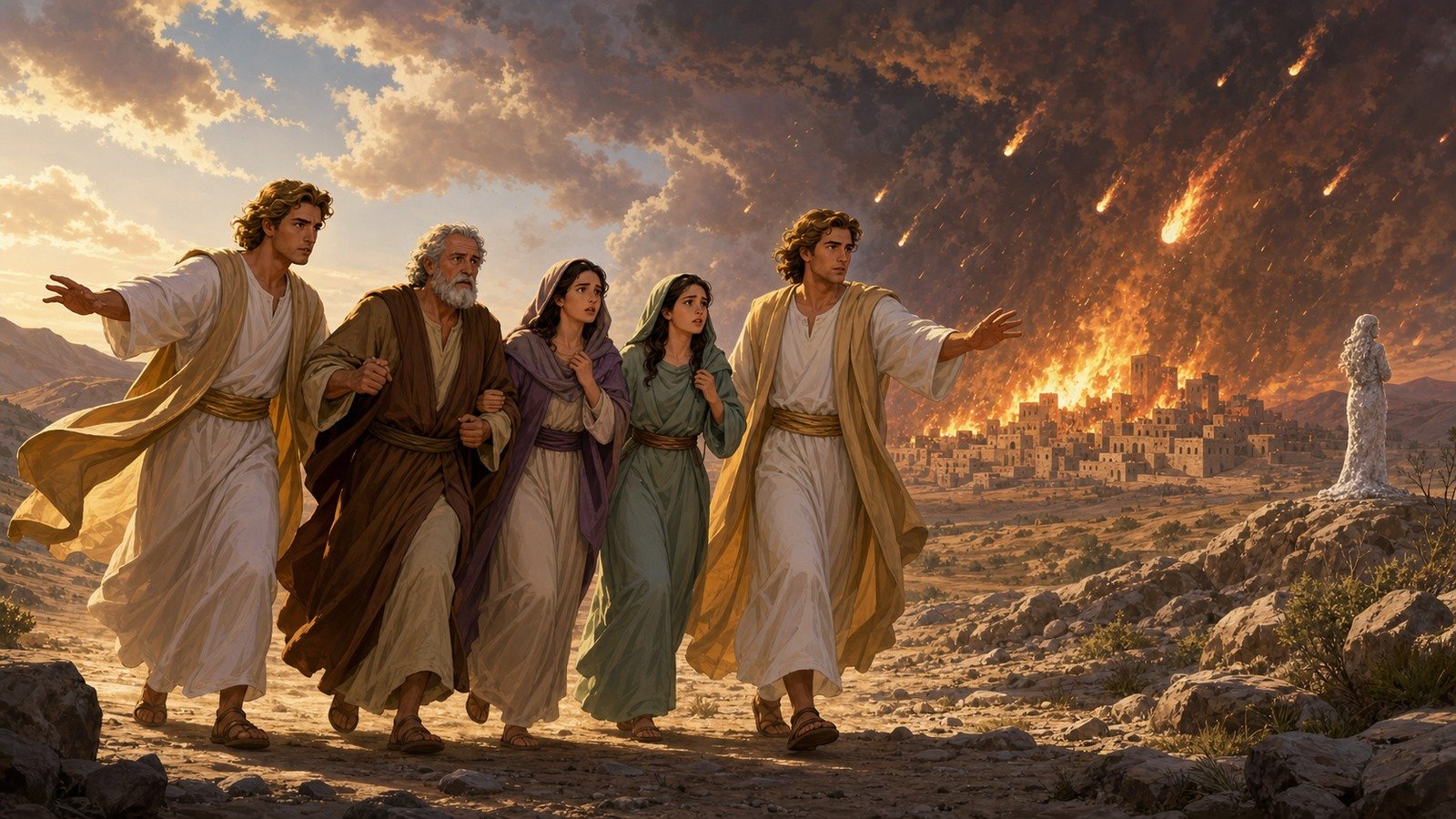
Two angels rescue Lot and his daughters from Sodom before God destroys the city and the surrounding plain with burning sulphur. Lot's wife looks back and is turned to a pillar of salt; the episode becomes a fixed Biblical image of divine judgement.
Further context
2 min readTwo angels reach Sodom in the evening and find Lot sitting in the gateway. The gate of an ancient city was where legal business was done and where the elders sat, so the detail indicates that a man who arrived as an outsider now holds a position in the town. He presses them to stay in his house rather than the square, which suggests he knows what the square would mean for them.
Before they lie down, the men of the city surround the house and demand that the visitors be brought out so they can have sex with them. Lot goes outside, shuts the door behind him and offers his two daughters instead. Not a word of approval is attached to that, and it is one of a number of places where the conduct of a central figure is reported and left for the reader to judge. The crowd refuses, accuses him of playing the judge over people he came to as a foreigner, and turns on him. The angels pull him inside and strike the men at the door with blindness.
He is told to gather his family. His sons-in-law think he is joking. At dawn he is still hesitating, and the angels take him, his wife and his daughters by the hand and lead them out. Told to flee to the mountains, he asks instead for a small town nearby, which is spared and renamed Zoar, a name related to the Hebrew for small.
The destruction is described as burning sulphur raining down and overthrowing the cities, the whole plain and everything growing in it. Lot's wife looks back and becomes a pillar of salt. Salt formations of exactly that kind exist at the south-western end of the Dead Sea, where Mount Sodom is a salt diapir several kilometres long whose eroded pillars have drawn the association since antiquity; Josephus reports being shown one in the first century.
Where the cities stood is unsettled. Bab edh-Dhra and Numeira, on the eastern side of the Dead Sea, are Early Bronze Age towns with burn layers and were argued for through the 1970s and 1980s. Tall el-Hammam, north-east of the Dead Sea, has been proposed more recently, and a 2021 paper claiming evidence of an airburst there has been strongly contested in the technical literature. No identification commands agreement.
The episode ends with something that explains two neighbouring peoples. Lot and his daughters live in a cave, the daughters conclude that no husbands remain anywhere, and they make their father drunk on successive nights and conceive by him. Their sons are Moab and Ben-Ammi, named as the ancestors of the Moabites and Ammonites, who occupy the territory east of the Dead Sea and appear throughout the rest of the Hebrew scriptures as neighbours and frequently as enemies. Ruth, the great-grandmother of King David, is a Moabite, which means the royal line of Israel runs back through this cave.
Jesus used the day Lot left Sodom as a picture of ordinary life interrupted without warning, and finished with three words: remember Lot's wife. Two New Testament letters treat the cities as a standing example of judgement, and one of them specifies sexual immorality and the pursuit of what it calls unnatural desire.