

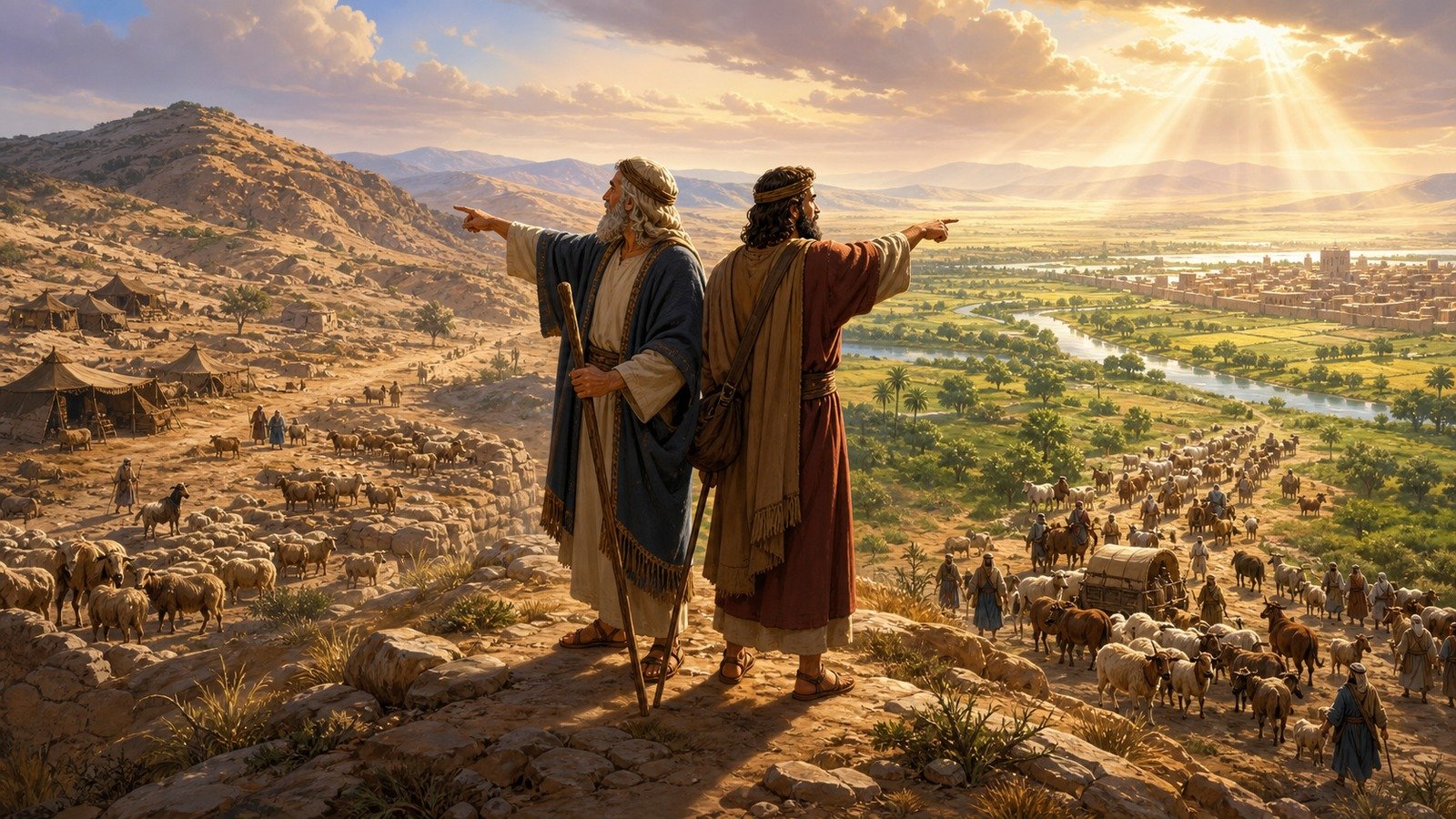
Growing herds and strife between Abram's and Lot's herdsmen force a separation. Lot chooses the well-watered plain toward Sodom, and God renews to Abram the promise of land and descendants "as numerous as the dust of the earth."
Further context
2 min readWealth caused the problem. Abram comes back from Egypt with large flocks and herds and with silver and gold, and Lot has his own flocks, herds and tents. The land cannot carry both households while they stay together, and their herdsmen begin quarrelling. A short reminder that the Canaanites and Perizzites were living in the country at the time explains why the two men could not simply spread out: the good grazing was already taken.
Abram's response reverses every expectation. He is the older man, the head of the family and the one to whom the land has been promised, and he offers his nephew the choice. If you go to the left, I will go to the right; if you go to the right, I will go to the left. Nothing compelled the offer, and a legal claim would have run entirely the other way.
Lot looks and takes the plain of the Jordan. The description is generous: well watered everywhere, like the garden of the LORD, like the land of Egypt. Both comparisons are loaded, since the garden has already been lost in this story and Egypt has just been walked out of. A single clause is then dropped in that colours the whole decision, noting that this was before Sodom and Gomorrah were destroyed. Lot settles among the cities of the plain and pitches his tents near Sodom, whose men are described as wicked and sinning greatly against the LORD.
The country involved is severe. The Jordan valley is part of the Great Rift, and the surface of the Dead Sea lies more than four hundred metres below sea level, the lowest exposed land on earth. Its water is around ten times as saline as the ocean and supports no fish. Where fresh springs and the river itself reach the plain the land is fertile and the growing season is long; a few kilometres away it is desert. Lot has chosen the fertile strip and has not looked at what surrounds it.
Once he has gone, the promise is repeated to Abram in a fuller form. He is told to look north, south, east and west, because all the land he can see will be given to him and his offspring for ever, and his offspring will be like the dust of the earth, countable only if the dust can be counted. He is then told to walk through the length and breadth of it, which was a recognised way of asserting a legal claim across the ancient Near East.
The timing is what gives the episode its point. He has just handed over the better half of the territory, and the promise is renewed immediately afterwards. What he gave away was never his to lose.
He moves his tents to the great trees of Mamre at Hebron, in the hill country about thirty kilometres south of Jerusalem and roughly a thousand metres above sea level, and builds an altar there. Hebron becomes the family's base for the rest of their story, and the burial cave he eventually buys sits at that same place.