

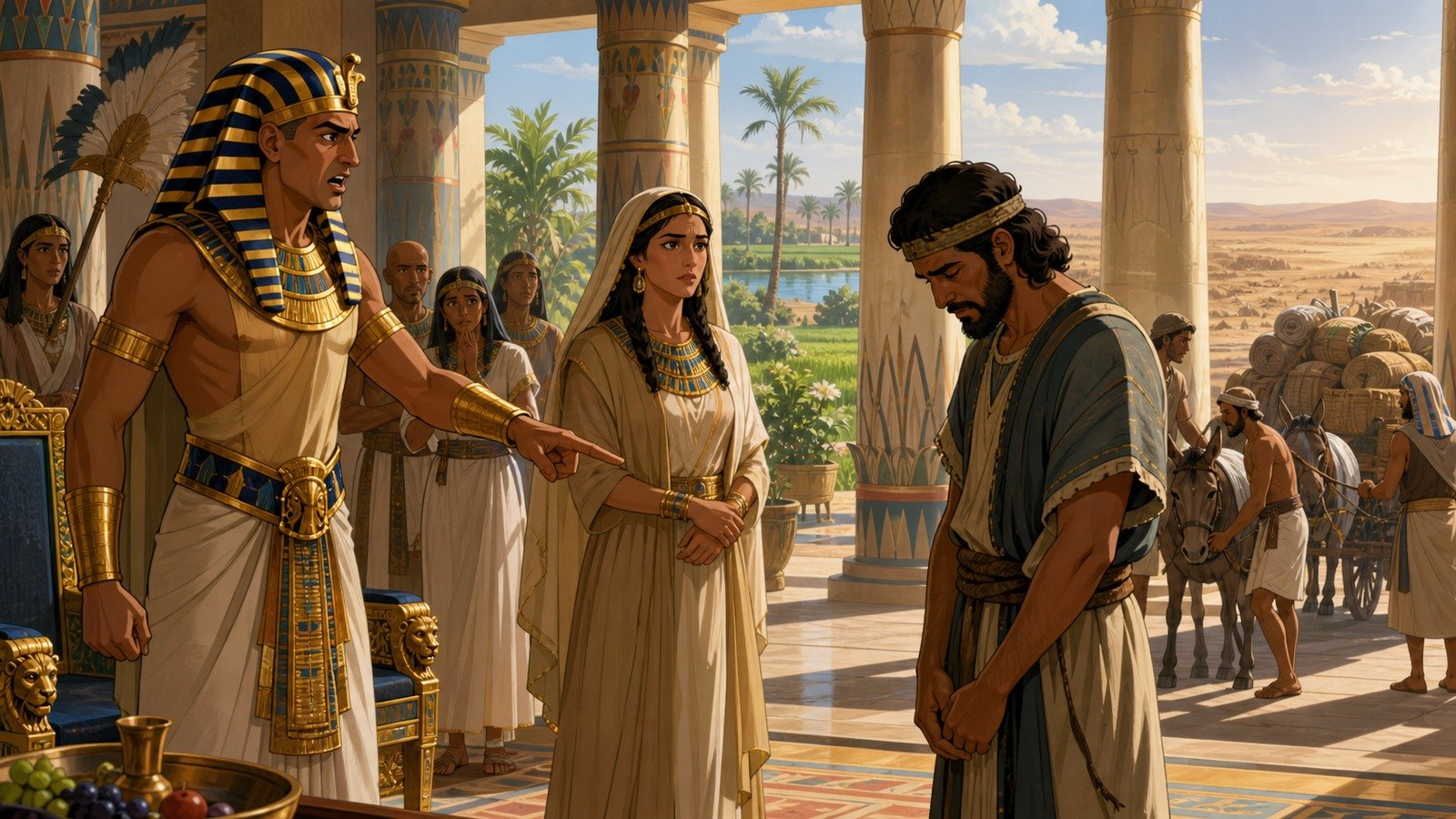
Famine drives Abram to Egypt, where he presents Sarai as his sister out of fear for his own life. Pharaoh takes her into his household, is struck with plagues, and expels Abram once the deception is discovered.
Further context
3 min readFamine drives the family south, and Egypt was the obvious place to go. Farming in Canaan depended on seasonal rain and failed when the rain did. Farming in Egypt depended on the Nile flood, which came from rainfall in Ethiopia and Uganda and was largely independent of Levantine weather. Egyptian records and tomb paintings show groups from Canaan entering the Delta during shortages, and a wall painting at Beni Hasan from around 1890 BC depicts a party of thirty-seven Semitic traders arriving with their goods, their donkeys and their weapons.
Approaching the border, Abram tells Sarai to say she is his sister. His stated reason is that her appearance will attract attention and he will be killed so that she can be taken. The claim is not entirely false; he explains much later that she is his half-sister, the daughter of his father but not of his mother. It is nonetheless a manoeuvre that protects him at her expense, and it is reported without any attempt to soften it.
It works exactly as predicted. Pharaoh's officials praise her, she is taken into the palace, and Abram is treated well on her account, acquiring sheep, cattle, donkeys, servants and camels.
The camels are the detail most often flagged. Systematic study of animal bones from copper-smelting sites in the Aravah valley, published in 2013, places the earliest domesticated camels in the southern Levant no earlier than the late tenth century BC, and camel remains before that are scarce across the region. Two explanations are offered: that these mentions come from a later hand writing for readers who knew camels as ordinary pack animals, or that limited domestic use existed earlier and left too small a trace to show up in the bone record. The evidence currently favours the first, and nothing in the story depends on it.
The rescue comes from outside the family. Serious diseases fall on Pharaoh and his household, he discovers the truth, and he summons Abram with a rebuke. Why did you not tell me she was your wife? Why did you say she was your sister, so that I took her to be my wife? The Egyptian ruler holds the moral ground in that exchange and Abram is given no reply at all. He is escorted out of the country with everything he owns.
The manoeuvre recurs twice more, once with Abraham at Gerar and once with Isaac in the same city. Some scholars read the three as variants of one tradition preserved in different sources. As the story stands they are separate incidents, and the third explicitly recalls the earlier ones.
The wider shape is difficult to miss once seen. A famine drives the family of promise into Egypt, they prosper there, a plague falls on Pharaoh's household, and they leave with substantial wealth and an escort to the border. Several centuries later the same sequence will happen to their descendants at the scale of a nation, and the pattern looks deliberate.
One consequence of the episode has a very long reach. Among the servants Abram acquires in Egypt, or shortly afterwards, is Hagar, described as an Egyptian. The woman whose son becomes the ancestor of twelve Arabian tribes, and whose expulsion into the desert is the bleakest scene in these chapters, arrives in the household as a direct result of a lie told at the Egyptian border. Nothing draws attention to that, and the sequence is simply left where it falls.