

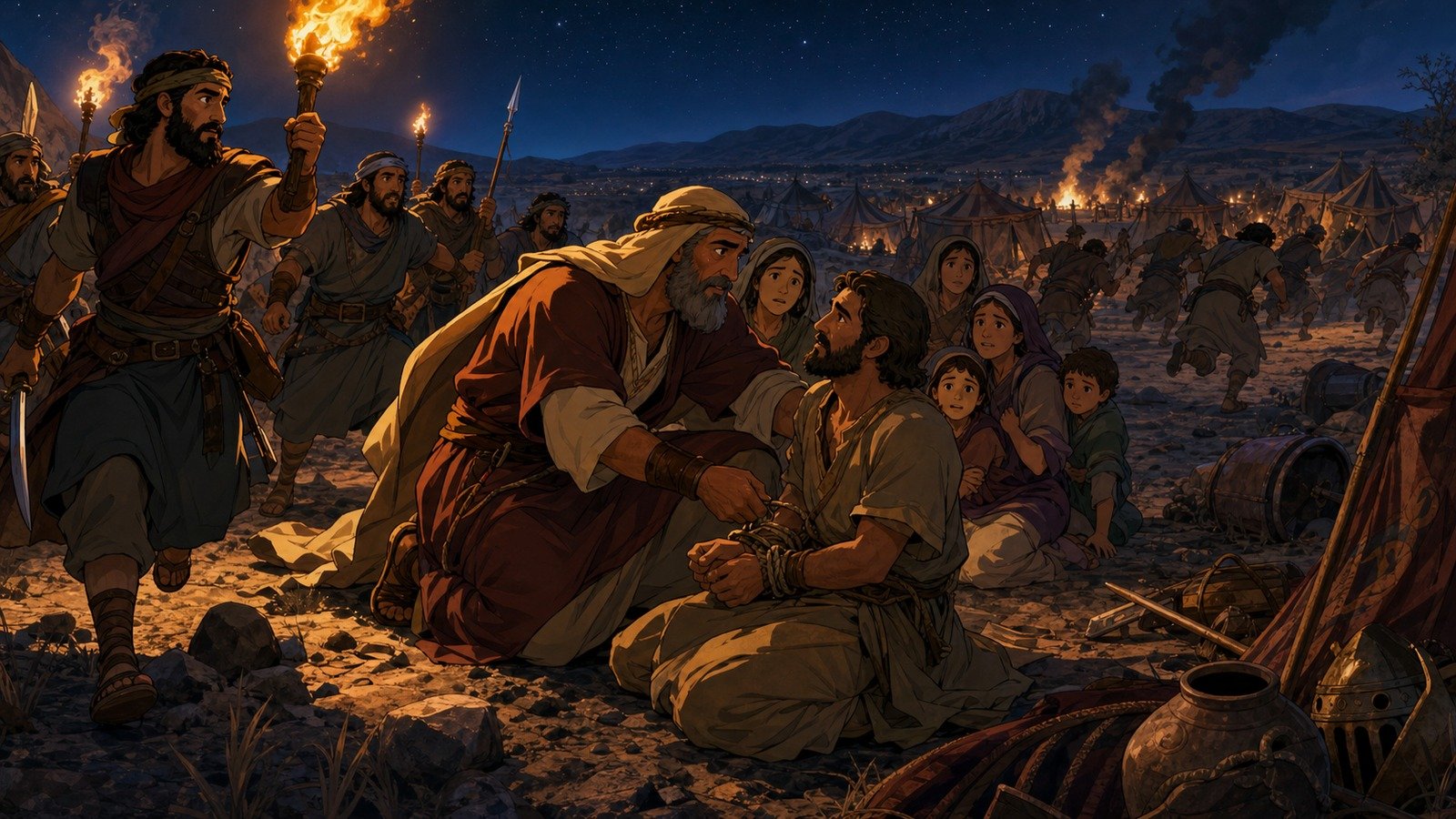
A coalition of eastern kings raids Sodom and takes Lot captive; Abram leads a small force to rescue him and recovers the captured people and plunder.
Further context
2 min readNine kings, a fourteen-year quarrel over tribute, and a nephew taken with the plunder. This episode reads unlike anything around it: a coalition of four eastern kings against five kings of the plain, all nine named, with a campaign route, dates and casualties.
The four are Kedorlaomer king of Elam, Amraphel king of Shinar, Arioch king of Ellasar and Tidal king of Goyim. Elam lay east of the Tigris and Shinar is southern Mesopotamia; the other two territories cannot be identified with confidence. Against them stand the kings of Sodom, Gomorrah, Admah, Zeboyim and Bela. The five had been subject to Kedorlaomer for twelve years, rebelled in the thirteenth, and in the fourteenth he came to put the rebellion down.
The campaign follows a coherent route down the eastern side of the Jordan and back up through the Negev, hitting peoples along the way. It also names populations that are otherwise almost invisible: the Rephaim, Zuzim, Emim and Horites. Three of those names turn up again in Deuteronomy as earlier inhabitants displaced by the Moabites, Ammonites and Edomites. Anyone inventing an impressive campaign would have had no reason to list obscure peoples who mattered only for explaining who lived where before the nations of the writer's own day arrived.
The decisive battle takes place in the Valley of Siddim, described as full of tar pits, and two of the kings of the plain fall into them while fleeing. Bitumen occurs naturally around the Dead Sea and has been collected there since antiquity; blocks of it still surface after seismic activity.
Lot is taken because he is living in Sodom by this point. A survivor brings the news to Abram, who is called Abram the Hebrew here, the first use of that word anywhere. Its origin is debated, with a possible connection to the habiru of Late Bronze Age Near Eastern texts, a term for displaced or landless groups rather than an ethnic label.
He musters three hundred and eighteen trained men born in his own household, which indicates the size of the establishment he had built up, and pursues with allies as far as Dan in the far north, roughly two hundred kilometres from Hebron. He divides his force, attacks by night, and drives the raiders beyond Damascus. Everything is recovered: the goods, Lot, the women and the other captives.
The historical status of the episode is unresolved and should not be overstated in either direction. None of the four eastern kings has been identified in Mesopotamian records. Amraphel was widely equated with Hammurabi of Babylon in the late nineteenth century, and that identification has been abandoned because the names cannot be reconciled linguistically. Against that, the names themselves, the use of obsolete place names with explanations attached for later readers, and the political picture of an eastern coalition raiding the Levant all fit the second millennium rather than the first, which is hard to explain if the material were invented late.
The episode also changes how Abram appears. He has been a herdsman moving between wells, promised a country he does not own. Here he commands an armed force, defeats a coalition and comes back as the dominant figure in the region.