

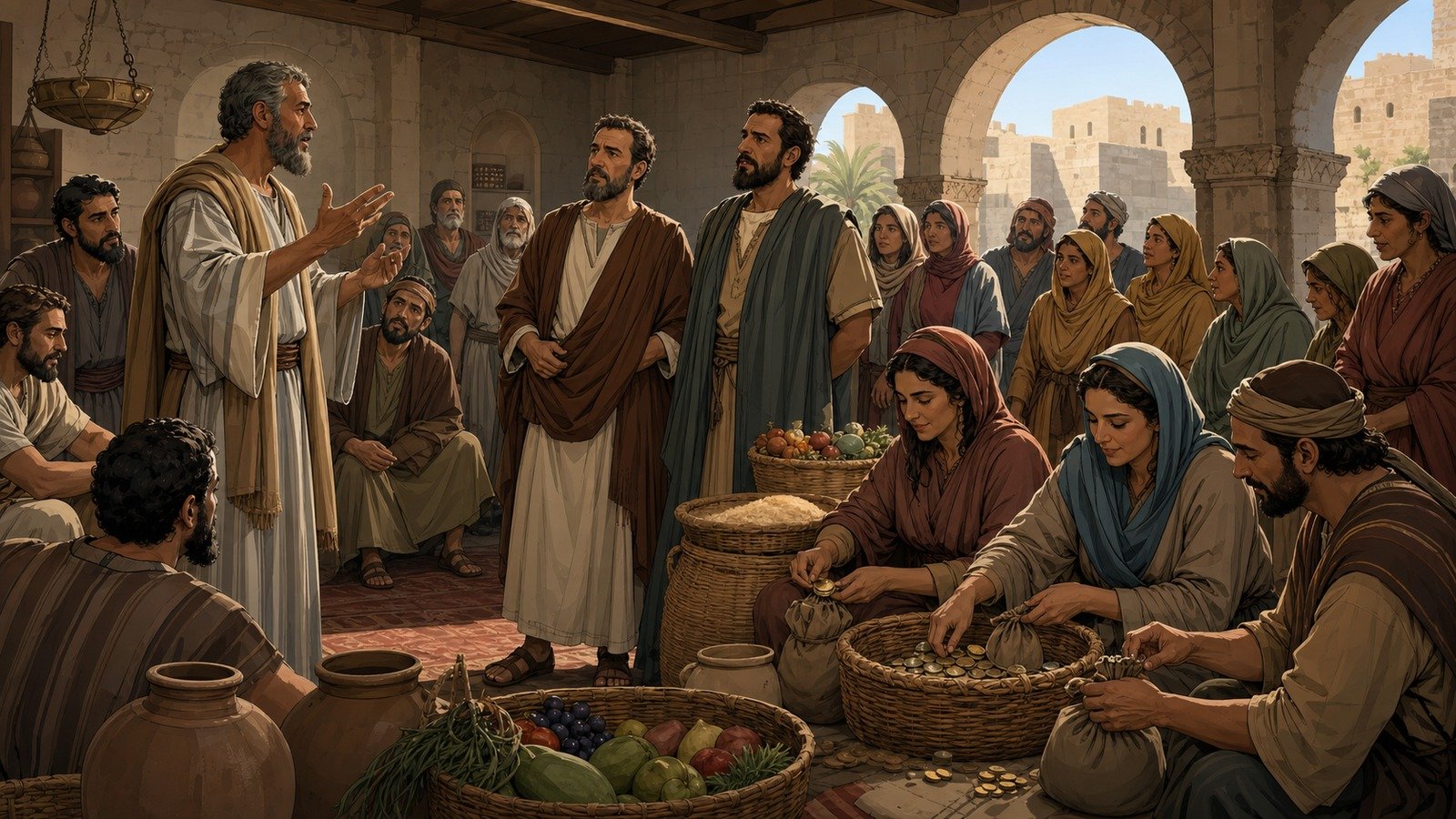
A prophet named Agabus predicts a severe famine across the Roman world; the Antioch church responds by sending financial relief to the believers in Judea by the hands of Barnabas and Saul, an episode some scholars connect with the Jerusalem visit Paul describes in Galatians 2.
Further context
2 min readProphets come down from Jerusalem to Antioch, and one of them, named Agabus, stands up and predicts through the Spirit that a severe famine will spread over the entire Roman world.
Agabus appears twice and both times he deals in specifics. Years later he takes Paul's belt, ties his own hands and feet with it, and says the owner of this belt will be bound like this in Jerusalem, which is the manner of the prophets acting out their message rather than only speaking it.
The famine is dated in one clause: this happened during the reign of Claudius.
Claudius was emperor from AD 41 to 54, and food shortages during his reign are well attested outside the New Testament. Roman writers describe grain crises in Rome itself, one of which produced a riot in which the emperor was pelted in the forum. Josephus describes a severe famine in Judea in about AD 46 to 48, and records that Helena, the queen of Adiabene, a kingdom in northern Mesopotamia whose royal family had converted to Judaism, bought grain in Egypt and figs in Cyprus and had them distributed in Jerusalem.
The disciples, as each one was able, decided to provide help for the brothers and sisters living in Judea.
Two things are worth pulling out of that sentence. Each one as able means the giving was proportionate rather than uniform, which is the same principle Paul later sets out when organising a much larger collection from the Greek churches. And the direction of travel is worth noticing: money going from a mixed Gentile congregation in Syria to the Jewish mother church in Jerusalem.
That direction stays constant for the rest of Paul's working life. The collection for the poor among the Lord's people in Jerusalem occupies him for years, takes up substantial parts of two letters, and is what finally brings him back to the city where he is arrested.
The gift is sent to the elders by Barnabas and Saul.
That is the first mention of elders in the Jerusalem church, and it indicates a structure emerging: not only apostles now, but a body of men to whom money can be entrusted.
Agabus is described as one of a group of prophets who travelled between congregations, which indicates a recognised function in the early church rather than an isolated figure. Prophets are listed alongside apostles and teachers in Paul's letters, and instructions for regulating what they said in meetings occupy a substantial part of one of them.
Whether the famine relief and the visit Paul describes in Galatians as his second trip to Jerusalem are the same journey is one of the standing puzzles of New Testament chronology, and it affects the dating of the letter.
Helena of Adiabene's tomb, a large rock-cut monument north of the Old City in Jerusalem, was excavated in the nineteenth century and its inscribed sarcophagus is now in the Louvre. Her famine relief is one of the better documented acts of charity of the period.