

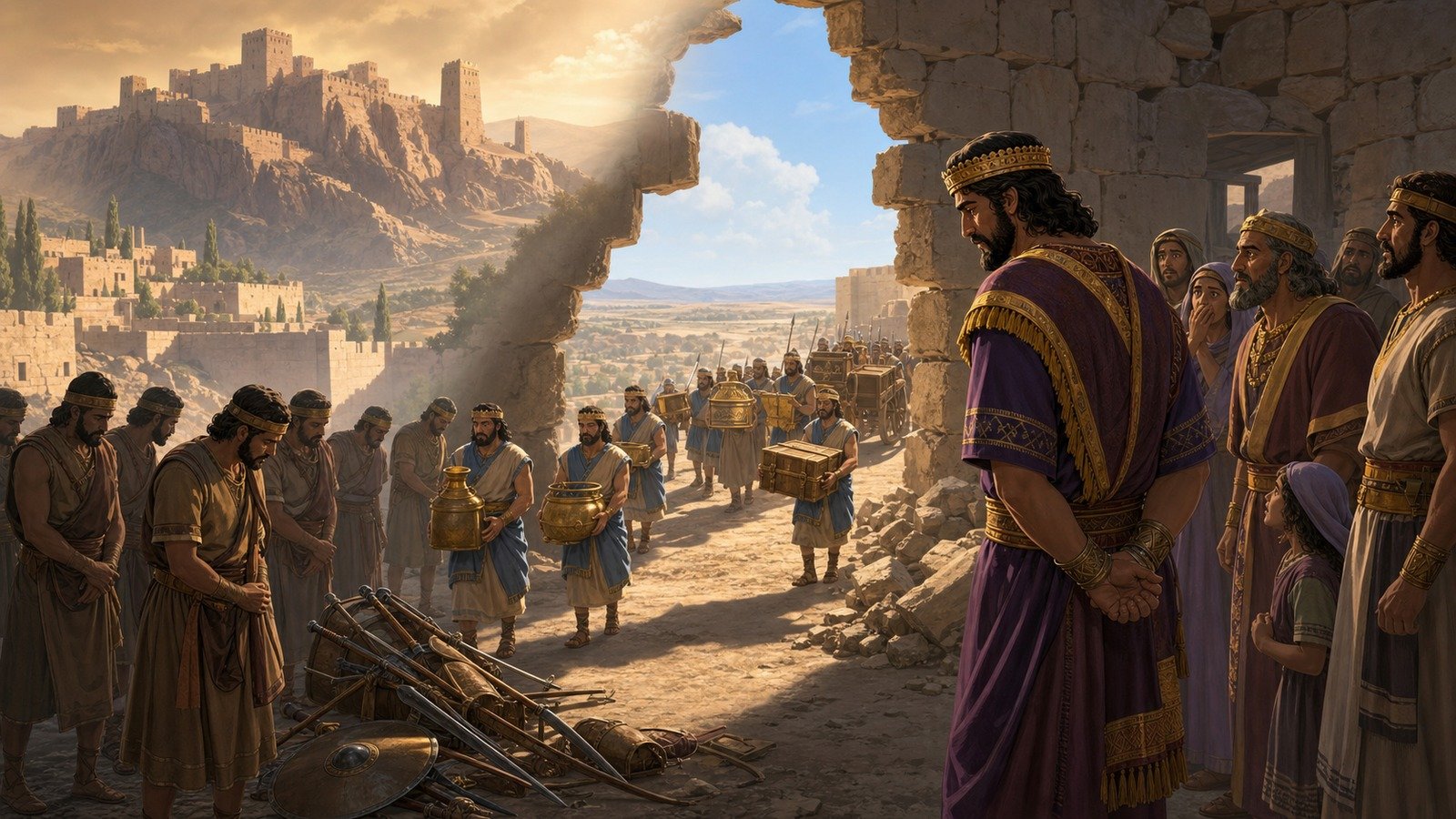
Amaziah defeats Edom but then unwisely provokes Israel into war, suffering a humiliating defeat in which Jerusalem's wall is breached and Temple treasures plundered; he is eventually assassinated in a conspiracy.
Further context
3 min readTwenty-nine years, and the assessment is the familiar half-verdict: he did what was right in the eyes of the LORD, but not as his father David had done, and the high places were not removed.
He begins with a legal restraint that is worth recording. Once the kingdom is firmly in his grip he executes the officials who had murdered his father, and then does not kill their sons, in accordance with the law that fathers shall not be put to death for their children nor children for their fathers, but each is to die for their own sin. It is one of the few places where a king is explicitly shown consulting a written law and limiting himself by it, at exactly the moment when nobody would have objected to going further.
He then musters Judah for a campaign against Edom and hires a hundred thousand mercenaries from Israel for a hundred talents of silver. A prophet tells him not to let the northern troops go with him, and his objection is entirely financial: what about the hundred talents I paid? The reply is the one line of that exchange anybody remembers: the LORD can give you much more than that. He dismisses them and they go home furious, and raid towns in Judah on the way.
The campaign succeeds. Ten thousand Edomites are defeated in the Valley of Salt and Sela is captured, and the parallel account adds that ten thousand more were thrown off a cliff.
Then the thing that undoes him. He brings back the gods of the people of Seir, sets them up as his own gods, bows down to them and burns sacrifices to them. Bringing home the gods of a nation you have just defeated is the least intelligible act of any king in these books, and the prophet sent to him says so in as many words: why do you consult this people's gods, which could not save their own people from your hand?
He tells the prophet to stop talking or be struck down, and the prophet stops with a sentence: I know that God has determined to destroy you, because you have done this and have not listened to my counsel.
He then challenges the northern kingdom, is routed at Beth Shemesh, taken prisoner, and watches a hole broken in the wall of his own capital. The mercenaries he hired and dismissed are worth a note. A hundred talents of silver was paid and written off on a prophet's advice, and the northern troops went home and sacked three Judaean towns and killed three thousand people on the way. Following the instruction cost him the money and the raid, and the campaign succeeded anyway, and nothing tidies that sequence up.
He outlives his conqueror by fifteen years, and is eventually murdered by conspirators at Lachish, having fled there.
Twenty-nine years, and the reign turns on one decision. Having hired a hundred thousand Israelite mercenaries for a hundred talents of silver, and then dismissed them on a prophet's advice, Amaziah defeats Edom in the Valley of Salt and brings back the gods of the people he has just beaten and sets them up as his own.
A prophet asks him the obvious question: why do you consult these gods, which could not save their own people from your hand?
The war with Israel that follows begins with Amaziah's challenge and an insulting reply about a thistle and a cedar. Jehoash breaks down two hundred metres of the wall of Jerusalem, empties the temple and palace of gold and silver, takes hostages and goes home.