

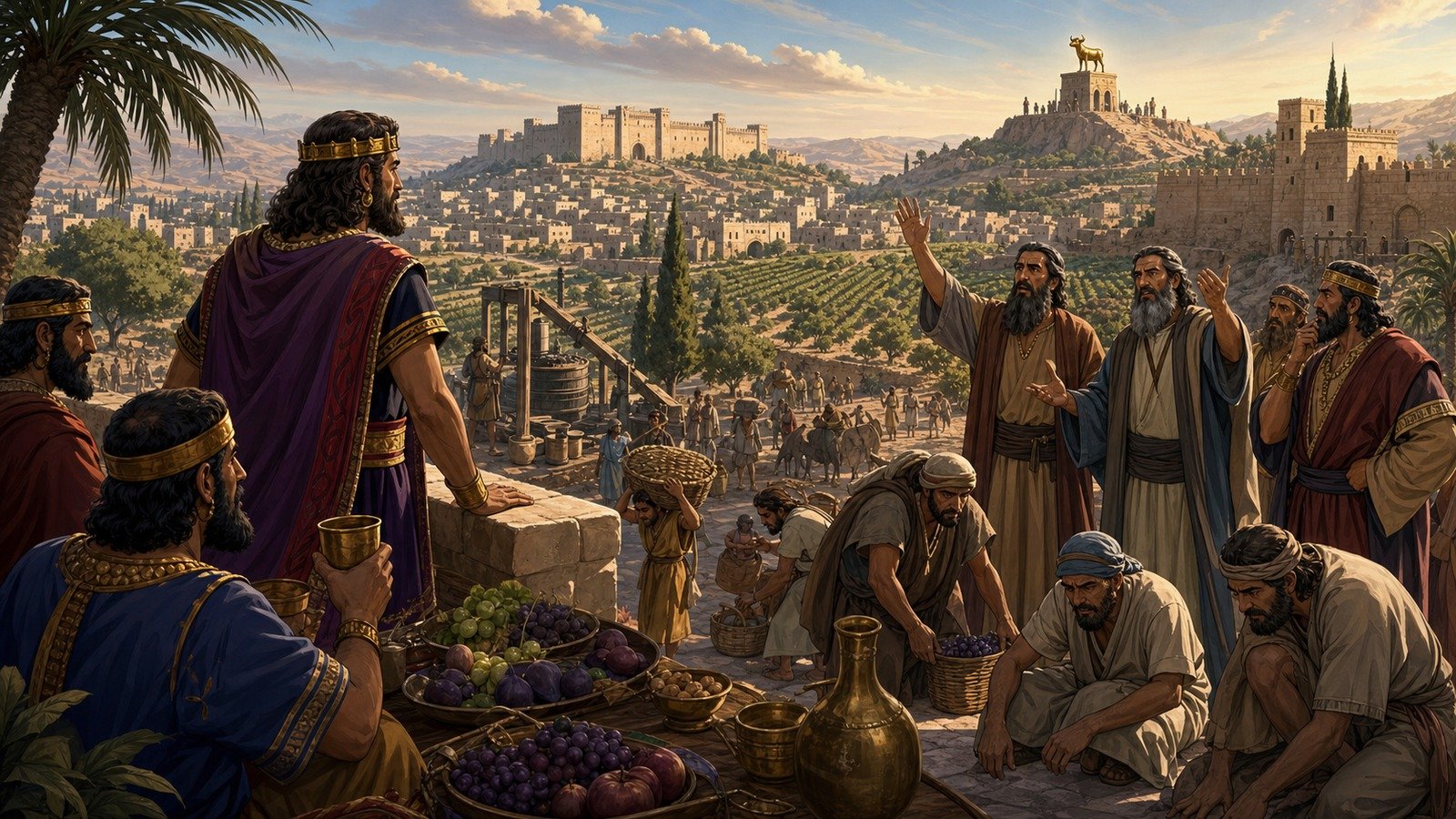
Jeroboam II restores Israel's borders to nearly Solomonic extent and presides over a long, materially prosperous reign, condemned nonetheless by Amos and Hosea for the social injustice and idolatry it concealed.
Further context
3 min readJeroboam II reigns forty-one years, the longest in the northern kingdom and by every material measure its most successful. He restores the boundaries of Israel from Lebo Hamath in the north to the Dead Sea, which is close to the extent David and Solomon had held, and he recovers Damascus and Hamath.
The explanation given for that success is unusually direct and it has nothing to do with his merits. The LORD had seen how bitterly everyone in Israel, whether slave or free, was suffering; there was no one to help them. And since he had not said he would blot out the name of Israel from under heaven, he saved them by the hand of Jeroboam son of Jehoash. The verdict on the man himself is the standard formula: he did evil and did not turn away from any of the sins of Jeroboam son of Nebat.
His reign gets seven verses. What is happening underneath it is described at length by two prophets working during it, and their picture is the reason this period matters.
Amos, a shepherd and fig-grower from Tekoa in Judah, comes north to Bethel and attacks the prosperity directly. He describes people who lie on beds inlaid with ivory, dine on choice lambs and fattened calves, drink wine by the bowlful and use the finest lotions, and who do not grieve over the ruin of the country. The ivory is not a figure of speech: hundreds of carved ivory furniture inlays have been excavated at Samaria from precisely this period. He accuses them of selling the innocent for silver and the needy for a pair of sandals, of trampling on the heads of the poor and denying justice to the oppressed, and of taking bribes in court and depriving the poor of justice at the gate.
The religious life is flourishing at the same time, and that is his sharpest point. I hate, I despise your religious festivals; your assemblies are a stench to me. Take away the noise of your songs. But let justice roll on like a river, righteousness like a never-failing stream.
Hosea, working in the north itself, describes a country where there is no faithfulness, no love, no acknowledgement of God, only cursing, lying, murder, stealing and adultery, and bloodshed follows bloodshed.
Amos is thrown out by the priest of Bethel, who reports him to the king for conspiracy and tells him to go back to Judah and earn his bread there.
Amos's answer to being thrown out is one of the clearest self-descriptions any of these figures gives: I was neither a prophet nor the son of a prophet, but I was a shepherd, and I also took care of sycamore-fig trees. The LORD took me from tending the flock and said, go, prophesy to my people Israel. He is denying that he belongs to the profession at all.
Within thirty years of Jeroboam's death the kingdom is gone.
Forty-one years, and the material prosperity of the reign is confirmed by the archaeology. The Samaria ostraca, potsherds recording deliveries of oil and wine to the palace from estates around the capital, belong to this period and show an economy producing surpluses for a wealthy court.
Amos and Hosea both worked during it, and what they describe is the underside of the same prosperity: people sold for a pair of sandals, the poor trampled, ivory beds, summer houses and winter houses, and courts where bribery was routine.
Amos was thrown out of the sanctuary at Bethel by its priest, who reported him to the king for conspiracy and told him to go back to Judah and earn his bread there.