

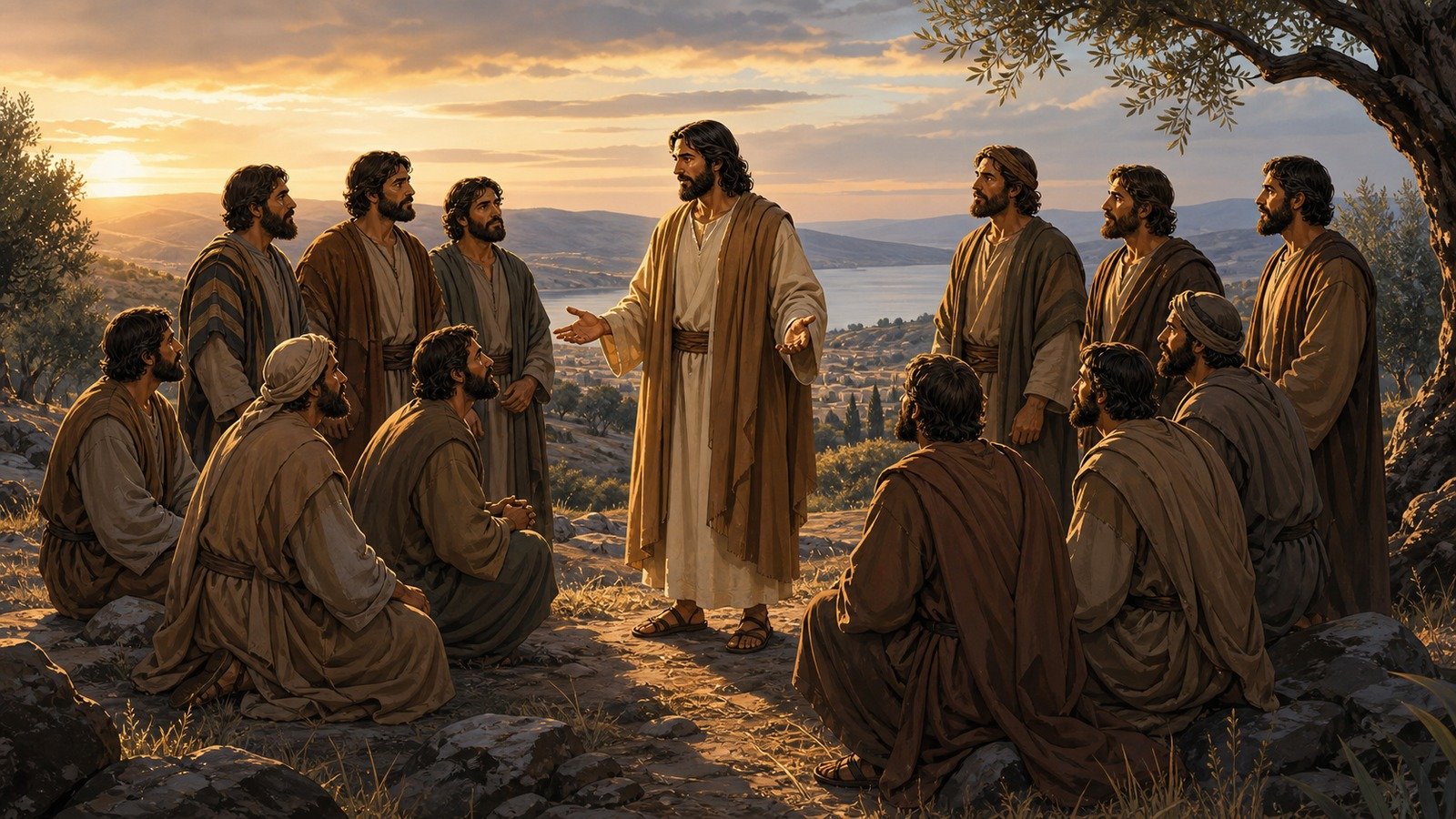
After a night of prayer, Jesus formally selects twelve disciples as apostles, "sent ones," from among his wider following, giving them his own authority to preach, heal and cast out demons, and forming the group that will lead the movement after his resurrection.
Further context
3 min readJesus goes out to a mountainside and spends the night praying, and when morning comes he calls his disciples to him and chooses twelve of them, whom he designates apostles.
The number is the whole point of the selection. Twelve tribes had descended from Jacob's sons and ten of them had effectively disappeared after the Assyrian deportations. Appointing twelve men is a claim about reconstituting the nation, and everybody watching would have understood it that way. He says as much later, promising them thrones judging the twelve tribes.
The word apostle means one who is sent, and the stated purpose is in two parts: that they might be with him, and that he might send them out to preach.
The list is preserved four times and always in the same three groups of four, with the same man heading each group even though the order inside the groups varies. Peter is always first and Judas Iscariot always last.
What the list contains is the striking part. Four are fishermen from the same lakeside town. One is a tax collector who worked for the client king. One is called the Zealot, a term for the nationalist movement that regarded collaboration with Rome as apostasy and which produced the revolt that destroyed the country a generation later. Putting a customs officer and a nationalist in the same group of twelve was not an accident, and the two of them walked the same roads for the next two years.
None of them is a religious professional. There is no priest, no scribe and no member of any recognised school, and later opponents note precisely that, describing Peter and John as unschooled ordinary men.
Several are related. Two pairs of brothers, and James and John are given a nickname meaning sons of thunder, which is presumably not a compliment about their temperament.
Judas is introduced in every list with the same phrase attached, who betrayed him, so that his presence is never a surprise. He is chosen after a night of prayer along with the rest.
Two of the names carry information nobody has resolved. Iscariot most plausibly means man of Kerioth, a town in southern Judea, which would make Judas the only member of the group who was not a Galilean. It has also been connected with the Latin for dagger-man, which would put him alongside Simon in the nationalist camp. Neither derivation is secure.
They are then sent out with instructions that leave them almost nothing: no bag, no bread, no money in their belts, and a staff and sandals only. Whatever house takes them in is where they stay.
Spending the whole night praying before choosing is stated plainly and it is the only decision described that way.
The twelve are named in four lists in the New Testament and the names vary slightly at the edges, which is what happens when men are known by more than one name in more than one language.
What is in the group is worth registering. Four fishermen from the same lake. A tax collector who worked for the administration. And Simon called the Zealot, whose label attaches him to the movement that regarded collaboration with Rome as apostasy.
A customs official and a nationalist were put in the same group and sent out in pairs.
Judas Iscariot is listed last every time, always with the same clause attached, and there is no indication anywhere that the others suspected him of anything.
The number twelve is the point of the exercise, and it matches the tribes.