

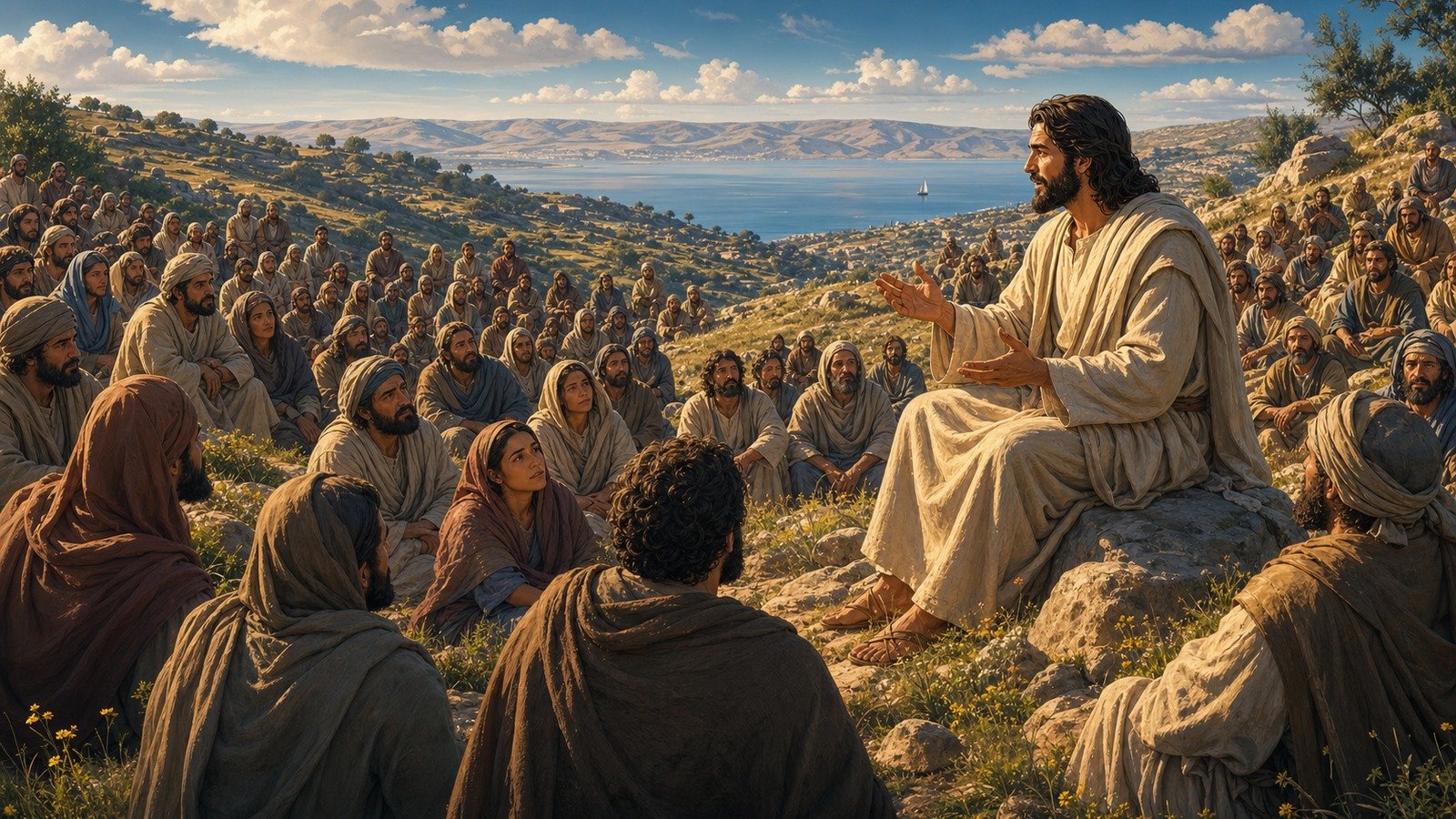
Jesus delivers his most extended recorded teaching, covering the Beatitudes, anger, lust, oaths, retaliation, love of enemies, prayer (including the Lord's Prayer), fasting, wealth, anxiety, judging others, and the parable of building on rock versus sand, laying out the ethic of his kingdom.
Further context
3 min readMatthew gives three chapters of teaching delivered sitting on a mountainside. Luke gives a shorter version delivered standing on a level place. Whether those are one occasion recorded differently or two related addresses is an old question; a travelling teacher would have given the same material many times, and the overlap and the differences both fit that.
It opens with a series of statements about who is fortunate, and the list inverts every expectation. The poor in spirit. Those who mourn. The meek. Those who hunger and thirst for righteousness. The merciful. The pure in heart. The peacemakers. Those persecuted because of righteousness. Luke's shorter version is blunter and adds matching woes: blessed are you who are poor, and woe to you who are rich.
Then six paragraphs following an identical pattern: you have heard that it was said, but I tell you. Each takes a commandment and pushes it inward. Murder becomes contempt. Adultery becomes the look. Divorce is restricted sharply in a society where a man could dismiss a wife almost at will. Oaths are abolished in favour of a plain yes or no. The limit on retaliation is replaced with turning the other cheek. And the requirement to love a neighbour is extended to enemies, with the reason attached that God sends rain on the righteous and the unrighteous alike.
Three religious duties are then addressed with the same structure: giving, prayer and fasting, each with an instruction to do it invisibly. The example prayer given in the middle of that is the one still recited everywhere, and it is fifty-odd words long.
The rest ranges over money, anxiety, judgement and the difference between saying and doing. Do not store up treasures on earth. Nobody can serve two masters. Look at the birds; consider the lilies. Do not judge, or you too will be judged, and take the plank out of your own eye first. Ask, seek, knock. Do to others what you would have them do to you. Watch for false prophets, who come in sheep's clothing. And a closing image of two houses, one on rock and one on sand, and the same storm hitting both.
Two of the instructions in it were remembered as the hardest and are worth naming. Love your enemies and pray for those who persecute you, delivered in an occupied country to people who had enemies in the ordinary sense of the word. And do not worry about tomorrow, said to subsistence farmers whose margin between a harvest and hunger was one bad season.
The reaction recorded is about authority again: the crowds were amazed at his teaching, because he taught as one who had authority, and not as their teachers of the law.
What makes the whole thing difficult is that nothing in it is presented as an ideal to admire. Each paragraph is framed as an instruction, and it ends with a warning about people who call him Lord and do not do what he says.
The material includes the Beatitudes, the salt and the light, the antitheses beginning you have heard that it was said, the Lord's Prayer, the instruction about treasure and moths and rust, the birds and the lilies, the plank and the speck, the narrow gate, the wolves in sheep's clothing and the two builders.
Almost all of it is intensification rather than relaxation. Murder is extended to anger, adultery to the look, oaths are abolished in favour of a plain yes or no, retaliation is replaced by turning the cheek, and the command to love a neighbour is extended to enemies.
Two passages have shaped whole movements. Turning the other cheek and refusing to resist an evil person underlie the historic peace churches and were quoted directly by Tolstoy and by Gandhi, who read them and corresponded about them.
And do not judge, or you too will be judged, which is the most quoted sentence in the sermon and almost never quoted with the two verses that follow it.