

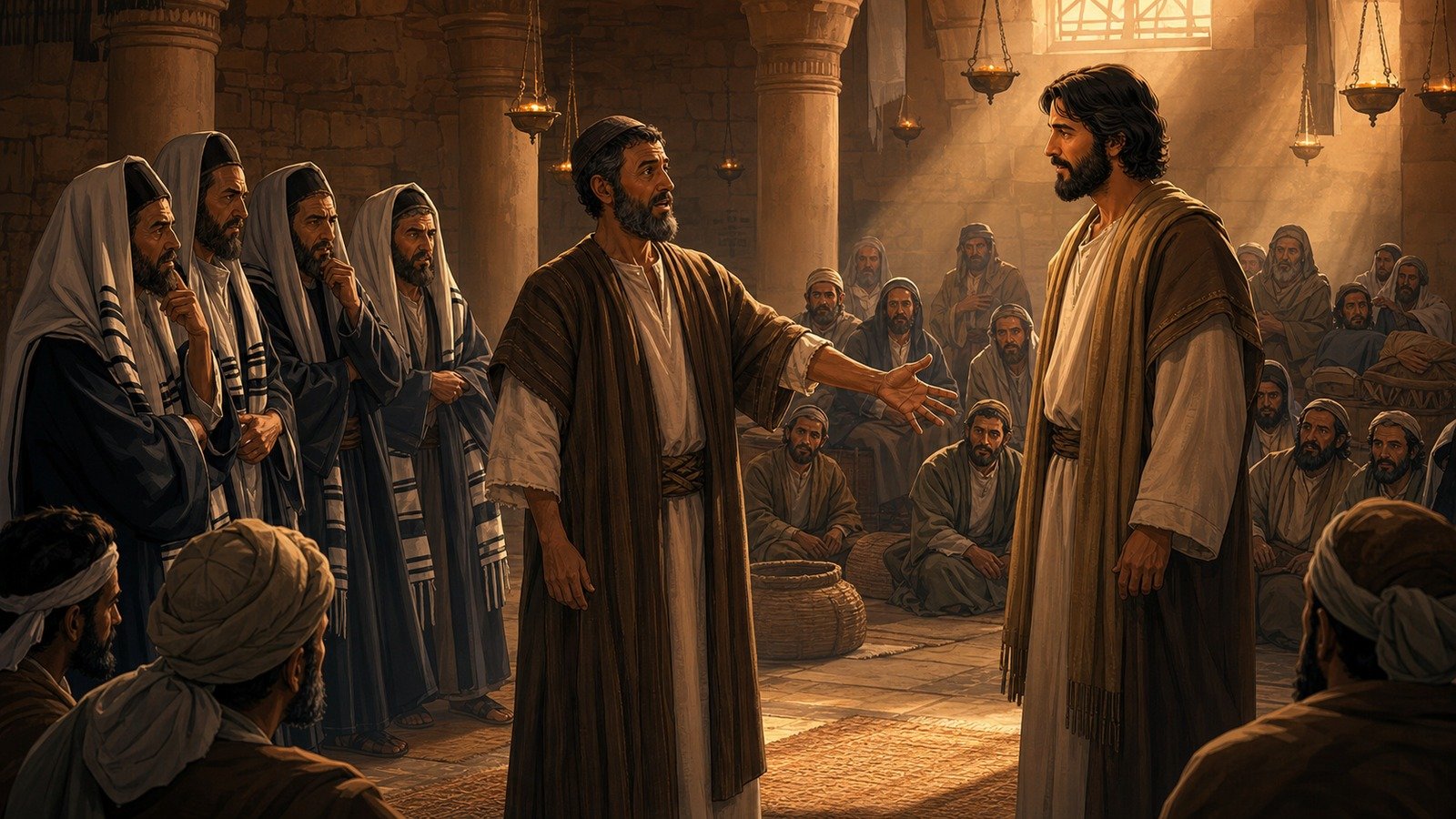
Watched closely by hostile religious leaders, Jesus deliberately heals a man's shrunken hand in a synagogue on the Sabbath, asking pointedly whether it is lawful to do good or harm on the Sabbath; the healing provokes a plot to kill him.
Further context
3 min readJesus goes into the synagogue and a man with a withered hand is there, and the situation is described as a trap before anything happens: they were looking for a reason to accuse him, so they watched him closely to see if he would heal on the Sabbath.
The legal position was not arbitrary and it is worth stating fairly. Healing was permitted on the Sabbath where life was in danger, and the principle that saving a life overrides the Sabbath was widely accepted. A withered hand is not life-threatening. The man had lived with it for years and could be treated the following morning, and on the prevailing interpretation there was no reason to act that day.
What he does is refuse to let it be settled quietly. He tells the man to get up and stand in front of everyone, which turns a legal question into a public confrontation with a person standing in the middle of it.
Then he puts the question to the room: which is lawful on the Sabbath, to do good or to do evil, to save life or to kill? Matthew adds a second argument from ordinary practice: if any of you has a sheep and it falls into a pit on the Sabbath, will you not take hold of it and lift it out? How much more valuable is a person than a sheep. Rescuing an animal from a pit on the Sabbath was permitted under the accepted rulings, which is why the comparison bites.
The man's hand is described with a word meaning withered or dried up, which in a labourer meant he could not work and depended on others. A day's delay would have cost him nothing medically and everything else stayed the same, which is precisely why the question of timing could be argued at all.
They say nothing.
The reaction attributed to him is unusual and only Mark records it: he looked round at them in anger and, deeply distressed at their stubborn hearts, said to the man, stretch out your hand. Anger and grief in the same sentence, directed at people in a synagogue.
The man stretches out his hand and it is completely restored. Nothing is touched, nothing is carried and no substance is applied, so on a strict reading no prohibited work has been performed at all; the only action anyone took was the man's own.
The consequence is the sentence the episode exists to reach. The Pharisees went out and began to plot with the Herodians how they might kill him.
Those two groups had nothing in common. The Herodians were supporters of the ruling house, politically compromised and religiously lax by Pharisaic standards, and the two parties would not normally have cooperated on anything. The first alliance formed against him is between people who disliked each other.
The setting is described as a trap before anything happens: they were looking for a reason to accuse him, so they watched him closely to see if he would heal on the Sabbath.
The legal position was not that healing was forbidden. Saving life overrode the Sabbath and everyone agreed on that. What was disputed was treatment that could wait until the following day, and a withered hand had presumably been withered for years.
He makes the whole thing public rather than avoiding it. Stand up in front of everyone, he tells the man, and then puts a question to the room: which is lawful on the Sabbath, to do good or to do evil, to save life or to kill?
Nobody answers, and the reaction to the silence is recorded in an unusual way: he looked round at them in anger and, deeply distressed at their stubborn hearts, said to the man, stretch out your hand.
That is one of only two places where his anger is described.