

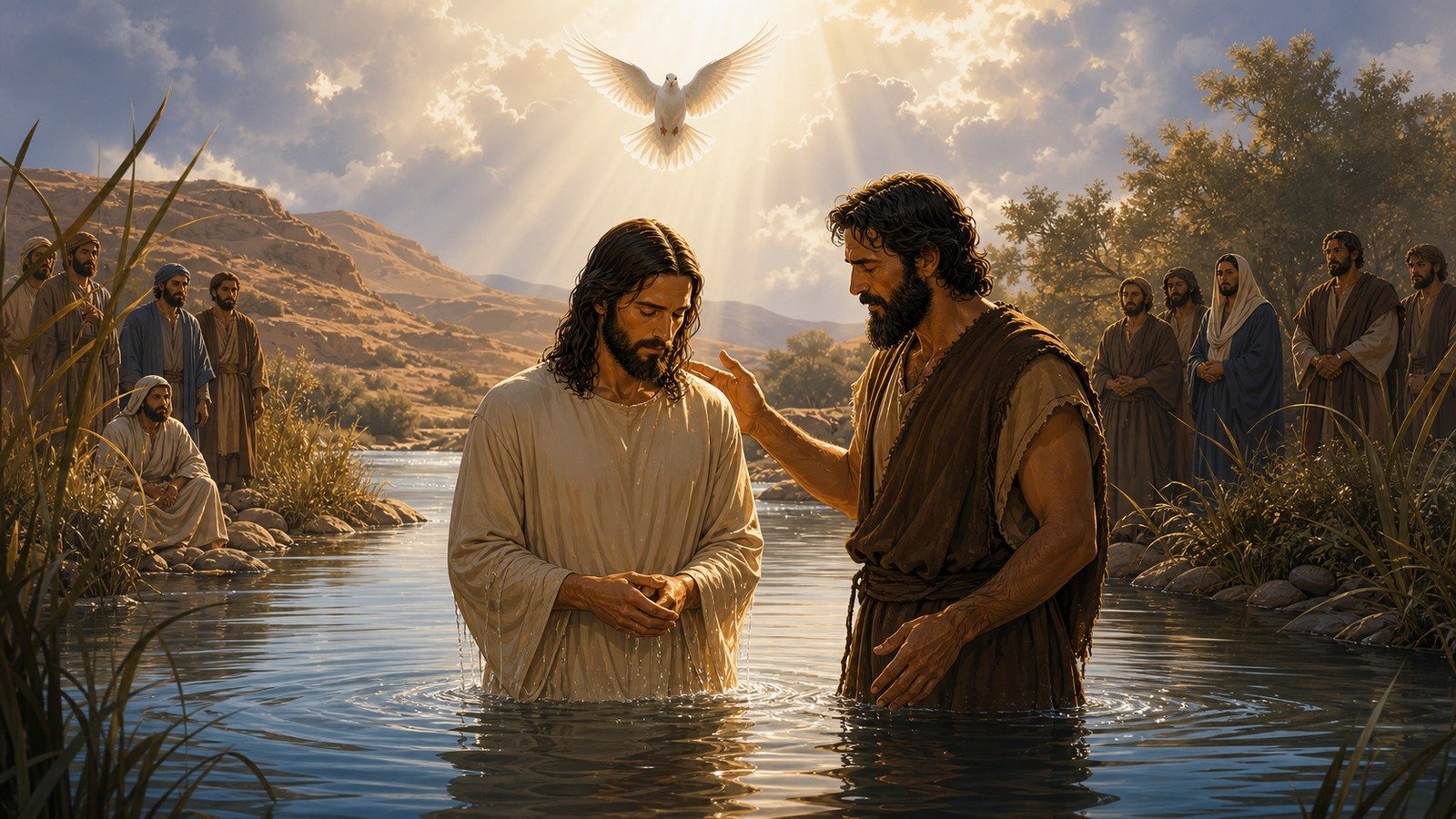
John baptises Jesus in the Jordan; the Spirit descends visibly as a dove and a voice from heaven declares, "This is my Son, whom I love; with him I am well pleased," a moment traditionally read as marking the public beginning of Jesus' ministry. Christians have long read this scene, Father, Son and Spirit all present at once, as one of the New Testament's clearest pointers toward the Trinity.
Further context
3 min readJesus comes from Galilee to the Jordan to be baptised, and the difficulty is immediate and John raises it: I need to be baptised by you, and do you come to me?
That objection is the one every reader has. A baptism of repentance for the forgiveness of sins is being administered to somebody the whole New Testament insists had none. Explanations offered from the earliest period include identification with the people he came to rescue, a public inauguration of his work, an act of obedience to something required of everyone, and the deliberate placing of himself among the guilty. The answer he gives is short and gives a reason without explaining it: let it be so now; it is proper for us to do this to fulfil all righteousness.
The location is the Jordan, and one Gospel names Bethany on the other side of the river.
Three things happen as he comes up out of the water, and they involve all three persons the later creeds name. Heaven is opened. The Spirit descends on him in bodily form like a dove. And a voice from heaven says, you are my Son, whom I love; with you I am well pleased.
That sentence is made of two quotations. The first half is from a royal psalm used at the coronation of a king of Judah. The second half is from the opening of the first of the servant songs in Isaiah, the sequence that ends with the figure who is pierced for our transgressions. A coronation formula and a servant formula are joined in one sentence, and the combination is the whole programme of what follows.
The dove has been read in several ways: as an echo of the Spirit hovering over the waters at creation, as the dove Noah sent out over a flooded world, and as a standard image of gentleness. Nothing in the wording settles it.
One further point about the location. The Jordan at that stretch is a muddy stream a few metres wide, running through a hot valley below sea level, nothing like the rivers of Damascus that Naaman had preferred. People walked out of Jerusalem, down a descent of over a thousand metres, to stand in it.
This is also the moment the public ministry begins. He is about thirty years old, which is the age at which a Levite entered service and the age at which Joseph stood before Pharaoh and David became king. Everything recorded of him before this covers a birth, a visit to the temple at twelve, and thirty years of nothing.
John's own account of it afterwards is that he did not know who it would be, and that the one who sent him to baptise had told him the man on whom he saw the Spirit come down and remain would be the one.
The difficulty John raises is not modesty. If baptism is for repentance, the one being baptised is placing himself among those who need it, and John says so: I need to be baptised by you, and do you come to me?
The answer given is a single sentence and it explains nothing: let it be so now; it is proper for us to do this to fulfil all righteousness.
What follows is described from the outside: heaven opened, the Spirit descending like a dove, and a voice. Whether the crowd saw and heard any of it is unclear, and the four versions differ in whether the voice speaks to him or about him.
The words spoken combine two older lines, one from a royal psalm about a son and one from the first servant song about a chosen one in whom God delights. Kingship and servanthood are put together in one sentence at the start of everything.
It is also the only scene in the Gospels where the Father, the Son and the Spirit all appear at once.