

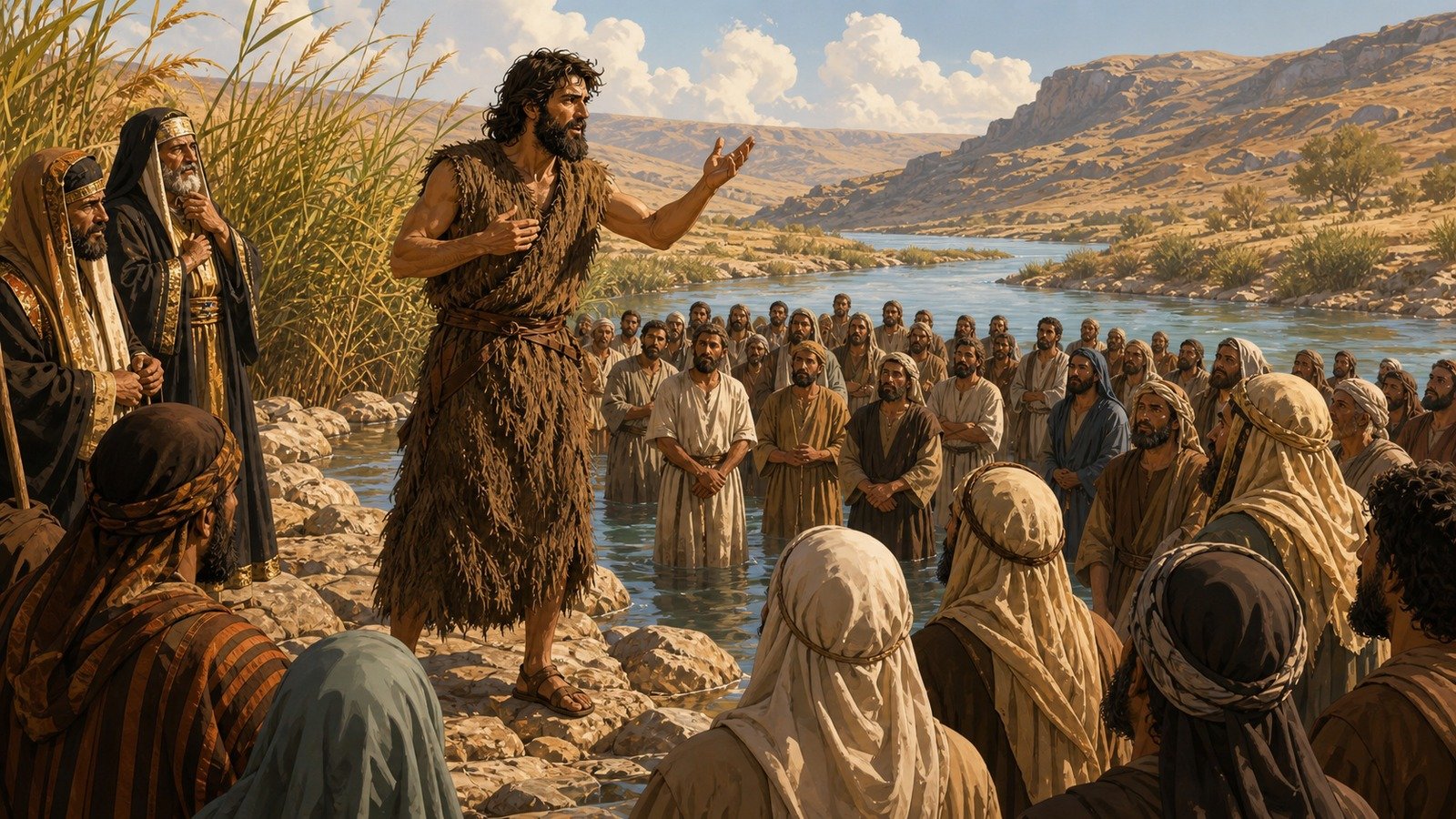
John preaches repentance and baptism in the Judean wilderness, drawing large crowds, calling out religious hypocrisy directly, and pointing to one coming after him "whose sandals I am not worthy to carry."
Further context
3 min readLuke dates the start of it with six simultaneous synchronisms, which is the most precise dating anywhere in the New Testament: the fifteenth year of the reign of Tiberius Caesar, when Pontius Pilate was governor of Judea, Herod tetrarch of Galilee, his brother Philip tetrarch of Iturea and Traconitis, Lysanias tetrarch of Abilene, during the high priesthood of Annas and Caiaphas. That places it around AD 28 or 29, depending on whether Tiberius's years are counted from his sole accession or an earlier co-regency.
The detail about two high priests at once is not an error. Annas had been deposed by the Romans years earlier and his son-in-law Caiaphas held the office, and Annas evidently retained the authority, which is why Jesus is taken to him first on the night of the arrest.
John appears in the wilderness of Judea, the dry country between Jerusalem and the Dead Sea, wearing clothing made of camel's hair with a leather belt round his waist and eating locusts and wild honey. That description is a deliberate quotation of how Elijah had been described, and everyone hearing it would have caught it.
His message is short and it is the same one every time: repent, for the kingdom of heaven has come near. The word behind repent means a change of mind that produces a change of direction, and what he demands is evidence of it rather than sentiment.
The baptism he offers is the thing that gave him his name and it is genuinely novel. Ritual washing was ordinary in Judaism and people performed it on themselves repeatedly. What he does is a single immersion, administered by somebody else, for Jews, as an act of national repentance, which implies that being descended from Abraham is not sufficient. He says so outright: do not think you can say to yourselves, we have Abraham as our father. Out of these stones God can raise up children for Abraham.
When crowds ask what they should do, the answers are unglamorous and specific. Anyone with two shirts should share with the one who has none, and anyone with food should do the same. Tax collectors are told not to collect more than they are required to. Soldiers are told not to extort money, not to accuse people falsely, and to be content with their pay. Nobody is told to leave their job.
About himself he is emphatic: I baptise you with water, but one who is more powerful than I will come, the straps of whose sandals I am not worthy to untie. Untying sandals was slave's work, and the point is that he would not qualify for it.
John's appearance is described in terms that would have been read as a costume: clothing made of camel's hair with a leather belt round his waist. That is what Elijah is described wearing, and the reference would not have been missed.
His diet was locusts and wild honey, both of which are permitted under the food laws and both of which are what a man living in open country would find.
The setting is the Judean wilderness and the Jordan valley, which is not empty desert but dry scrubland dropping to the river, and the community at Qumran lived a few miles from where he worked. Whether he had any connection with them has been argued since the scrolls were found, and there is no evidence either way.
What he demanded was baptism as a mark of repentance for Jews, which was the offensive part. Ritual immersion was familiar, and converts to Judaism from paganism were immersed. Requiring it of Israelites treated them as if they were starting again from outside.