

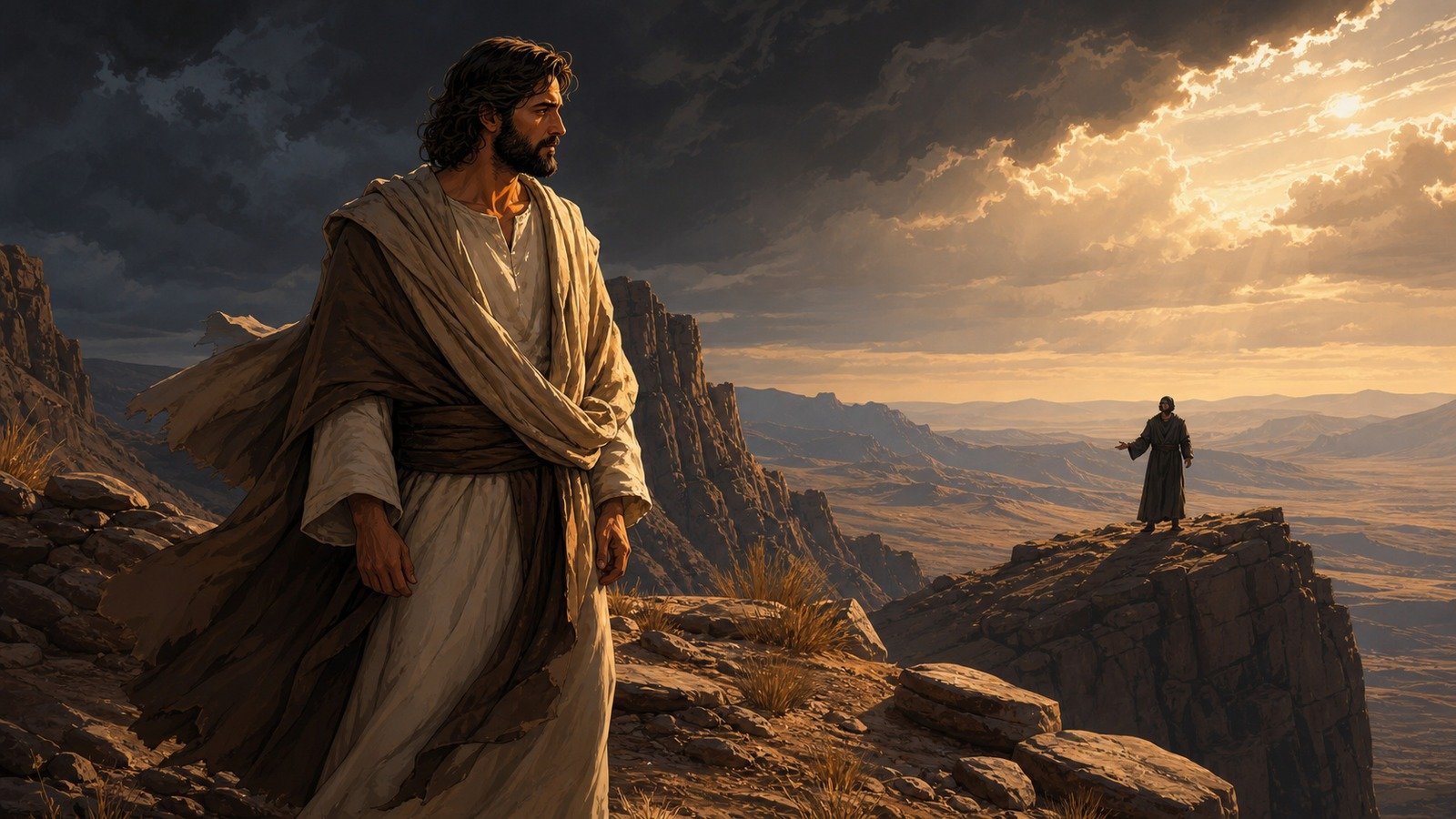
Led by the Spirit into the wilderness, Jesus fasts forty days and is tempted by Satan to turn stones to bread, to test God by jumping from the Temple, and to receive worldly power in exchange for worship, answering each temptation with Scripture.
Further context
3 min readJesus is led by the Spirit into the wilderness, and one Gospel uses a stronger verb, saying the Spirit sent him out, or drove him. He is there forty days and eats nothing, and the number matches the forty years Israel spent in the desert and the forty days Moses spent on the mountain.
Three specific temptations are recorded, and each is answered with a quotation from Deuteronomy, from the section dealing with the wilderness years. What is being replayed is the testing of Israel, with the same tests and different answers.
The first is bread. If you are the Son of God, tell these stones to become bread. He is starving, and there is nothing wrong with bread. The answer is that man shall not live on bread alone but on every word that comes from the mouth of God, which is the lesson attached to the manna.
The second, in Matthew's order, is the temple. He is taken to the highest point and told to throw himself down, and this time the tempter quotes Scripture too, from a psalm promising that angels will lift him up so that he will not strike his foot against a stone. The reply refuses the framing rather than the text: do not put the Lord your God to the test, which is what was said about the water crisis at Massah.
The third is the kingdoms of the world and their splendour, offered outright in exchange for an act of worship. The offer is not treated as empty, and the answer is the first commandment: worship the Lord your God and serve him only.
What the three have in common is worth naming. None of them is an invitation to do something obviously wicked. Each is a shortcut to something he has genuinely come for: bread for the hungry, public vindication, and authority over the nations. What is being tested is the route rather than the destination.
One feature of the exchange is worth naming. Both parties quote Scripture, and one of them quotes it accurately and uses it to argue for something disastrous. The reply does not dispute the text; it sets it against another text about not putting God to the test. A dispute conducted entirely in quotations, in which the correct citation is not by itself the deciding move, is unusual and it is the point.
The wilderness in question is the Judean desert, a rain-shadow region of limestone ridges and dry wadis dropping to the Dead Sea, and it is genuinely lethal. Mark adds one line the others do not: he was with the wild animals, and angels attended him.
The tempter leaves him until an opportune time, which is a note that the matter is deferred rather than settled, and the same offer of a crown without a cross turns up again from a crowd who want to make him king by force, and from Peter, and from voices at the foot of the cross telling him to come down.
Forty days is the figure attached to Moses on the mountain, to Elijah's journey to Horeb, and to the years in the wilderness, and the parallels are made explicit by the three answers, all of which are quotations from Deuteronomy and all of which come from passages about the wilderness generation.
The three temptations are not obviously about vice. Turning stones to bread is about hunger, and the man had not eaten. Throwing himself from the temple is about a spectacular public authentication in front of the crowds below. The kingdoms of the world are offered on terms, and the terms are the point.
Every one of them is a shortcut to something he was going to be given anyway.
The devil quotes Scripture in the second, and quotes it accurately, which is a detail nobody inventing the scene would have thought necessary.
Matthew and Luke give the three in different orders, and neither offers a reason.