

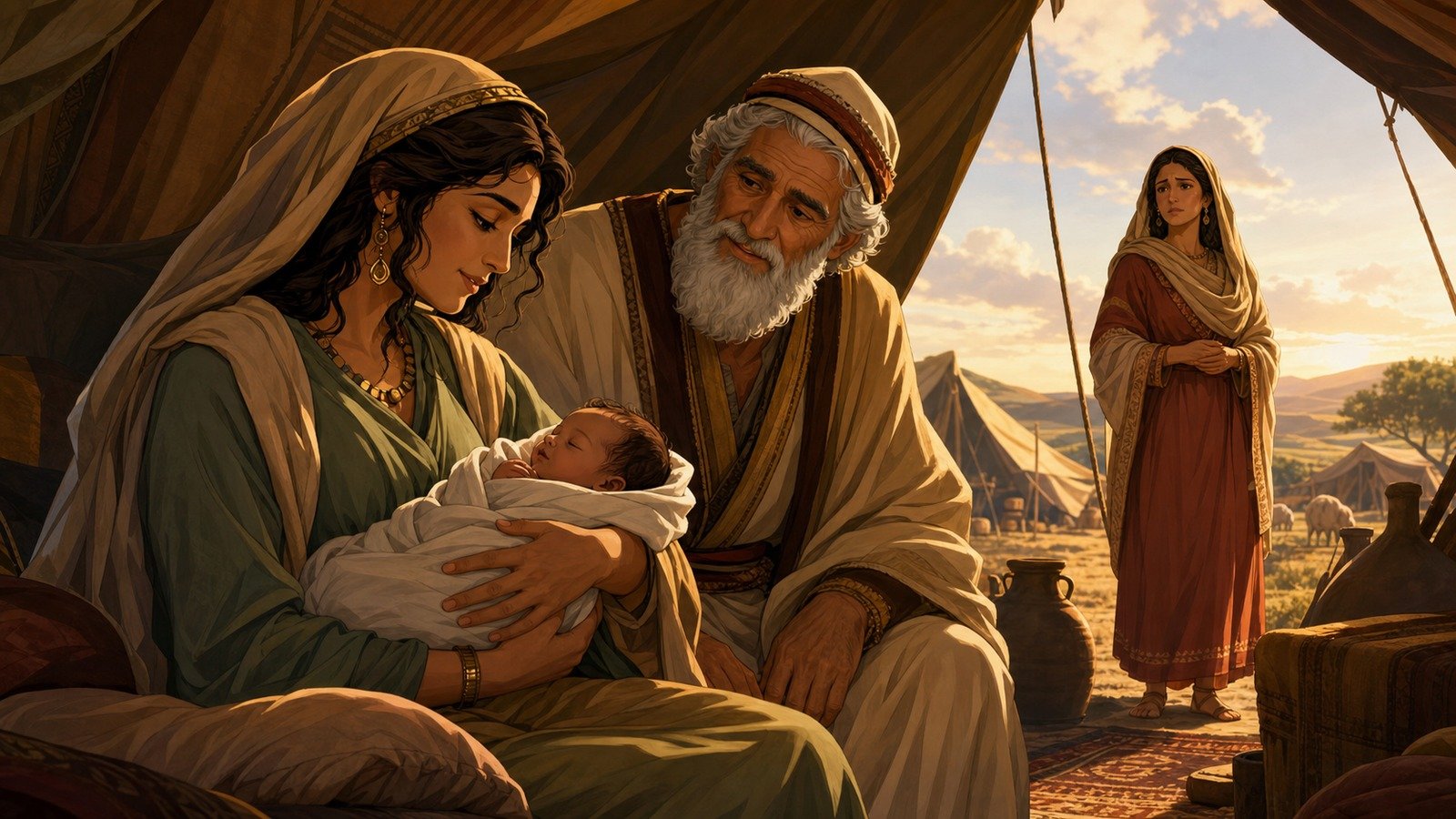
Sarai, still childless, gives her servant Hagar to Abram to bear a son on her behalf, following a common ancient Near Eastern custom. Ishmael is born when Abram is 86; tension between Sarai and Hagar begins immediately.
Further context
2 min readTen years in Canaan and no child. Sarai proposes that Abram sleep with Hagar, her Egyptian slave, so that she may build a family through her, and he agrees without a word.
The arrangement was a recognised legal device rather than an improvisation. Old Babylonian marriage contracts and the Code of Hammurabi both address the situation of a childless wife providing a slave to her husband, and they set out the resulting obligations, including limits on what the wife may do to the slave once the slave has conceived. What happens follows that sequence closely. Hagar conceives and begins to despise her mistress, Sarai complains to Abram, he tells her the slave is in her hands to do with as she thinks best, and Sarai mistreats her until she runs away.
Hagar heads for a spring in the desert on the road to Shur, which runs towards Egypt. She is a slave with no legal standing, pregnant, alone, and going home.
The angel of the LORD finds her there, and this is the first appearance of that figure anywhere. Two things about the encounter are easy to walk past. The first person in Scripture to be met by an angel is a foreign slave woman, not a patriarch. And what she is given is a version of the promise made to Abram: descendants too numerous to count.
The instruction that comes with it is hard. She is told to go back to her mistress and submit to her. No softening is offered and no explanation, and the question of whether that was fair is never raised.
Her son is to be called Ishmael, which means God hears, and the reason is stated: the LORD has heard of your misery. He is described as one who will be like a wild donkey of a man, living in hostility towards all his brothers. That comparison is far less insulting than it sounds in English. The wild donkey, in one of the great catalogues of untameable creatures, is the animal that laughs at the driver's shout and ranges the hills for pasture. The image is of a life that cannot be domesticated, not of a bad character.
Her response has no parallel anywhere else. She gives God a name, calling him the God who sees me (El Roi), and asks whether she has now seen the one who sees her. Nobody else in the Bible names God. The well is afterwards called Beer Lahai Roi, and it turns up again later as a place where Isaac lived.
Abram is eighty-six when Ishmael is born.
The promise made at that spring was kept. Twelve sons of Ishmael are named later, each described as a tribal ruler, with their settlements running from Havilah to Shur along the northern edge of the Arabian peninsula. Several of those names, including Kedar, Nebaioth, Dumah and Tema, appear afterwards both in the Hebrew scriptures and in Assyrian records as identifiable Arabian groups. Twelve is also the number of Jacob's sons, and it is applied to both lines deliberately.