

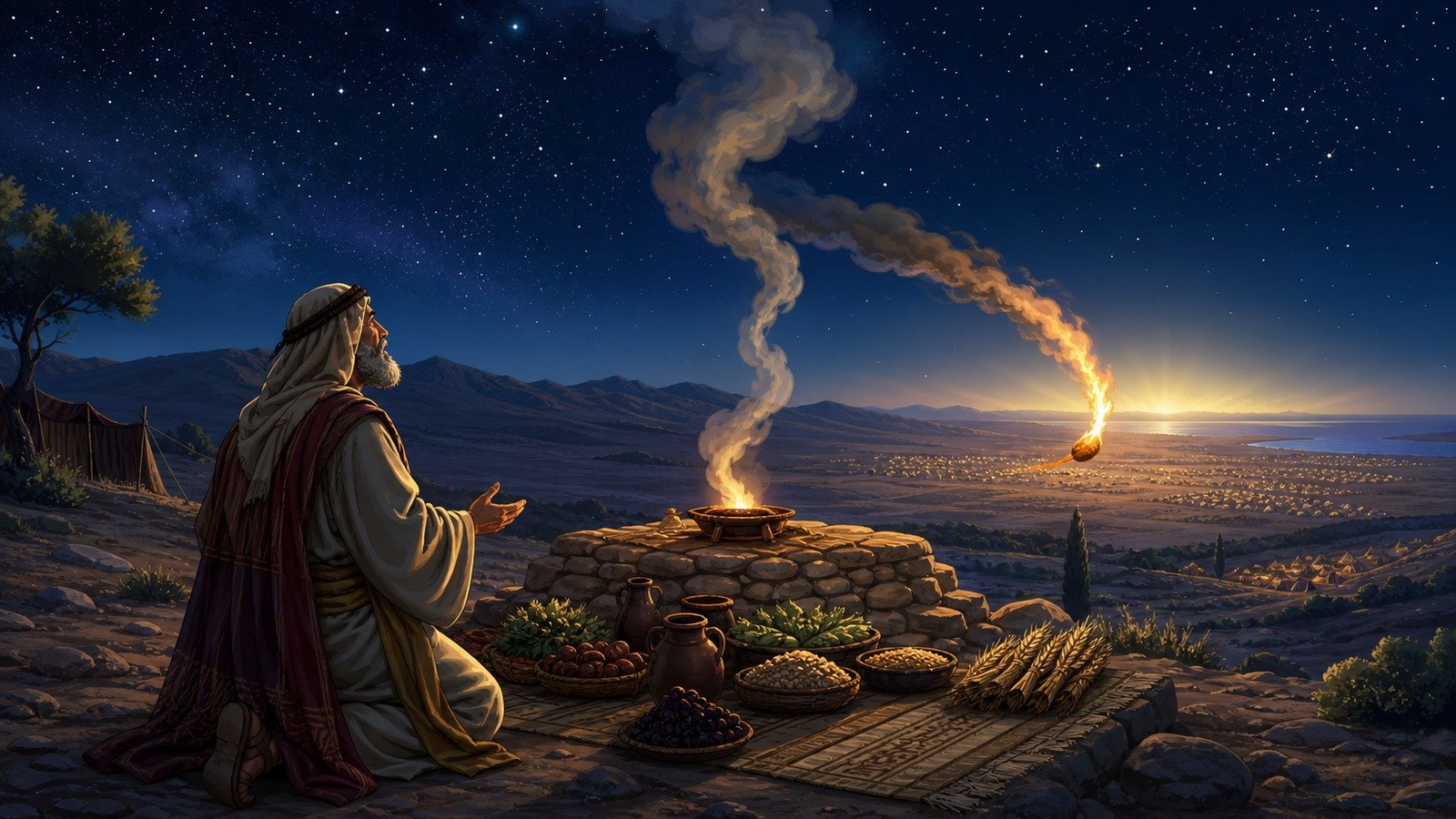
God reaffirms his promise of offspring and land to Abram in a formal covenant ceremony, foretelling four hundred years of slavery for his descendants before their return to Canaan. Abram's faith is "credited to him as righteousness," a phrase Paul later builds a theology on.
Further context
2 min readReassurance is offered and a complaint comes back. Abram is told not to be afraid, that God is his shield and his very great reward, and he answers by asking what any of it is worth while he remains childless, since his estate will pass to a servant, Eliezer of Damascus. Adopting a household servant as heir in the absence of a son is attested in Mesopotamian legal practice, so the objection is a legal one rather than a mood.
He is taken outside and told to count the stars if he can, and that his offspring will be as numerous. What is said next is among the most argued-over sentences in the Bible: Abram believed the LORD, and he credited it to him as righteousness. The verb belongs to the language of accounting. Paul quotes that sentence twice and builds his whole case about how a person stands right with God on the observation that it is said of Abram before he has done anything and before any law exists.
Then comes a ceremony that needs background. He is told to bring a heifer, a goat and a ram, each three years old, along with a dove and a young pigeon. He cuts the animals in two and lays the halves opposite each other, leaving the birds whole, and drives off the birds of prey that come down on the carcasses. At sunset a deep sleep falls on him along with a thick and dreadful darkness, and a smoking brazier with a blazing torch passes between the pieces.
None of this was invented for the occasion. Covenant-making by walking between severed animals is attested in Near Eastern texts, and Jeremiah describes it directly when he condemns officials who walked between the halves of a calf and then broke their word. The parties were calling down on themselves the fate of the animals if they failed to keep the terms. The Hebrew idiom for making a covenant is literally to cut one.
What happens here departs from the pattern in the single respect that carries the meaning. Abram is asleep. Only the fire passes between the pieces. The commitment is one-sided, and no condition is placed on him at all.
Between the arrangement and the fire he is told what is coming. His descendants will be strangers in a country not their own, enslaved and mistreated for four hundred years; the nation that enslaves them will be judged; they will come out with great possessions; and in the fourth generation they will return, because the sin of the Amorites has not yet reached its full measure. That last clause supplies a reason for the delay. The land is not being taken arbitrarily, and the timing is tied to the conduct of the people living in it.
The four hundred years given here does not match the four hundred and thirty stated later, and Paul counts four hundred and thirty from the promise rather than from the entry into Egypt. How to reconcile the figures is disputed and belongs with the Exodus rather than here.
The boundaries described, running from the river of Egypt to the Euphrates, are the widest statement of the promised territory anywhere in the patriarchal story.