

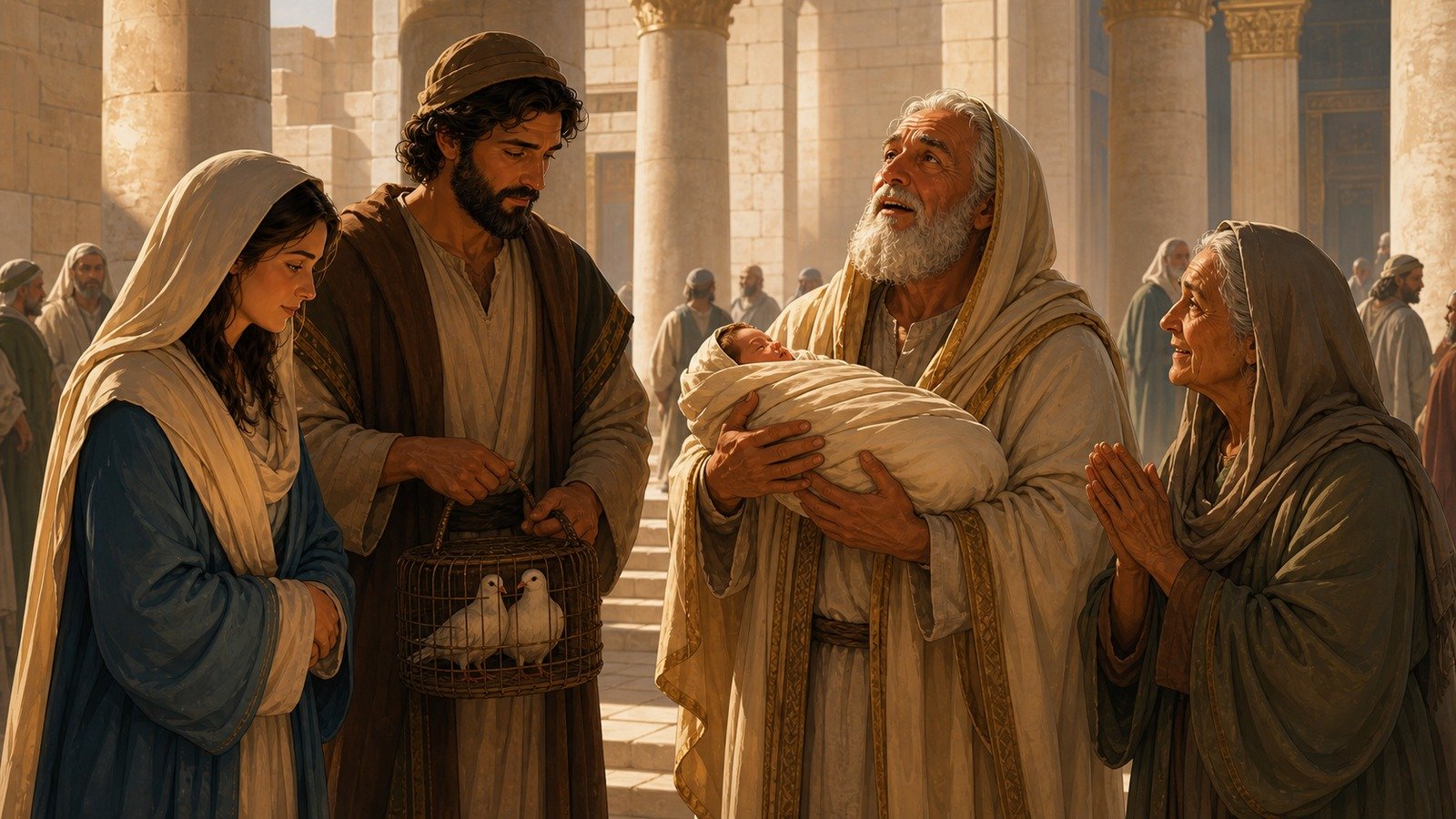
Jesus is circumcised on the eighth day and presented at the Temple forty days after birth per the Law; the elderly Simeon, told he would not die before seeing the Messiah, recognises the infant and blesses him, and the prophetess Anna also speaks about the child to all who were looking for redemption.
Further context
3 min readThree legal requirements are being met and they are worth separating.
On the eighth day the child is circumcised and named, which is what the covenant with Abraham required. Then, after the period of the mother's purification, forty days for a son, the parents go up to Jerusalem for two further things: the presentation of a firstborn son, since every firstborn male was to be consecrated, and the offering that completed the purification.
The offering they bring identifies their income exactly. The law specified a lamb, and made provision for anyone who could not afford one to bring two doves or two young pigeons instead. They bring the birds.
Simeon is described as righteous and devout, waiting for the consolation of Israel, and it had been revealed to him that he would not die before he had seen the Lord's Messiah. He is moved by the Spirit to go into the temple courts at the moment the family arrives, and he takes the child in his arms.
What he says is the third of the poems in these opening chapters, and it is the shortest. Sovereign Lord, as you have promised, you may now dismiss your servant in peace, for my eyes have seen your salvation, which you have prepared in the sight of all nations: a light for revelation to the Gentiles, and the glory of your people Israel. The verb for dismiss is the one used for releasing a slave or a sentry from duty.
The child's parents marvel at what is said about him, and then Simeon blesses them and says something to Mary alone that is not a blessing: this child is destined to cause the falling and rising of many in Israel, and to be a sign that will be spoken against, so that the thoughts of many hearts will be revealed. And a sword will pierce your own soul too.
That is said over a forty-day-old baby to a mother in her teens.
Anna is introduced with an unusual amount of detail. She is a prophet, of the tribe of Asher, widowed after seven years of marriage and now eighty-four, and she never left the temple but worshipped night and day, fasting and praying. She comes up at that moment, gives thanks, and speaks about the child to all who were looking forward to the redemption of Jerusalem.
The redemption of a firstborn son involved paying five shekels to a priest, and the whole practice went back to the night in Egypt when the firstborn of Israel were spared. A family bringing a firstborn to the temple and paying that price were re-enacting a rescue from four centuries of slavery, and doing it with the cheaper offering because they could not afford a lamb.
Two elderly people who had spent their lives waiting recognise an infant carried in by a couple who could not afford a lamb.
Three legal requirements are being met in the space of a few sentences, and the family fulfils all of them.
Circumcision on the eighth day, with the naming attached. The purification of the mother forty days after the birth of a son. And the redemption of the firstborn male, who under the law belonged to God and had to be bought back.
The offering they bring is the detail that places them socially: a pair of doves or two young pigeons, which the law specifies as the alternative for those who cannot afford a lamb.
Simeon is described as waiting for the consolation of Israel and having been told he would not die before seeing the Messiah. His song, known as the Nunc Dimittis, has been used at evening prayer for fifteen centuries.
What he says to Mary afterwards is not comforting: this child is destined to cause the falling and rising of many in Israel, and a sword will pierce your own soul too.