

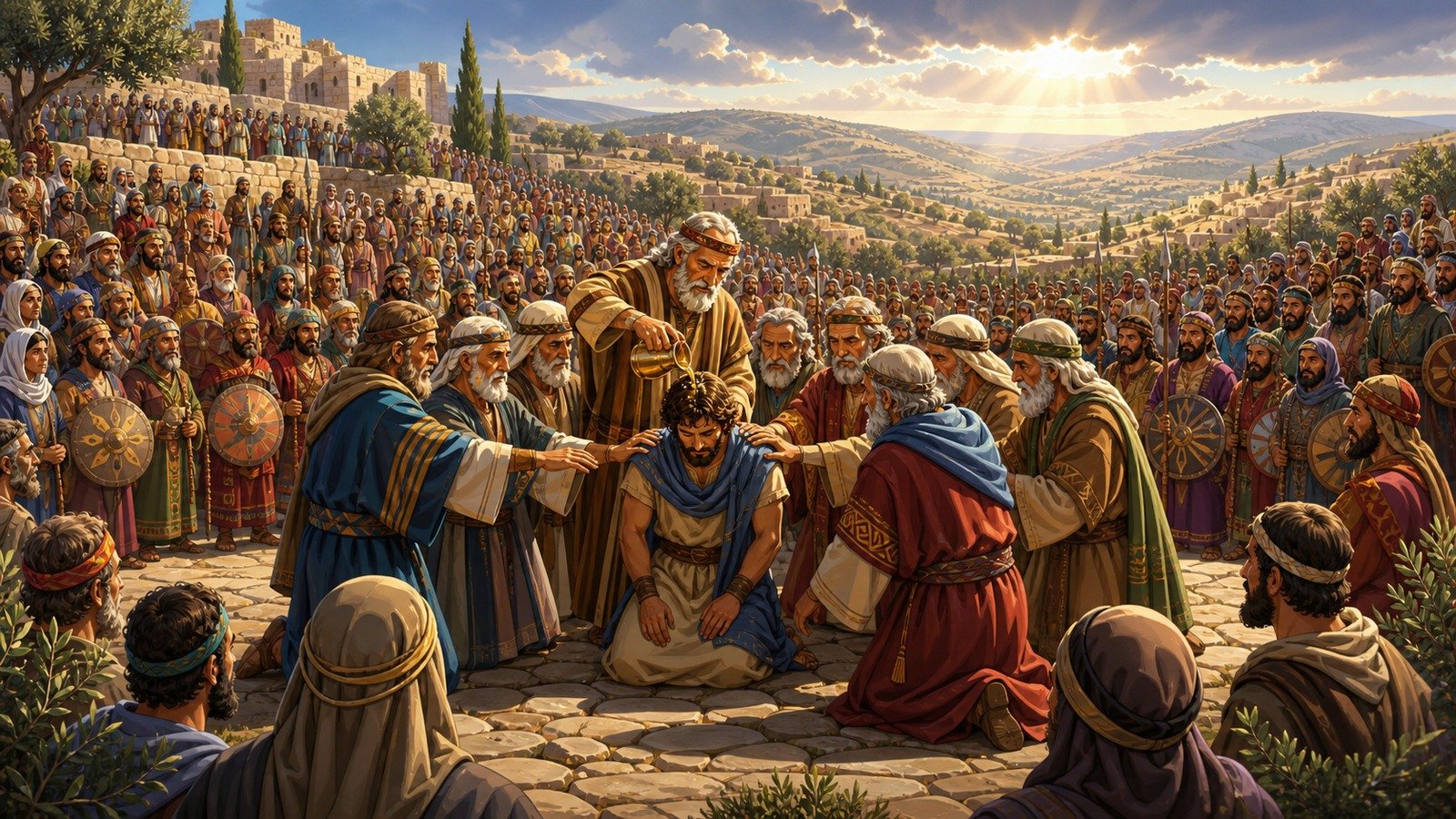
All the tribes of Israel formally accept David as king at Hebron, ending seven years of civil war and division.
Further context
2 min readAll the tribes come to Hebron, and what they say has three parts and each one is an argument.
First, kinship: we are your own flesh and blood. Second, record: even while Saul was king, you were the one who led Israel on their military campaigns. Third, the anointing: the LORD said to you, you will shepherd my people Israel, and you will become their ruler. They are citing something that had happened at Bethlehem thirty years earlier and had never been made public, which means it was known.
A covenant is made before the LORD at Hebron and they anoint him king over Israel. It is the third time he has been anointed: privately by Samuel as a boy, by the men of Judah at Hebron, and now by the whole nation.
The regnal summary given at this point is one of the fixed points of Israelite chronology: he was thirty when he became king and he reigned forty years, seven and a half in Hebron over Judah and thirty-three in Jerusalem over all Israel and Judah.
The shepherd image in what the tribes say is not decoration. Shepherd was the standard word for a king across the ancient Near East, used of Mesopotamian and Egyptian rulers for a thousand years before this, and it carried an expectation of provision and protection rather than of splendour. It is also literal here, since the man they are addressing was fetched in from a flock to be anointed and had spent his adolescence doing the job.
What has actually happened over seven and a half years is worth stating plainly, because it is the reason the northern tribes came south rather than being conquered. Every obstacle between David and the throne was removed by somebody else. Saul died on his own sword. Jonathan died in the same battle. Abner was murdered by David's own commander in a private feud, and David cursed him for it in public. Ish-Bosheth was assassinated by two of his own officers, and David executed them. He fought no campaign against the house of Saul and killed none of its members, and at each stage he made his distance from the killing conspicuous.
Whether that was scrupulousness or political skill of a very high order is a question the surrounding narrative leaves open, and the two are not exclusive. What is beyond argument is that a man who had twice refused to kill Saul when he had the chance ended up with the throne without ever having to explain a death.
The covenant made at Hebron is worth registering as a constitutional act. This is not a conquest and not an inheritance; it is an agreement between a king and the tribes, made before the LORD, and the same word is used for it as for the agreements at Sinai and Shechem. A century and a half later the northern tribes will invoke exactly that framework when they meet Solomon's son and treat the terms as negotiable.
He is thirty-seven, and the country is unified for the first time since the tribes crossed the Jordan.