
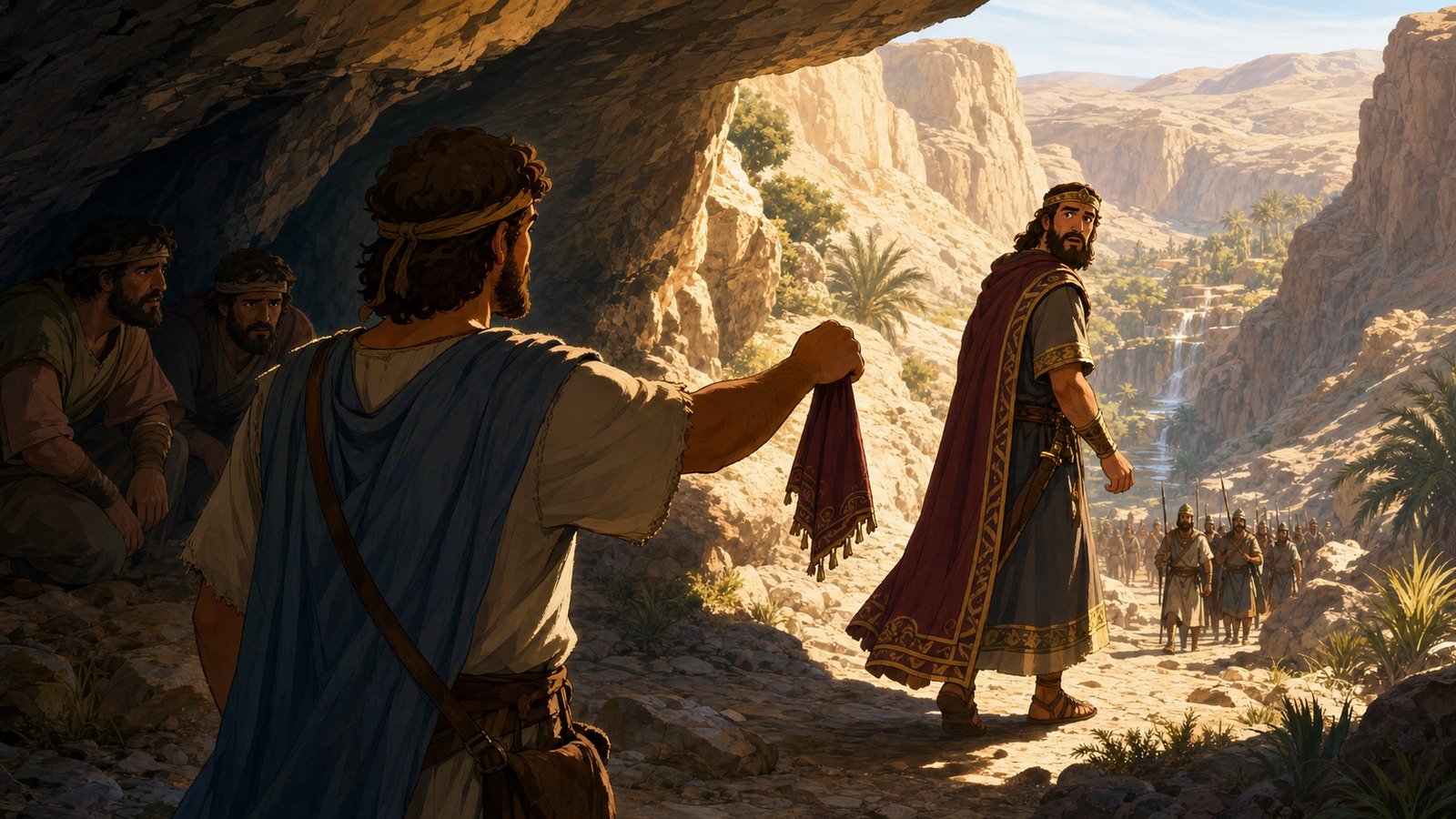
Saul unknowingly enters the very cave where David and his men are hiding at En Gedi; David cuts off a corner of Saul's robe but refuses to kill "the Lord's anointed," and later shows Saul the cloth as proof of his restraint.
Further context
2 min readEn Gedi is an oasis on the western shore of the Dead Sea, a freshwater spring in an escarpment of limestone riddled with caves, and it is a natural refuge for anyone who does not want to be found. Saul takes three thousand chosen men and goes looking.
He goes into a cave to relieve himself and David and his men are hiding in the back of it. The situation is as compromising as it sounds, and the practical detail is what makes it plausible: a cave mouth in bright sunlight is blinding from outside and the interior is invisible until the eyes adjust, so a man stepping in for privacy would see nothing at all.
David's men urge him on with a piece of prophecy nobody has recorded anywhere else: this is the day the LORD spoke of when he said he would give your enemy into your hands to deal with as you wish. He creeps up and cuts off a corner of Saul's robe, and then is conscience-stricken for having done even that.
His reasoning is stated twice and it is the fixed point of his whole conduct through these years. The LORD forbid that I should do such a thing to my master, the LORD's anointed, or lay my hand on him, for he is the anointed of the LORD. He is refusing to remove a king he has been anointed to replace, on the grounds that the office is not his to unmake.
He has to restrain his men with these words, which suggests they were not persuaded.
Then he goes out of the cave and shouts after him, and the exchange in the open is the heart of it. He bows down, calls him my lord the king, and holds up the piece of cloth. See, my father, look at this piece of your robe in my hand. I cut off the corner and did not kill you. Understand that I am not guilty of wrongdoing or rebellion. Then a proverb: from evildoers come evil deeds. And then a question that is almost mockery: against whom has the king of Israel come out? A dead dog? A flea?
Saul weeps. He calls David his son. He says, you are more righteous than I, because you have treated me well while I have treated you badly. He then says the thing everyone in the story already knows: I know that you will surely be king and that the kingdom of Israel will be established in your hands.
His final request is the same one his son made. Swear that you will not kill off my descendants or wipe out my name from my father's family. David swears it.
Then Saul goes home and David goes back to the stronghold, which is the sensible response to a reconciliation with a man who has hunted him twice already.