

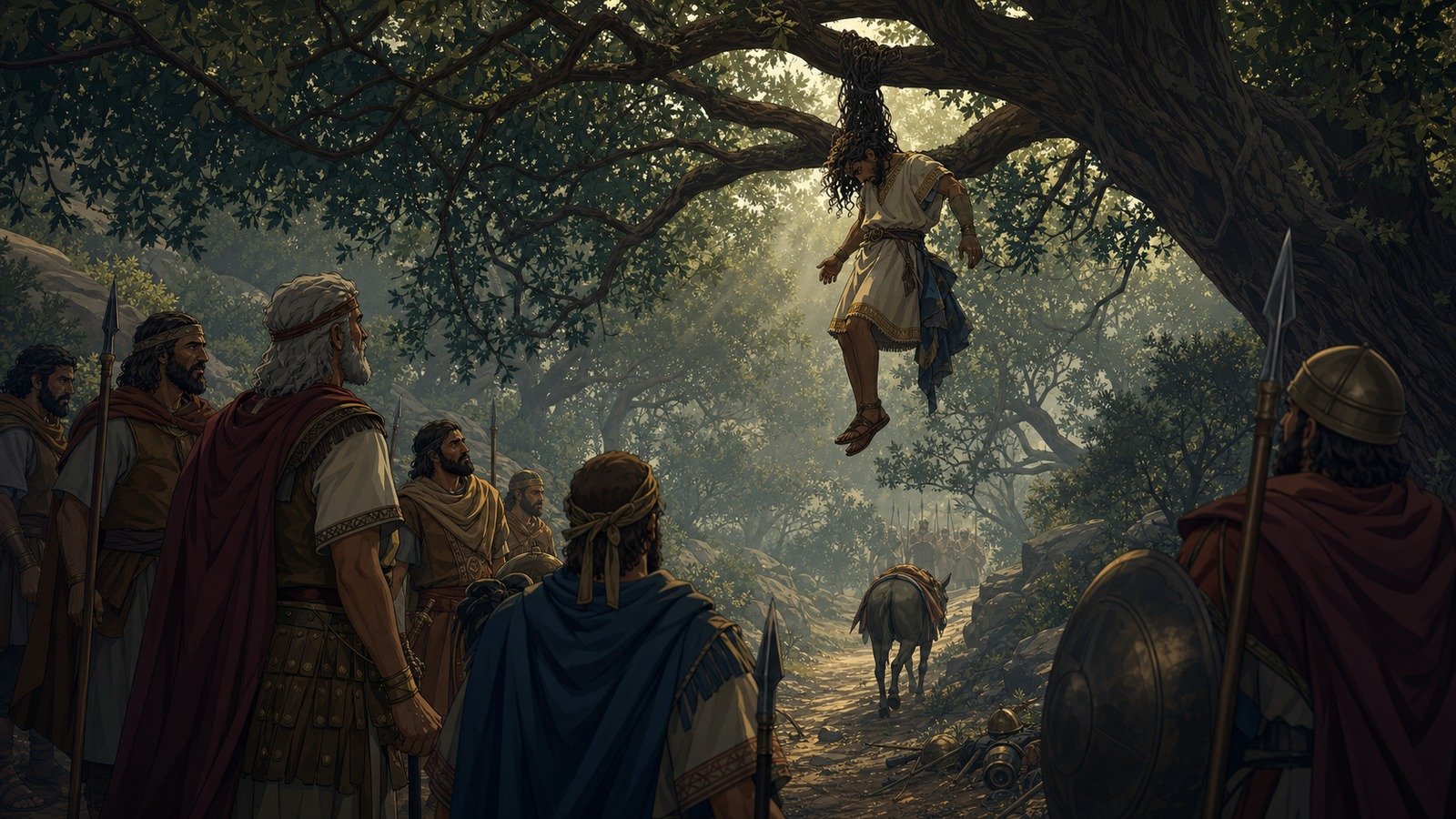
Absalom's forces are defeated, and against David's explicit orders Joab kills him personally after finding him caught in a tree by his hair, plunging David into grief even in victory.
Further context
2 min readThe battle is fought in the forest of Ephraim, east of the Jordan, and the terrain decides it. Absalom's levy is larger and has no experience; David's core is professional and is commanded by Joab. The fighting spreads over the whole countryside and the forest claimed more lives that day than the sword.
Before it starts David gives an order in the hearing of the whole army: be gentle with the young man Absalom for my sake. Every soldier there has heard a king ask them to protect the man who is trying to kill him.
Absalom rides into a low branch of a large oak while fleeing on his mule, and his head is caught fast, and he is left hanging in mid-air while the mule keeps going. The famous hair is not mentioned at that moment, though the earlier note about its weight has made the connection irresistible ever since.
A soldier reports it to Joab and is asked why he did not strike him down on the spot for a reward of ten shekels and a warrior's belt. His answer is a rebuke: even if a thousand shekels were weighed out into my hands, I would not lay a hand on the king's son. We heard the king command you and Abishai and Ittai to protect him. And if I had put my life in jeopardy, you would have kept your distance from me.
Joab does it himself with three javelins into the heart, and ten of his armour-bearers finish it. He is thrown into a pit in the forest and a large heap of rocks is piled over him, and the trumpet is sounded to stop the pursuit.
The news is carried by two runners and the mechanics of that are given at length, because a messenger bringing bad news to this king had reason to be careful. Ahimaaz arrives first and, asked directly whether the young man is safe, evades the question. The Cushite arrives and answers it: may the enemies of my lord the king be like that young man.
What follows is the most quoted line of grief in the Hebrew scriptures. The king was shaken. He went up to the room over the gateway and wept, and as he went he said: O my son Absalom! My son, my son Absalom! If only I had died instead of you, O Absalom, my son, my son!
One detail placed earlier explains the heap of stones. Absalom had put up a pillar for himself in the King's Valley during his lifetime, saying he had no son to carry on the memory of his name, and had called it after himself. Three sons are listed elsewhere, so either they died young or the pillar was vanity. Either way, a man who built a monument to preserve his name ends under an unmarked cairn in a wood.
A victory turns into mourning throughout the whole army, and the troops creep back into the city as though ashamed of winning a battle.