

Having spent years courting popular support, Absalom launches an open rebellion that forces David to flee Jerusalem, one of the lowest points of his reign, while advisors on both sides manoeuvre for advantage.
Further context
2 min readAbsalom takes his time, and the method is a masterclass in how to build a following. He provides himself with a chariot and horses and fifty men to run ahead of him, which nobody in Israel had done before, and then gets up early and stands by the side of the road leading to the city gate, where legal cases were heard.
Whenever anyone comes with a complaint to bring before the king, he intercepts them. He asks which town they are from, and then says: look, your claims are valid and proper, but there is no representative of the king to hear you. And then the line he repeats: if only I were appointed judge in the land! Then everyone who has a complaint could come to me and I would see that they receive justice.
When they bow to him he reaches out, takes hold of them and kisses them. Four years of that, and he stole the hearts of the people of Israel.
The grievance he is exploiting is real. His father had been famous for doing what was just and right for all his people, and by this point the judicial system is not functioning well enough for petitioners to get a hearing.
The revolt is launched from Hebron, which is where David himself was first anointed and which had lost the capital to Jerusalem. He asks permission to go and fulfil a vow, takes two hundred guests from Jerusalem who go innocently and know nothing, and sends secret messengers through all the tribes to wait for the trumpets.
Ahithophel, David's own counsellor and one of the most respected advisers in the country, joins him. His counsel in those days was like that of one who enquires of God, and he is very probably Bathsheba's grandfather, which would supply a motive nobody states.
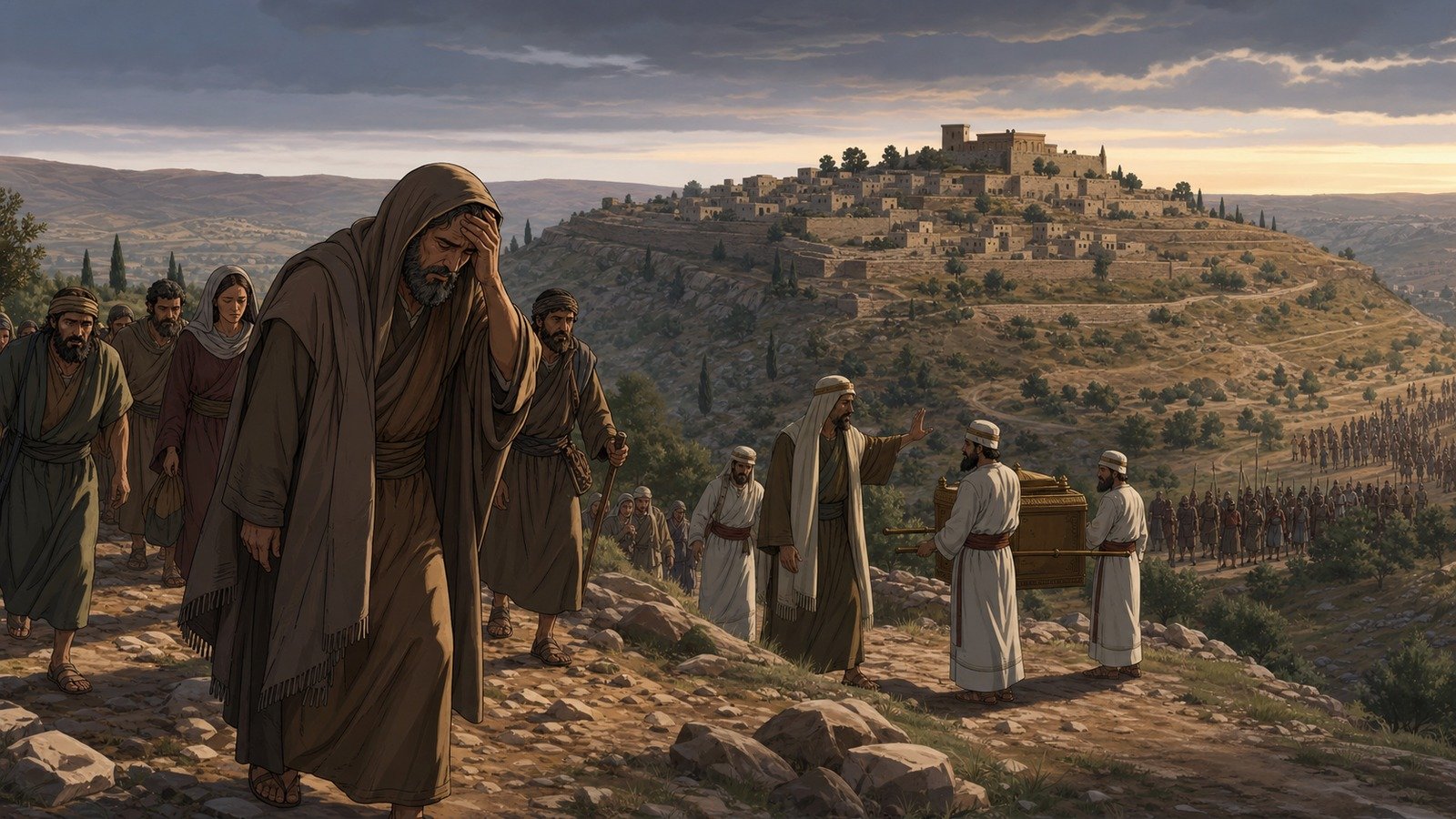
David's decision to abandon Jerusalem rather than defend it is made instantly and saves the city, and the retreat over the Kidron and up the Mount of Olives is described in detail: the whole countryside weeping aloud, the king walking with his head covered and barefoot, and the people covering their heads and weeping as they went.
He sends the ark back, refusing to use it as a talisman, with a sentence that is the most self-possessed thing he says in the whole crisis: if I find favour in the LORD's eyes, he will bring me back. But if he says he is not pleased with me, then I am ready; let him do to me whatever seems good to him.
He also leaves two priests and their sons in the city as an intelligence network, and sends his friend Hushai back to pose as Absalom's adviser with instructions to frustrate Ahithophel's counsel, which is exactly what happens and is what saves him.
On the way a man of Saul's clan called Shimei walks along the opposite hillside cursing him and pelting him with stones and calling him a murderer. Abishai offers to remove his head, and David refuses.