

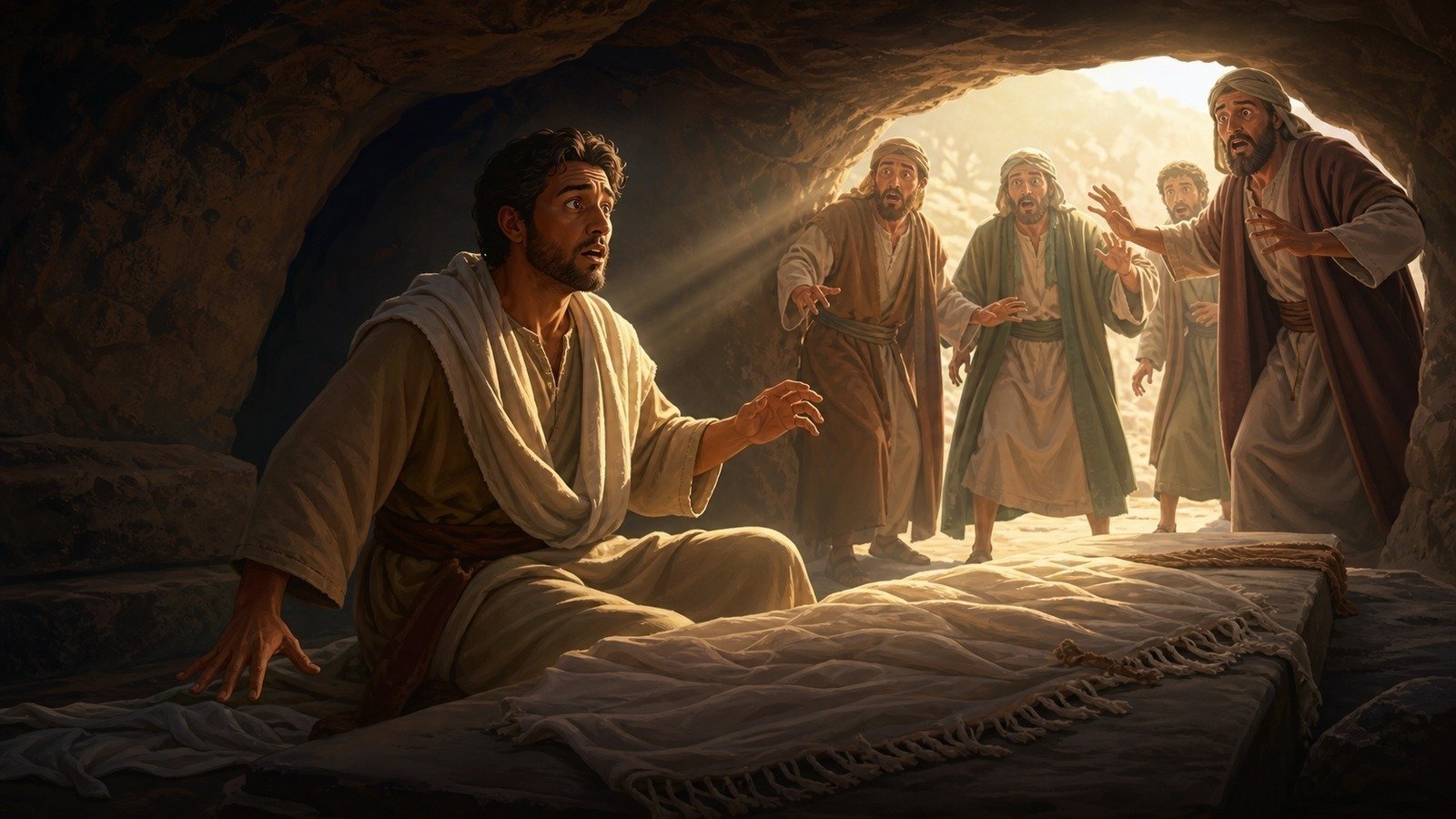
Elisha dies of illness during the reign of Jehoash; a dead man thrown hastily into Elisha's tomb is revived on touching his bones, a final miracle attributed to the prophet even after death.
Further context
3 min readElisha is suffering from the illness he will die of when the king of Israel comes down to see him and weeps over him, and what he calls him is what he himself had shouted when Elijah was taken: my father, my father, the chariots and horsemen of Israel.
The scene that follows is the last of his prophetic acts and it is deliberately ambiguous. He tells the king to take a bow and arrows, puts his own hands over the king's hands, has the east window opened towards the Aramean territory and tells him to shoot, calling it the LORD's arrow of victory over Aram. Then he tells him to take the arrows and strike the ground. He strikes three times and stops, and Elisha is angry: you should have struck five or six times, then you would have defeated Aram completely. Now you will defeat it only three times.
What went wrong is never explained, and the most defensible reading is that the king did the minimum required to comply rather than continuing until he was told to stop.
He dies and is buried. Then two sentences that close a fifty-year career with something nobody expects.
Moabite raiders used to enter the country every spring, and one year some Israelites were burying a man when they saw a band of raiders and threw the body into Elisha's tomb. When it touched Elisha's bones, the man came to life and stood up on his feet.
Nothing whatever is made of that. It is not a lesson, nobody witnesses it who matters, the man is not named and is never mentioned again, and no comment follows. A hurried burial in a raiding season, a body dropped into the wrong grave, and a man standing up.
The two careers make a matched pair. Elijah worked in public against a king and a queen, on mountains, with fire, and asked to die under a bush afterwards. Elisha asked for a double share and got roughly twice as many recorded episodes, most of them in houses: a widow's oil, a woman's son, a poisoned pot, a borrowed axe, a foreign general's skin. He also anointed a king who exterminated a dynasty, walked a blinded army into a capital and fed it, and forecast a market price.
The double portion he had asked for is often taken as a request for twice the power, and the recorded episodes have sometimes been counted to see whether they come to twice Elijah's. That is a misreading of the phrase, which is the inheritance share of an eldest son, and the tally is beside the point in any case.
His last recorded conversation is with a king he had spent his life opposing, who is weeping at his bedside and calling him father.
The arrows are the strangest deathbed scene in these books. Elisha puts his own hands on the king's hands on the bow, tells him to shoot eastward, calls it the LORD's arrow of victory over Aram, and then tells him to strike the ground. He strikes three times and stops, and is told he should have struck five or six.
What the king was supposed to know is never explained, and interpreters have divided between reading it as a test of persistence and reading it as arbitrary.
Then a final episode, after his death, which is the only posthumous miracle in the Bible. Moabite raiders interrupt a burial, the mourners throw the body into Elisha's tomb, and when it touches his bones the man comes to life and stands on his feet.
The last thing said about him is that a corpse touched his corpse and got up.