

A severe Aramean siege of Samaria reduces the city to cannibalism; Elisha predicts sudden, abundant food within a day, fulfilled when the Aramean army flees in panic overnight, leaving its supplies behind.
Further context
3 min readBen-Hadad of Aram besieges the northern capital, and the famine inside is described by its prices. A donkey's head sells for eighty shekels of silver and a quarter of a kab of seed pods for five. A donkey was an unclean animal and its head the least edible part of it, and what the second item was is uncertain, with dove's dung and a wild plant both proposed. Either way, inedible things are being traded at the price of livestock.
Then the king, walking on the wall, is stopped by a woman with a legal complaint, and what she says is the worst thing in these books. She and another woman had agreed to eat her son one day and the other woman's the next. They cooked and ate hers, and the next day the other woman hid her child.
He tears his robes, and the people see that he is wearing sackcloth underneath. Then he swears to have Elisha's head off that day, which locates where he thinks the blame lies.
Elisha's answer to the delegation is a market forecast: about this time tomorrow, a seah of the finest flour will sell for a shekel and two seahs of barley for a shekel at the gate of Samaria. The officer on whose arm the king was leaning says that even if the LORD opened the floodgates of heaven this could not happen, and is told he will see it with his own eyes and not eat any of it.
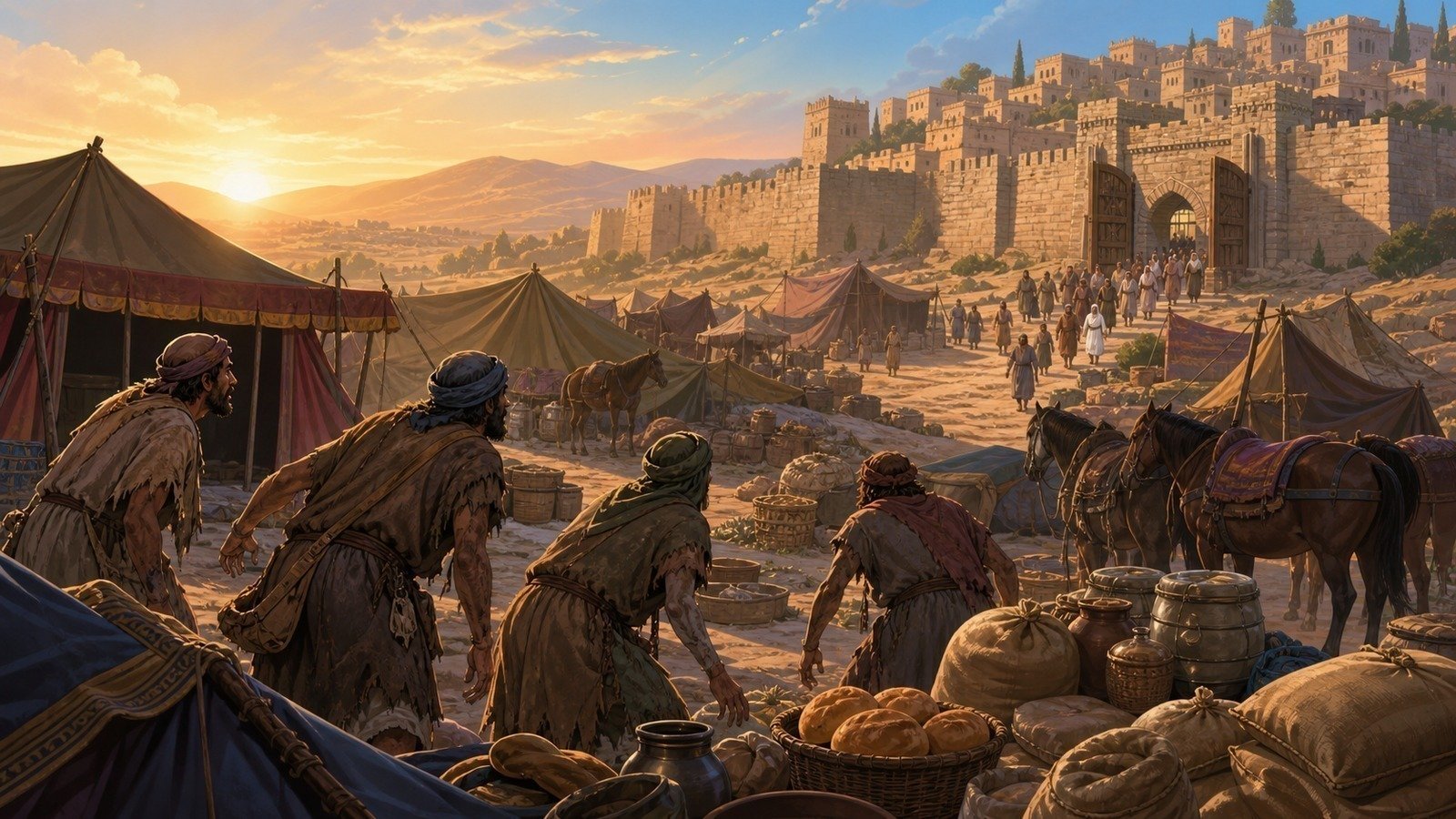
The relief comes through four men with a skin disease sitting at the city gate, excluded from the town by law and starving outside it. Their reasoning is a piece of pure calculation: if we stay here we die, if we go into the city we die, so let us go over to the Aramean camp and surrender, and if they spare us we live and if they kill us we die anyway.
They walk into an empty camp. The Aramean army had heard the sound of chariots and horses and a great army, concluded that Egyptian and Hittite kings had been hired against them, and abandoned everything and fled in the dusk.
The four men eat, drink, carry off silver, gold and clothing and hide it, and then stop. What they say to each other is the sentence the whole episode turns on: we are not doing right. This is a day of good news and we are keeping it to ourselves. They go and report it at the gate.
The city plunders the camp, the prices fall exactly as predicted, and the officer who had scoffed is trampled to death in the gateway by the crowd.
The prices quoted are the whole argument of the passage. Eighty shekels for a donkey's head, an animal both unclean and inedible, and five shekels for a quarter of a kab of what the Hebrew calls dove's dung, which may be a plant name or may be exactly what it says.
The woman's complaint to the king on the wall is worse. She and another woman had agreed to eat her son one day and the other woman's the next, and the second woman has hidden her child. The king tears his robes and the people see he is wearing sackcloth underneath.
Cannibalism under siege is described in the covenant curses in the law, and Josephus reports it again during the Roman siege eight centuries later.
The four men with leprosy who discover the abandoned camp are outside the gate because the law required them to be, and their reasoning is entirely practical: if we stay here we die, so we may as well surrender.