

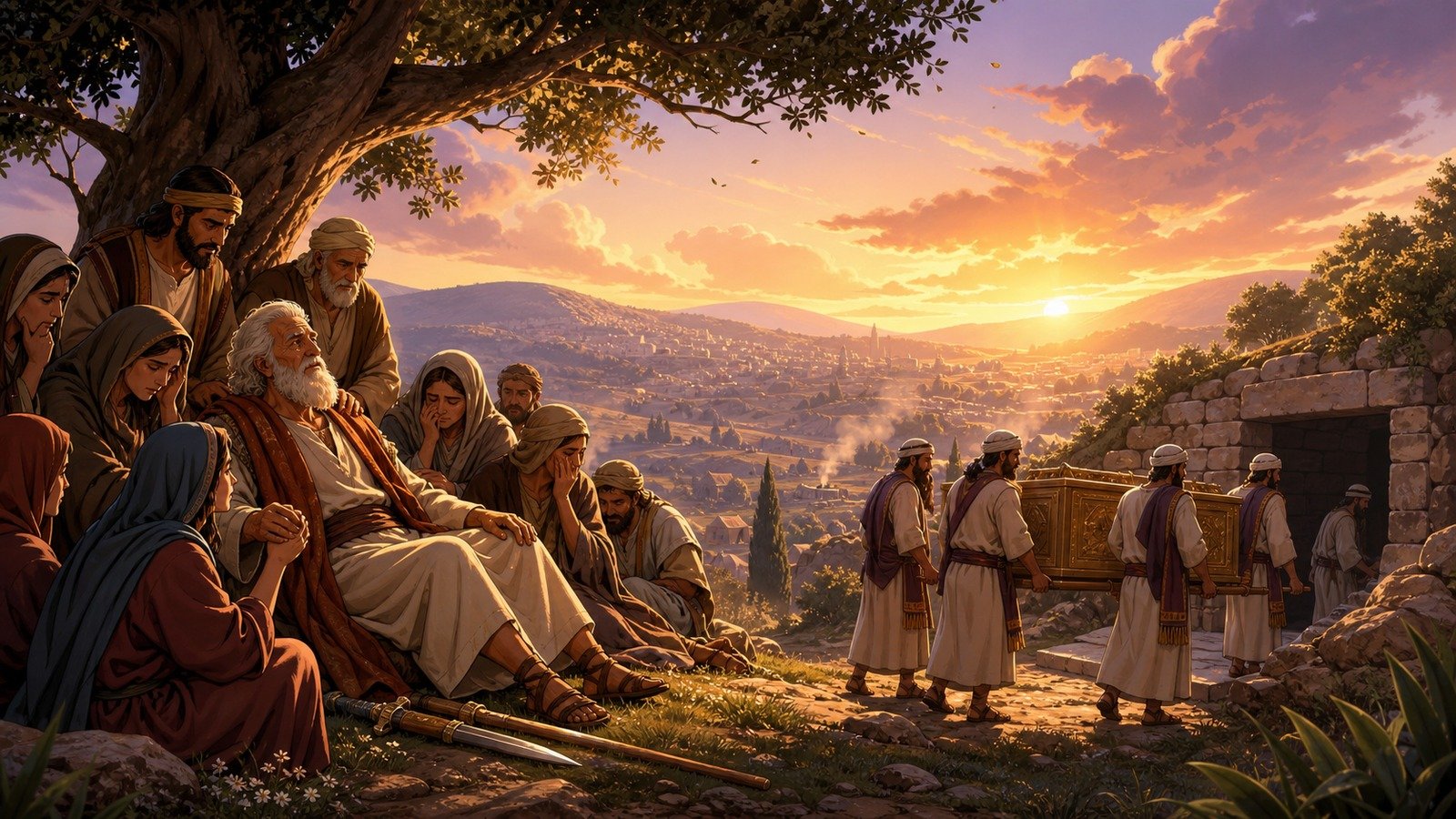
Joshua dies at 110, closing out the conquest generation; Joseph's bones, carried out of Egypt generations earlier, are finally buried at Shechem.
Further context
2 min readJoshua dies at a hundred and ten, the same age given for Joseph, and he is buried at Timnath Serah in the hill country of Ephraim, on his own land.
The verdict on his generation is careful and it has a time limit built into it. Israel served the LORD throughout the lifetime of Joshua and of the elders who outlived him and who had experienced everything the LORD had done for Israel. Those two clauses do a great deal of work. Obedience is tied to the presence of people with first-hand memory, and the moment that generation is gone the pattern breaks, which is exactly what the next book describes happening.
Three burials are recorded together at the end, and putting them side by side is deliberate.
Joshua is buried on his own inheritance, which is the whole point of the preceding chapters: a man who spent forty years in a tent and seven in a campaign dies owning land.
Joseph's bones are buried at Shechem, in the plot Jacob bought from the sons of Hamor for a hundred pieces of silver. That coffin has now travelled through four centuries in Egypt, the departure, forty years in the wilderness and the whole conquest, because of an oath sworn by a man who had never seen the country. It is buried in the second piece of ground the family ever legally owned, bought by his father, near the well where his brothers once grazed the flocks he was sent to check on.
Eleazar son of Aaron is buried at Gibeah, which belonged to his son Phinehas. The high priesthood has passed through three generations without incident since the day the garments were transferred on Mount Hor.
The age of a hundred and ten is the same figure given for Joseph, and it was the Egyptian ideal lifespan. Whether that is coincidence or a deliberate closing of a circle is unknown, but the two men bracket the whole period between the family going down into Egypt and the nation settling in Canaan, and both are buried in the same small patch of hill country.
The country at this point has a territory, a legal code, a sanctuary at Shiloh, a distributed priesthood, a system of cities of refuge and no central government of any kind. There is no king, no capital, no standing army and no permanent judiciary. Twelve tribes hold neighbouring pieces of land, bound together by a covenant, an ark and a shared story, and the arrangement depends entirely on everyone continuing to take that seriously.
What happens when they do not is the subject of the next three centuries. The book that follows opens by listing the towns each tribe failed to take and the Canaanite populations each one left in place, and then states the consequence: another generation grew up who knew neither the LORD nor what he had done for Israel.