

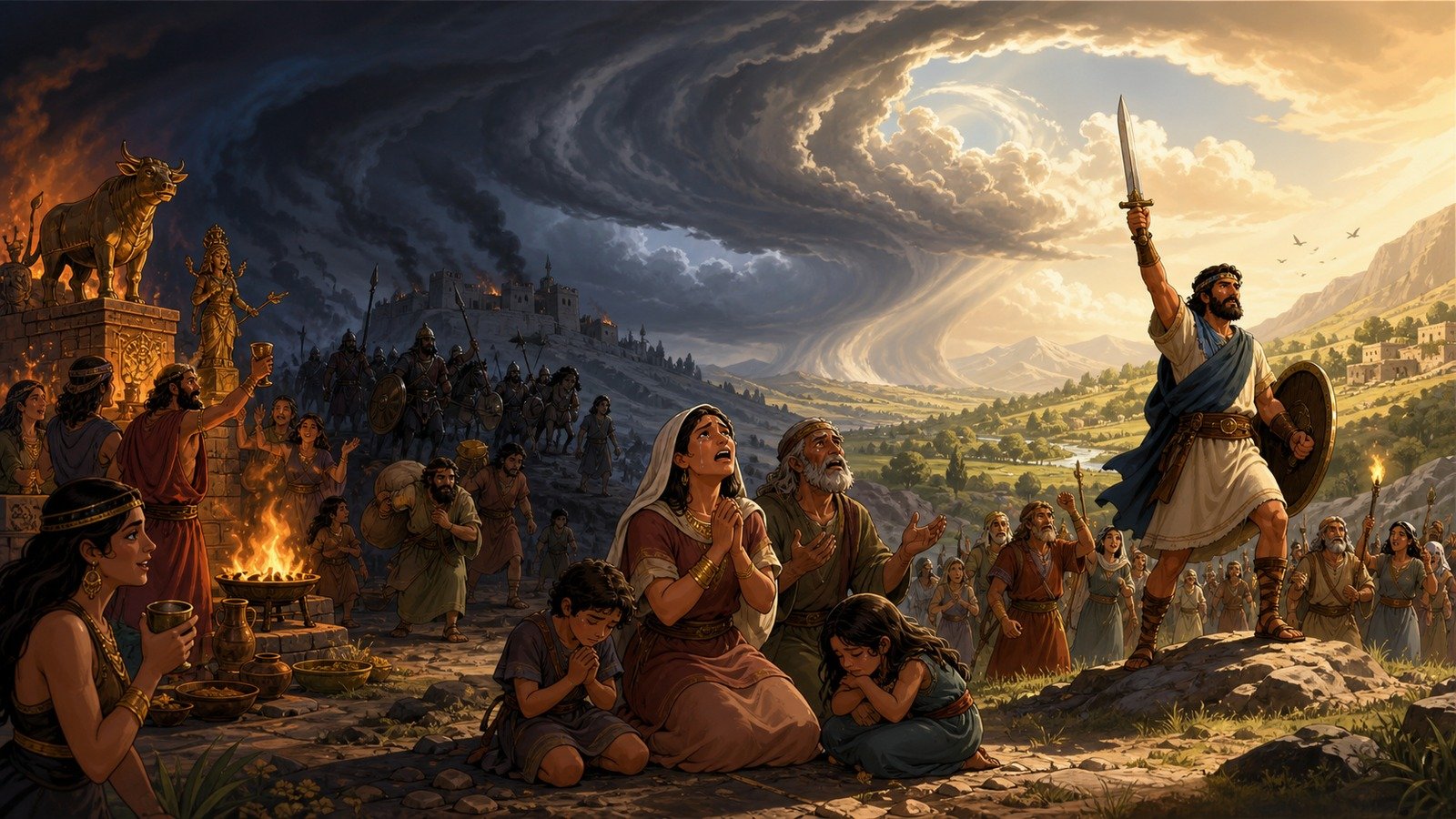
After Joshua's generation dies, Israel fails to complete the conquest and adopts Canaanite worship. Judges 2 sets out the recurring pattern that structures the rest of the book: apostasy, oppression by a foreign power, a cry for help, and a God-raised deliverer.
Further context
2 min readThe period after Joshua runs for roughly three centuries and it has a shape that repeats. The pattern is stated in full at the outset and then demonstrated a dozen times: the people abandon the LORD and serve other gods, they are handed over to raiders or a neighbouring power, they are oppressed and cry out, a deliverer is raised up, the land has peace for a generation, the deliverer dies, and they go back to worse behaviour than before.
The word usually translated judge is misleading in English. These are not magistrates presiding over courts. The Hebrew term covers governing and delivering as much as judging, and what these people mostly do is fight. They are local, temporary and unelected, they hold no office that passes to anyone, and several of them are deeply unattractive characters.
The cause is identified at the start and it is not primarily theological. The tribes did not drive out the populations of the towns on the plains, because those towns had iron chariots, and they settled among Canaanites instead of replacing them. Intermarriage follows, then participation in local worship, then the two are indistinguishable. The gods named are Baal and Asherah, and both are well attested outside the Bible: Baal is the storm and fertility god of the Canaanite and Phoenician world, known in detail from the tablets found at Ugarit in 1929, and Asherah is a mother goddess whose name turns up on inscriptions from Kuntillet Ajrud and Khirbet el-Qom, in one case in a formula that appears to pair her with the God of Israel.
That is what a farming population in that region did. Baal was who you appealed to for rain, and rain was the difference between eating and not eating.
Dating any of this precisely is impossible, and the two frameworks for the Exodus produce answers about two centuries apart. The individual terms of office also overlap. Several of these figures operate in different parts of the country at the same time rather than in a national succession, so adding their years produces a total far longer than the period can hold.
The deliverers themselves are a strange collection and the selection looks deliberate. A left-handed assassin. A woman holding court under a tree. The youngest son of an insignificant family, hiding in a winepress. The son of a prostitute running a band of outlaws. A man whose entire career is driven by personal grievance and who dies in an enemy temple. Not one of them is a king's son, a priest or a professional soldier, and several of them behave appallingly.
One sentence recurs four times and functions as the book's own diagnosis: in those days Israel had no king; everyone did as they saw fit. Whether that is an argument for monarchy or a lament about a nation that would not govern itself is left open, and the two books that follow are about a demand for a king and what came of it.