

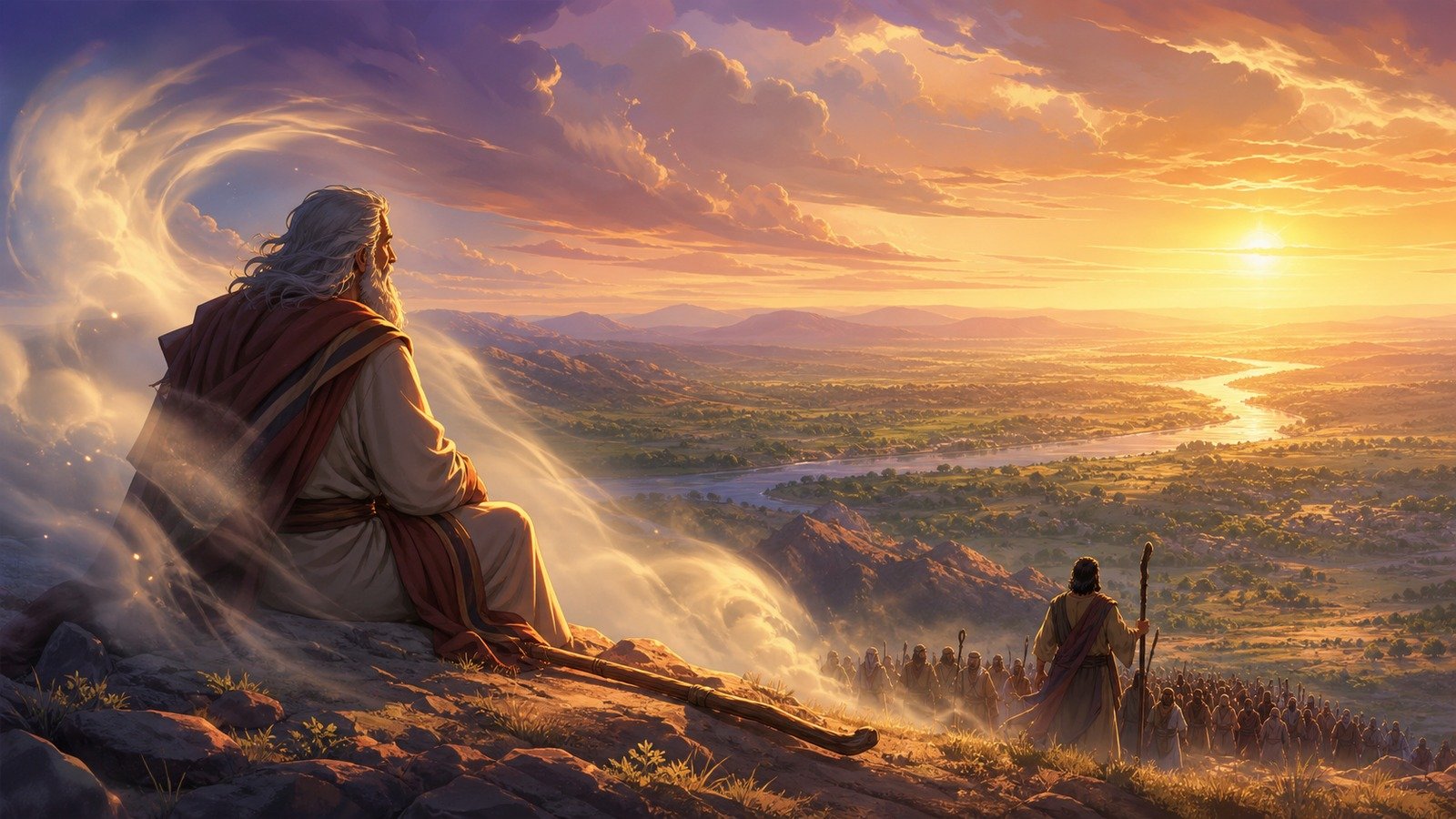
Moses views the promised land from Mount Nebo but is not permitted to enter it himself, and dies at 120. He is buried by God in an unknown location, and Scripture notes no prophet like him arose again in Israel.
Further context
2 min readMoses climbs Mount Nebo, in the Abarim range east of the Jordan opposite Jericho, and is shown the whole country from there: Gilead as far as Dan, Naphtali, Ephraim and Manasseh, all of Judah as far as the Mediterranean, the Negev and the Jordan valley down to Zoar. The view from that summit does in fact take in a very large part of it, though not all of what is listed.
Then: this is the land I promised on oath to Abraham, Isaac and Jacob when I said I will give it to your descendants. I have let you see it with your eyes, but you will not cross over into it.
He dies there at a hundred and twenty, and the sentence about his condition is worth having: his eyes were not weak nor his strength gone. He is not dying of old age. He is stopping because he was told to stop.
He is buried in a valley opposite Beth Peor, and nobody knows where the grave is. That is stated as a fact known to later generations rather than as a mystery, and it forecloses the obvious possibility. A tomb would have become a shrine, and the man whose entire career was spent opposing the worship of anything visible does not get one.
Israel mourns for thirty days.
The closing assessment is unusual because it is comparative and because it is written by somebody looking back across a long stretch of time. Since then no prophet has risen in Israel like Moses, whom the LORD knew face to face, who did all those signs and wonders, and who performed all the mighty acts and awesome deeds in the sight of all Israel. Whoever wrote that had a substantial history of Israelite prophecy behind them to compare him with.
A short and obscure New Testament letter refers to a dispute between the archangel Michael and the devil over his body, drawing on a Jewish tradition that survives only in fragments elsewhere, and which explains nothing about why the grave was hidden.
He appears once more. On a mountain in Galilee, roughly thirteen centuries later, Moses and Elijah are described as talking with Jesus, and Luke says the subject of the conversation was his departure, using the Greek word exodos. The man who was refused entry to the country is finally standing in it, in the north, discussing a second departure with the person whose own account he had spent his life preparing the ground for.
Mount Nebo has been identified since the fourth century AD with a ridge in Jordan about ten kilometres north-west of Madaba, where a Byzantine church and monastery were built and where mosaics survive. The view from it on a clear day reaches the Jordan valley, Jericho, the Judean hills and, in good conditions, as far as the western horizon.
What he leaves behind is a nation with a law, a priesthood, a portable sanctuary, a successor commissioned in public and a poem to sing when things go wrong. He arrived at the burning bush arguing that he was the wrong man and could not speak properly.