

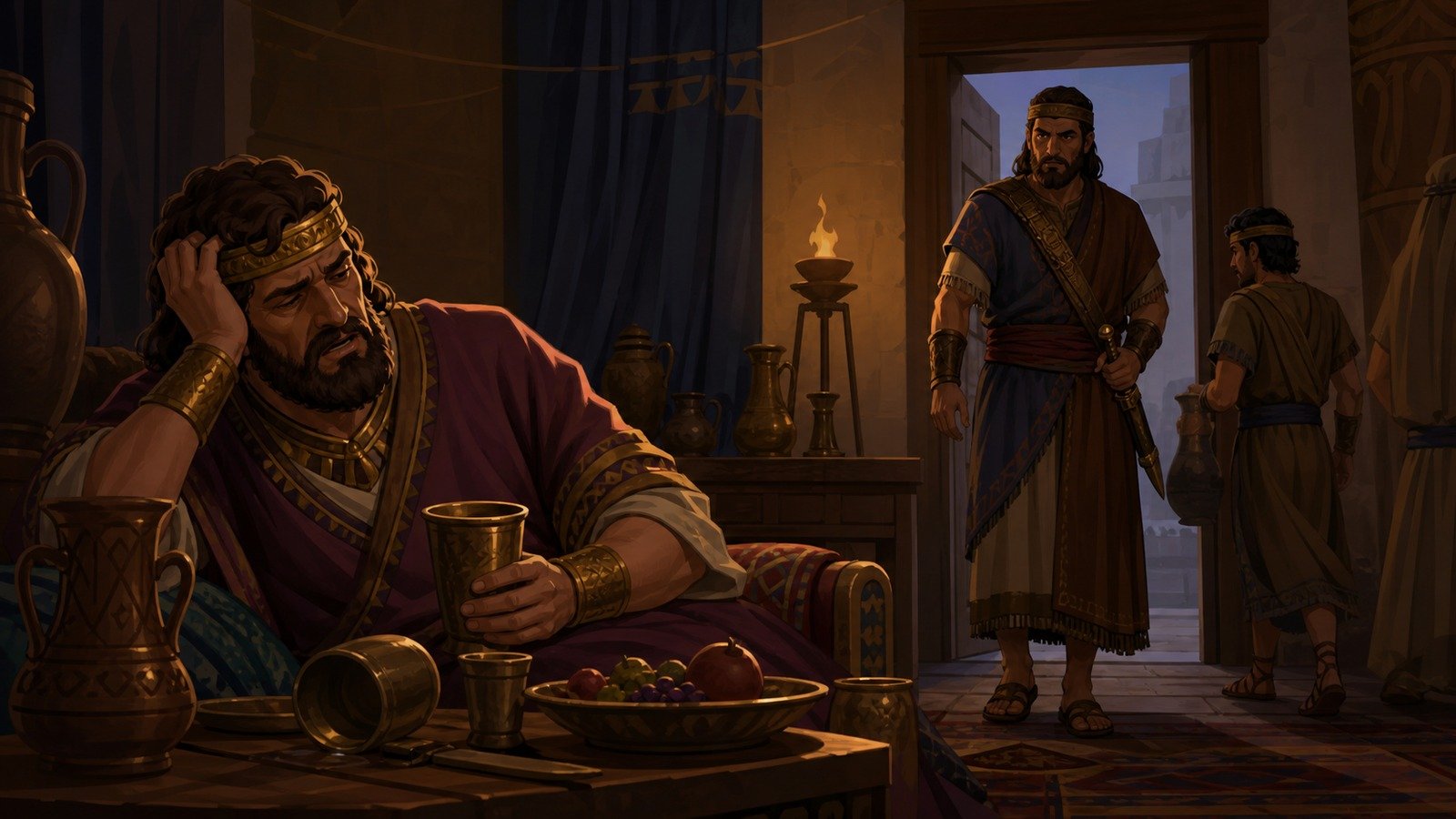
Baasha's son Elah is murdered by his own chariot commander Zimri while drunk at a friend's house, and Zimri wipes out Elah's entire household in turn.
Further context
3 min readBaasha's son reigns two years and dies drunk. The detail given is precise about where: he was in Tirzah, at the house of Arza, the palace administrator, getting drunk, while his army was in the field besieging Gibbethon. Zimri, who commanded half his chariots, came in and struck him down and became king in his place.
The contrast is the point of the sentence. The king is drinking at a subordinate's house in the capital while the fighting men are at a siege on the Philistine frontier, and the man who kills him is the officer responsible for half the kingdom's most expensive military asset. Chariot commanders in that world were aristocrats with resources and followings, and the northern throne is now within reach of anybody in that position.
Zimri then does what Baasha had done to Jeroboam's family. He kills the whole house of Baasha and does not spare a single male, whether relative or friend, and the judgement announced by the prophet Jehu son of Hanani is carried out in a few hours by a man acting entirely for himself.
Tirzah is worth a note because this is where the northern kings were living before Samaria. It sits in the hills north-east of Shechem, and it is generally identified with Tell el-Farah North, which has been excavated and shows a substantial town of this period with a gate complex and evidence of a building phase abandoned unfinished. It is also mentioned in the Song of Songs as a byword for beauty, paired with Jerusalem.
Two things about the northern kingdom become visible in this short episode.
The first is that its political culture has collapsed into pure force. Three dynastic massacres have now happened in about fifty years, each carried out by a soldier, and each described in the same formula about not sparing a single male. Nobody in the north can pass a throne to a son with any confidence.
The second is that the army is where the power sits. Zimri commands half the chariots. His successor commands the whole army. The man who removes him after that is another commander. For the next century, whoever controls the field force controls the succession, and the kings who last are the ones who were generals first.
The assessment given for Elah is the standard one, applied to a man who reigned two years and is recorded doing nothing except getting drunk: he did evil in the eyes of the LORD and caused Israel to sin. The formula is applied mechanically at this stage, which is itself a comment on how interchangeable these reigns had become.
Zimri commanded half the chariots, which made him one of the two or three most powerful officers in the kingdom, and he struck while the army and its commander were away at the siege.
Getting drunk at the house of the palace administrator places the king in a private residence without his guard, and the detail about whose house it was is the sort of thing that gets remembered by people who were there.
With Elah the second northern dynasty ends after two kings, exactly as the first had. The prophetic word against Baasha's house is quoted again as it is carried out, and the writer notes that all this happened because of the sins Baasha and his son had committed and had caused Israel to commit.