

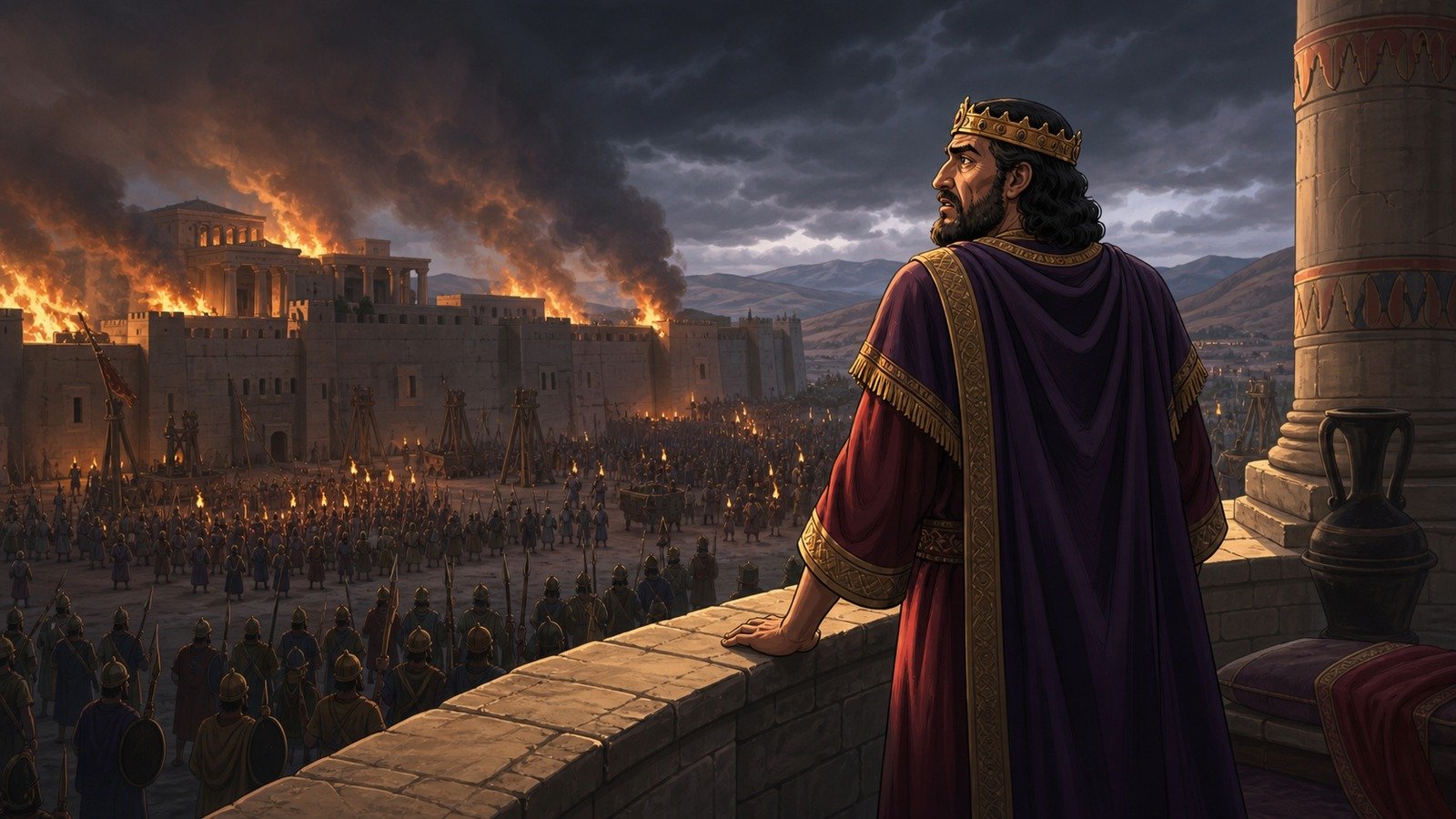
Zimri holds the throne for only seven days before Omri's army, hearing of the coup, marches on the capital; Zimri sets the palace on fire around himself rather than surrender, the shortest reign of any king in either kingdom.
Further context
3 min readSeven days is the shortest reign in the Bible and it ends with a man setting fire to his own palace with himself inside it.
The problem is that the army is at Gibbethon and had no part in the coup. When the news reaches the camp that Zimri has plotted against the king and murdered him, the troops proclaim their own commander, Omri, king over Israel that very day, in the camp. They abandon the siege and march on Tirzah.
The city is taken and Zimri goes into the citadel of the royal palace, sets it on fire around him and dies in it. Excavation at the site identified with Tirzah has found a destruction layer and an unfinished building phase from roughly this period, which fits a capital burned and then abandoned as the seat of government within a decade.
How he got into the palace at all is worth asking. He commanded half the chariots, which means he had troops and access, and the king was drinking at an official's house rather than in the citadel. What the sequence describes is a state where the head of government could be reached and killed by a subordinate in an afternoon, with the field army a week's march away.
The verdict pronounced over him is the standard formula and it is applied to a man who held power for a week: because of the sins he had committed, doing evil in the eyes of the LORD and following the ways of Jeroboam. Whatever he did in seven days, it evidently included maintaining the shrines.
His name outlives him in an unexpected way. Twenty years later, when Jehu drives into Jezreel to overthrow another dynasty, Jezebel greets him from a window with the words, have you come in peace, Zimri, you murderer of your master? It has become a byword for a soldier who kills a king and does not last.
What follows the seven days is a civil war inside the northern kingdom that takes several years to resolve. The people are divided into two factions, half supporting Tibni son of Ginath and half supporting Omri, and the summary of the outcome is brutally short: Omri's followers proved stronger, Tibni died, and Omri became king.
Two claimants, an unspecified period of fighting, and one sentence about the loser dying. Nothing is said about how.
So in the space of a few years the northern kingdom has run through a king killed while drunk, a chariot commander who lasted a week and burned himself alive, a disputed succession fought between two factions, and a general who wins. Fifty years after the split, the institution that the northern tribes broke away in order to control has become a prize taken by whoever has troops.
Seven days is the shortest reign recorded anywhere in the Bible and one of the shortest in ancient history.
What went wrong is stated plainly: when the army heard that Zimri had plotted against the king and murdered him, they proclaimed Omri, their commander, king over Israel that very day, in the camp. He raised the siege, marched on Tirzah and took it.
Burning the palace down over himself is the act of a man who knew what happened to failed usurpers, and it is recorded without comment.
Zimri's name became a byword. Decades later, when Jehu rides into Jezreel having killed a king, Jezebel greets him from a window with a single word: Zimri, murderer of your master.