

Fleeing Jezebel's death threat and despairing of his mission, Elijah travels forty days to Horeb, where God speaks not in wind, earthquake or fire but in a gentle whisper, recommissions him, and directs him to anoint Elisha as his eventual successor.
Further context
3 min readJezebel's message reaches Elijah the next morning and it is one sentence: may the gods deal with me, be it ever so severely, if by this time tomorrow I do not make your life like that of one of them.
He runs. A man who has just faced down four hundred and fifty prophets and a king in front of the whole nation is put to flight by a threatening note from a queen, and this is the point at which the story becomes about him rather than about the contest.
He goes a day's journey into the wilderness, sits down under a broom bush and asks to die: I have had enough, LORD. Take my life; I am no better than my ancestors. Then he falls asleep.
What happens next is the most humane sequence in the whole of these books. An angel touches him and tells him to eat, and there is bread baked over hot coals and a jar of water. He eats and drinks and lies down again. The angel comes back a second time, touches him again and says, get up and eat, for the journey is too much for you. No rebuke, no theology, no instruction. Sleep, food, sleep, food.
Strengthened by that, he travels forty days and forty nights to Horeb, which is Sinai, the mountain where the covenant was made, and spends the night in a cave.
Asked what he is doing there, he gives an answer that is largely accurate and slightly self-pitying: I have been very zealous for the LORD God Almighty. The Israelites have rejected your covenant, torn down your altars and put your prophets to death with the sword. I am the only one left, and now they are trying to kill me too.
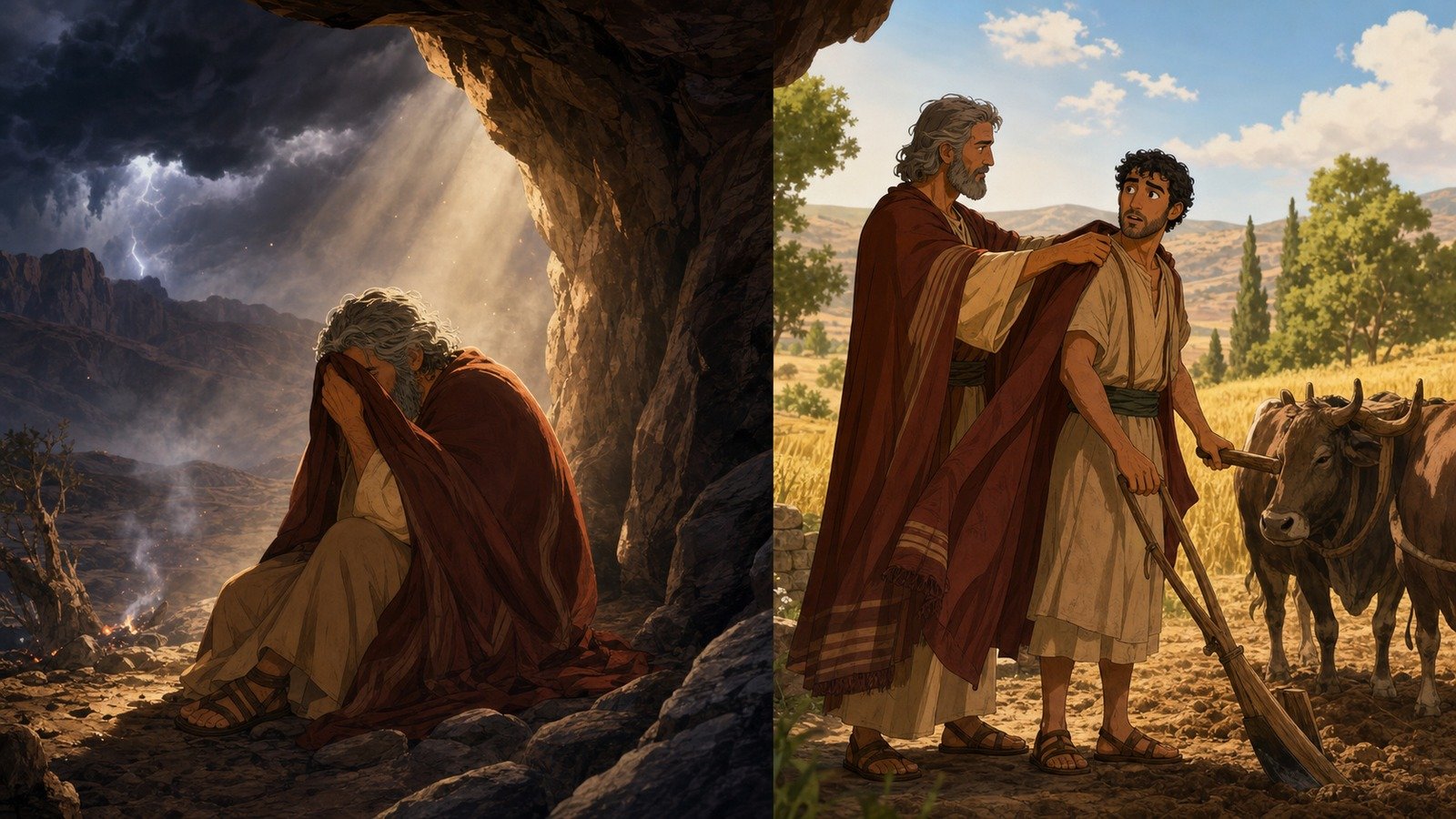
He is told to stand on the mountain, and a great and powerful wind tears the mountains apart and shatters the rocks, but the LORD is not in the wind. Then an earthquake, and then a fire, and he is not in either. Then a sound of sheer silence, which older translations render as a still small voice, and he pulls his cloak over his face and goes to the entrance.
The same question is asked again and he gives exactly the same answer, word for word. What he receives in reply is not an argument but three tasks and a correction: anoint Hazael king over Aram, anoint Jehu king over Israel, anoint Elisha to succeed you. And I reserve seven thousand in Israel whose knees have not bowed down to Baal.
He finds Elisha ploughing with twelve yoke of oxen and throws his cloak over him.
Horeb is the other name for Sinai, and Elijah walks forty days to reach it, which is the same figure given for Moses on the mountain and for Israel in the wilderness. He goes to the place where the covenant was made and spends the night in a cave.
The question he is asked twice, what are you doing here, is not answered either time. Both times he gives the same speech: I have been very zealous for the LORD God Almighty. The Israelites have rejected your covenant, torn down your altars and put your prophets to death with the sword. I am the only one left, and now they are trying to kill me too.
The wind, earthquake and fire pass and God is in none of them, which reverses the entire vocabulary of the mountain where he had appeared in exactly those forms.
Then a sound of sheer silence, and the man who had just faced down a nation pulls his cloak over his face.