

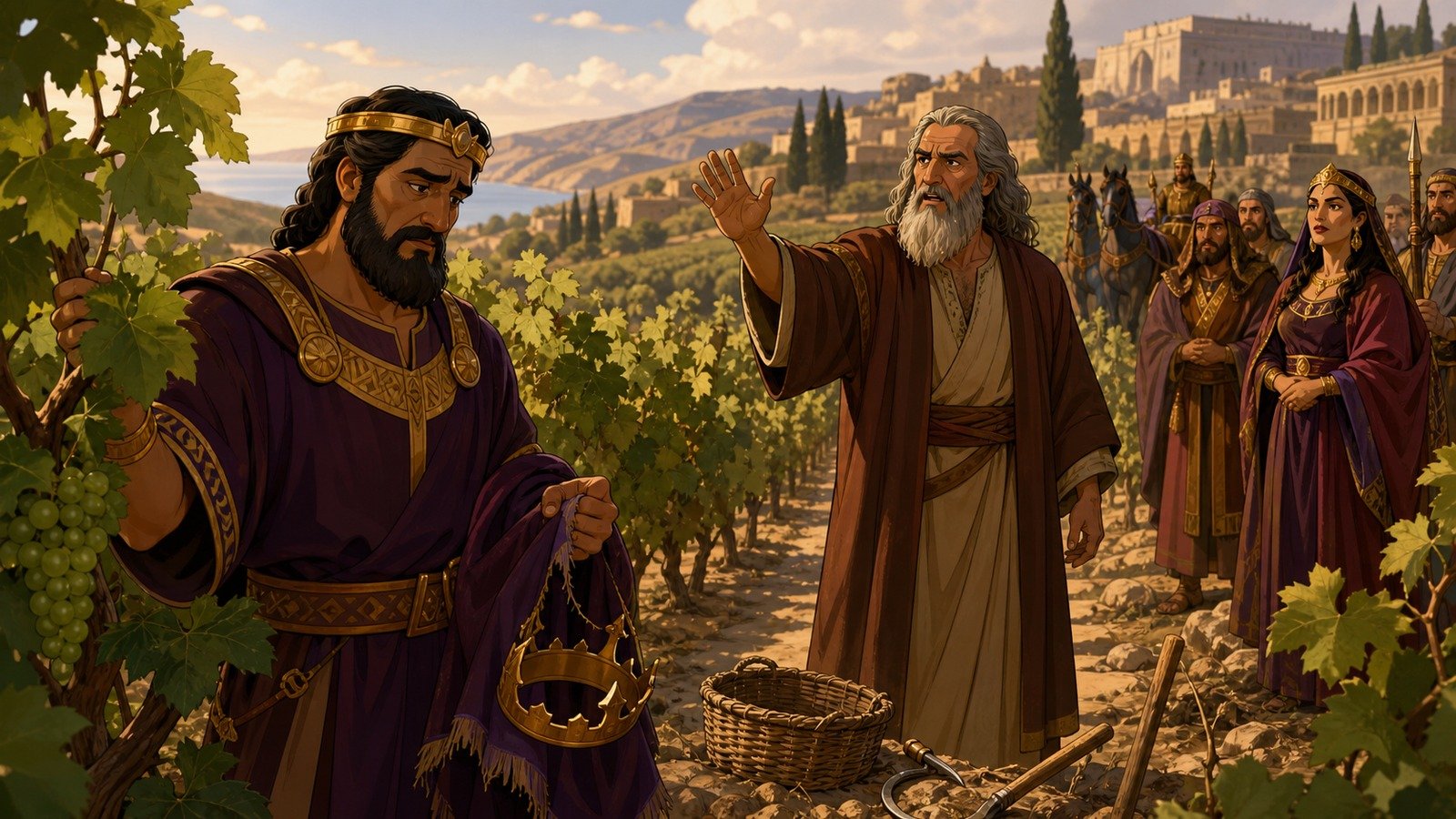
Jezebel arranges false charges to have Naboth executed so Ahab can seize his vineyard; Elijah confronts Ahab with God's judgement on his house, a sentence partially deferred because of Ahab's momentary repentance but ultimately fulfilled on his dynasty.
Further context
3 min readNaboth has a vineyard next to the palace at Jezreel, and the king wants it for a vegetable garden and offers either a better vineyard or the market price in silver. The offer is fair and the refusal is absolute: the LORD forbid that I should give you the inheritance of my ancestors.
That is not stubbornness. Land in Israel was not property in the modern sense but an inheritance held from God and allocated by tribe, and the law provided that it could not be sold permanently and was to return to the family at the jubilee. Naboth is refusing on legal and religious grounds and he is entirely within his rights, and the king knows it, which is why he goes home sullen and angry, lies on his bed sulking with his face to the wall and refuses to eat.
Jezebel's reaction is the whole clash of two systems in one sentence: is this how you act as king over Israel? Get up and eat! I will get you the vineyard. She is Phoenician royalty, where a king takes what he wants, and she cannot see why this is difficult.
Her method is judicial murder conducted with correct procedure. She writes letters in the king's name, seals them with his seal and sends them to the elders and nobles of Naboth's own town. Proclaim a day of fasting and seat Naboth in a prominent place among the people. Then seat two scoundrels opposite him and have them bring charges that he has cursed both God and the king. Then take him out and stone him to death.
Two witnesses were the legal minimum for a capital charge, and the accusation is the one offence for which the penalty was death and the property could be forfeited. Everything is done to the letter, by the town's own elders, on the king's seal.
The elders do it. Naboth is stoned, and his sons are killed too, which is mentioned later and explains why nobody inherits. Jezebel tells her husband to go and take possession, and he gets up and goes down.
Elijah meets him in the vineyard, and the greeting is four words: have you found me, my enemy? The answer is that he has sold himself to do evil, and the judgement is specific to the place: in the place where dogs licked up Naboth's blood, dogs will lick up your blood. Jezebel will be eaten by dogs by the wall of Jezreel.
Ahab tears his clothes, puts on sackcloth, fasts and goes about meekly, and the sentence is deferred to his son's reign because of it, which is one of the more surprising concessions anywhere in these books.
The refusal is not stubbornness. Naboth's answer, the LORD forbid that I should give you the inheritance of my ancestors, states a legal principle: land in Israel was held in trust by family and tribe and could not be permanently alienated, which is the whole basis of the jubilee provisions in the law.
Jezebel's reaction shows how differently a Phoenician royal household understood kingship. Is this how you act as king over Israel? Get up and eat! Cheer up. I will get you the vineyard.
The method is judicial murder conducted by correct procedure. Letters in the king's name with the king's seal, a proclaimed fast, Naboth seated in a prominent place, two scoundrels seated opposite to bring the charge of cursing God and the king, and a stoning outside the town. The law required two witnesses and it got them.
His sons are killed with him, mentioned only in passing later, so that no heir could reclaim the land.