

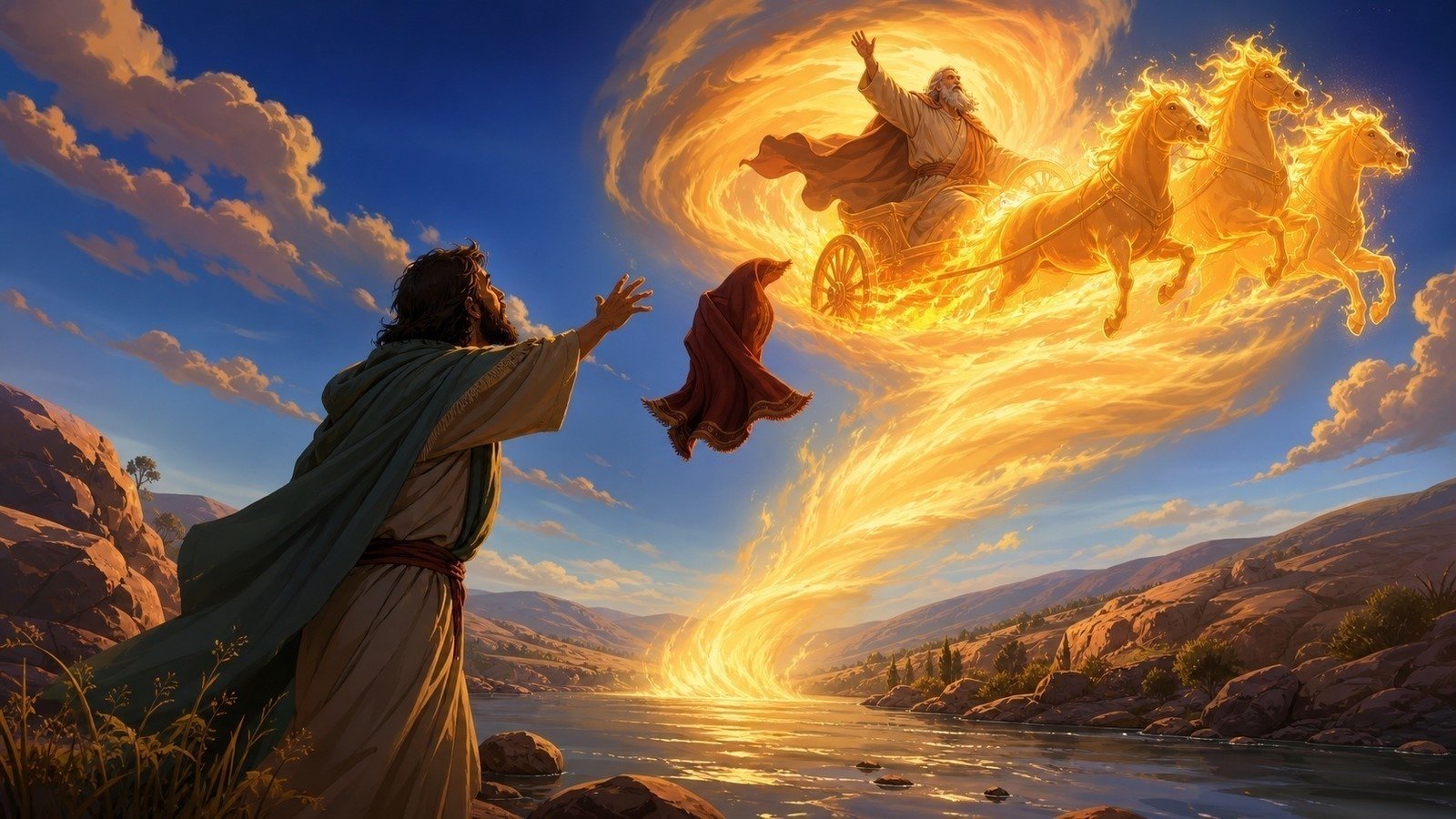
Elijah is taken up in a whirlwind by a chariot and horses of fire, witnessed by Elisha, who receives a double portion of his spirit and takes up his mantle to begin his own prophetic ministry, immediately demonstrated by parting the Jordan River.
Further context
3 min readThe last day is a walk, and everybody knows what is coming. Three times Elijah tells his successor to stay behind, at Gilgal, at Bethel and at Jericho, and three times the answer is the same: as surely as the LORD lives and as you live, I will not leave you. At each stop a company of prophets comes out and asks Elisha whether he knows that his master is going to be taken from him today, and each time he says yes, and tells them to be quiet about it.
At the Jordan, Elijah rolls up his cloak and strikes the water and it divides, and the two of them cross on dry ground, which is a deliberate echo of two earlier crossings.
The question he is asked on the far side is open-ended: tell me, what can I do for you before I am taken from you? The request is not for power. Let me inherit a double portion of your spirit. A double portion was the legal share of the firstborn son, so what is being asked for is not twice the ability but the status of an heir.
The answer is conditional and honest: you have asked a difficult thing, yet if you see me when I am taken from you, it will be yours.
As they walk on, a chariot of fire and horses of fire separate them, and Elijah goes up to heaven in a whirlwind. What Elisha shouts is the same phrase a king will later shout at his own deathbed: my father, my father, the chariots and horsemen of Israel. He tears his own clothes in two, picks up the cloak, goes back to the Jordan and strikes the water with it, asking where the LORD, the God of Elijah, is. The water divides.
Elijah is one of only two people in the Hebrew scriptures who leave without dying, and the expectation of his return becomes fixed in later tradition. Malachi, closing the Old Testament, announces that God will send the prophet Elijah before that great and dreadful day, and the Gospels apply that to John the Baptist, who wore a garment of camel's hair and a leather belt, which is exactly how Elijah was described.
He also appears once more in person, standing on a mountain in Galilee with Moses, talking to Jesus.
The two episodes that immediately follow Elisha's succession are as different from each other as anything in these books: he purifies a poisoned spring at Jericho with a bowl of salt, and then a crowd of youths jeer at him on the road to Bethel and two bears maul forty-two of them.
The journey the two men make on the last day traces the story of Israel backwards: Gilgal, where the nation first camped in the land, then Bethel, then Jericho, then across the Jordan on dry ground.
Elisha's request for a double portion of his spirit is not a request for twice as much. It is the language of inheritance, since the firstborn received a double share of the estate, and what he is asking for is to be treated as the heir.
The chariot of fire and horses of fire separate them and Elijah goes up in a whirlwind, and Elisha's cry is the one repeated over his own deathbed decades later: my father! My father! The chariots and horsemen of Israel!
Elijah does not die, which is said of only one other person in the Bible, and it is why he appears alive on a mountain with Moses eight centuries later.