

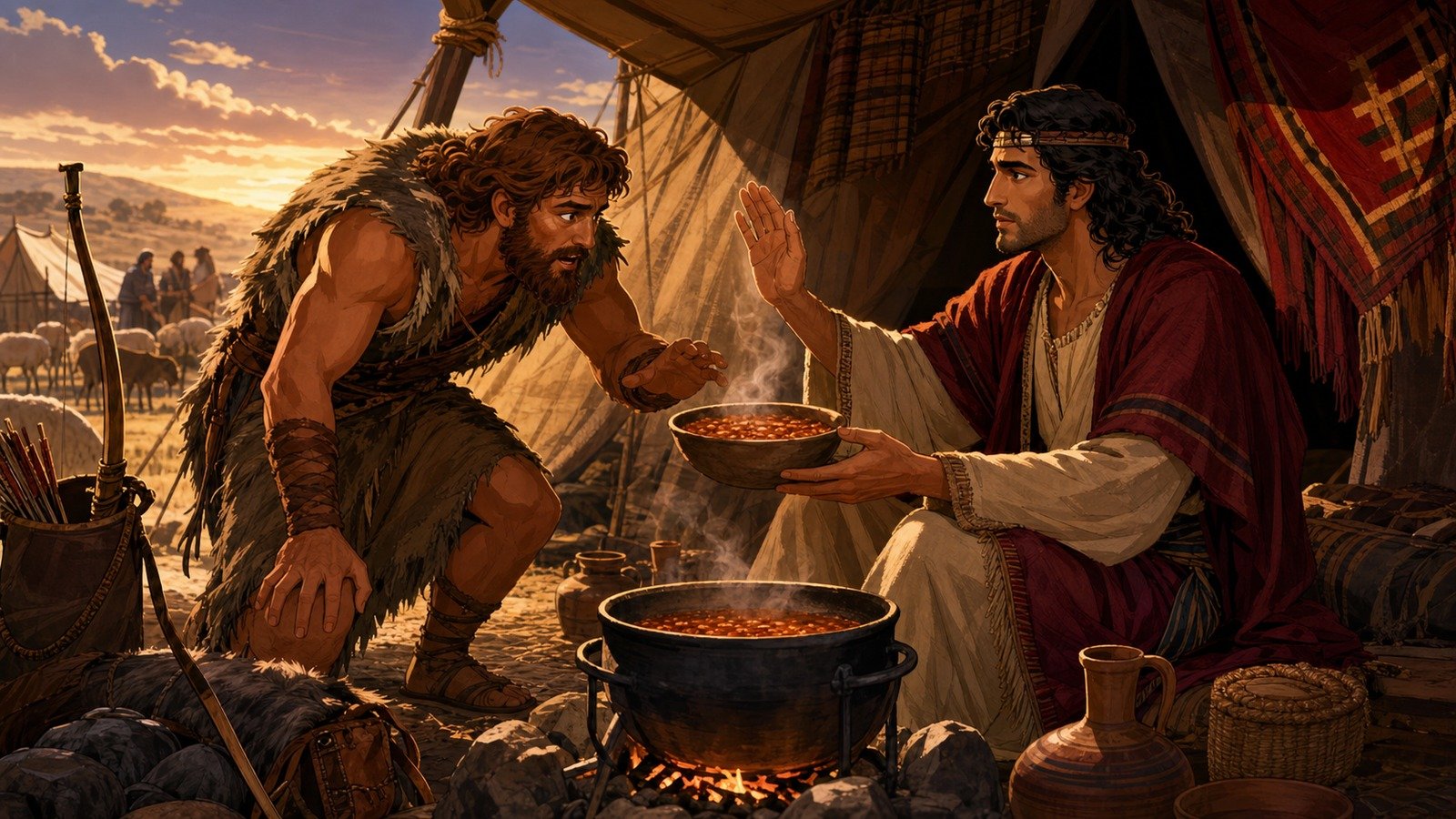
Returning exhausted from the field, Esau trades his birthright, the double inheritance and family leadership due the firstborn, for a bowl of Jacob's stew, an act Scripture treats as evidence of his contempt for his inheritance.
Further context
3 min readThe two brothers are set against each other in a single sentence. Esau becomes a skilful hunter, a man of the open country. Jacob is called tam, a word meaning quiet, whole or blameless, and stays among the tents. Then the family situation is stated without comment: Isaac loved Esau because he had a taste for wild game, and Rebekah loved Jacob. Each parent has a favourite, and the reason given for one of them is a preference in food.
The episode itself is short. Jacob is cooking stew when Esau comes in from the open country famished. His demand is blunt and, in Hebrew, almost inarticulate: let me gulp down some of that red, red stuff. That is why he was also called Edom, meaning red, so a nation takes its name from a moment of appetite.
Jacob's response is immediate: first sell me your birthright.
The birthright is a specific legal entitlement rather than a sentiment. At its core it is a double share of the inheritance, and in a patriarchal household it carried with it the headship of the family after the father's death. In this family it also carried the promise made to Abraham, which is what raises it above a property question.
Esau's reply is the line everything turns on: I am about to die, so what good is the birthright to me? He is hungry rather than dying, and the exaggeration is the point. Jacob makes him swear an oath, which converts a rash statement into a binding one, then gives him bread and lentil stew. Esau eats, drinks, gets up and leaves.
Five verbs in a row with no reflection between them close the scene, and then a verdict is delivered directly, which happens rarely: so Esau despised his birthright.
Neither brother comes out of it well. Esau treats something of permanent value as worth less than a meal. Jacob exploits his brother's hunger and locks the exchange in under oath, which is how he operates for the next twenty years and what he will eventually have to unlearn.
The birthright and the blessing are two different things, and merging them makes the following chapters incoherent. The birthright is property and legal standing, transferable between parties, and it changes hands here by agreement. The blessing is a spoken act performed by the father, conferring prosperity and authority, and it is obtained later by deception. Esau surrenders the first and is robbed of the second, and his complaint afterwards names both separately: he took my birthright, and now he has taken my blessing.
A New Testament letter uses him as a warning about treating sacred things cheaply, describing a man who sold his inheritance rights for a single meal, and adding that afterwards he could not undo what he had done, though he sought the blessing with tears. That detail refers to the later scene, not to this one.
What makes the sale legally effective is the oath rather than the stew. Contracts across the ancient Near East were enforceable because they were sworn, and an oath invoking a god was not a formality but the mechanism that made the transfer stick. Esau could have refused to swear and eaten anyway; his brother would have had no hold on him. Jacob's instinct throughout his early life is to convert an advantage of the moment into something permanent and binding, and this is the first time it is on display.
How old they were is unknown. They are old enough for one to be hunting alone and the other to be running a kitchen, and their father is still alive and fit, which places the episode somewhere in their young adulthood and no closer than that.