

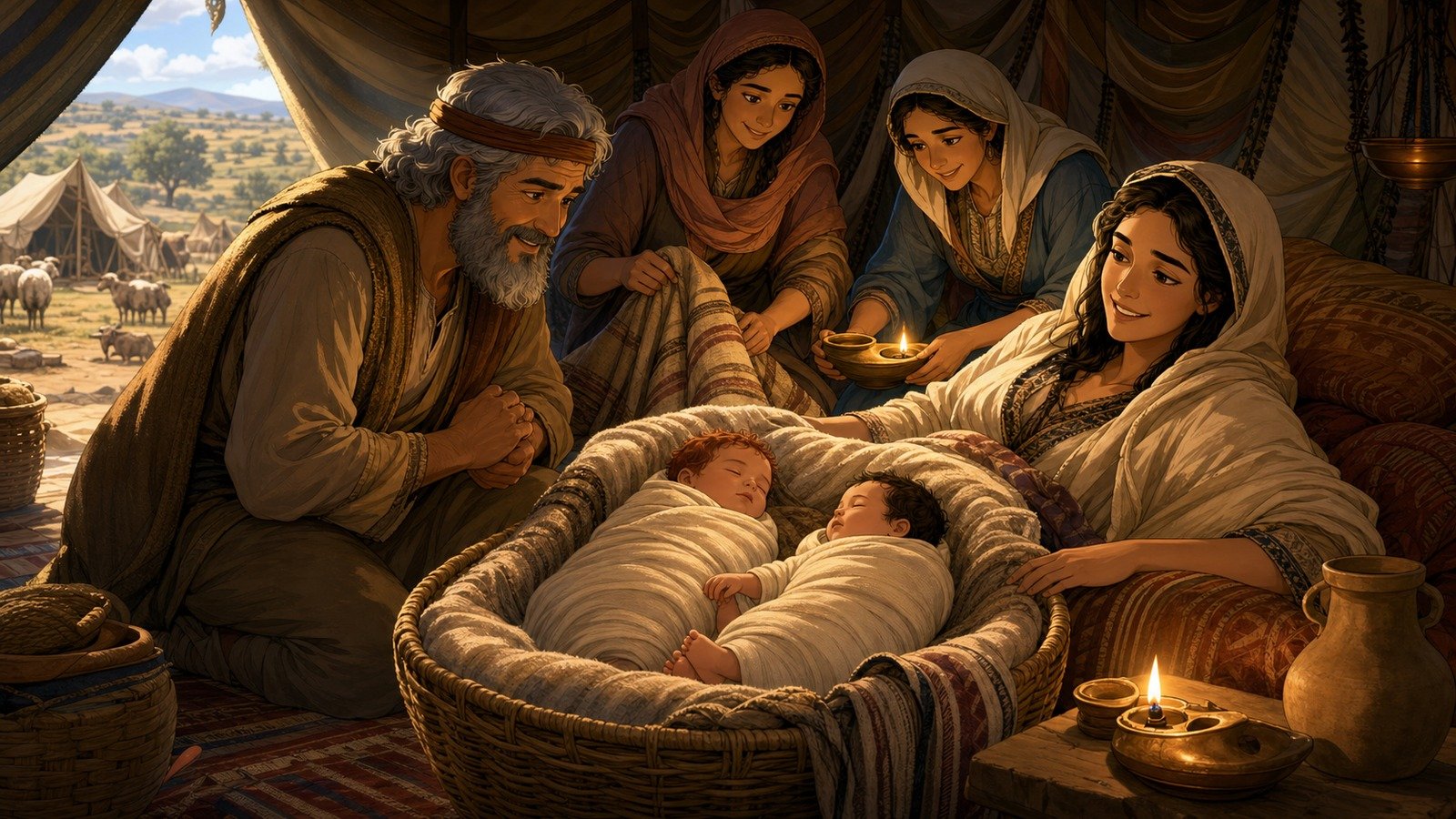
After twenty years of Rebekah's barrenness, twins are born to Isaac: Esau first, then Jacob grasping his heel. God tells Rebekah beforehand that the older will serve the younger, a reversal that shapes the rest of the family's story.
Further context
3 min readTwenty years pass between Isaac's marriage and the birth of his children. Rebekah was unable to conceive and Isaac prayed for her, and this is the second of three times the same pattern appears: the woman through whom the promise runs cannot have a child, and the child arrives only after a delay long enough to make the outcome look impossible. Sarah waited until ninety. Rebekah waits two decades. Rachel will wait while her sister bears six sons.
The pregnancy is difficult. The children jostle each other inside her, and she asks a question that is recorded without softening: if it is going to be like this, why go on living? She then goes to enquire of the LORD, and the answer comes in verse.
Two nations are in your womb, and two peoples from within you will be separated. One people will be stronger than the other, and the older will serve the younger.
That last line inverts the ordinary rule of inheritance and sets the agenda for everything that follows. It is also given before either child is born and before either has done anything, which is the feature later writers seize on.
The birth is described with attention to two details that become names. The first is red and covered with hair and is called Esau. The Hebrew for red (admoni) and for hair (se'ar) point forward to Edom, the nation descended from him, and to Seir, the mountainous territory it occupied south-east of the Dead Sea. The second comes out gripping his brother's heel (aqev) and is called Jacob (Ya'aqov), a name that can be read as one who grasps the heel, with the figurative sense of one who supplants or deceives. His brother uses that sense of it bitterly a few years later.
Both physical descriptions have consequences. Esau's hairiness is what makes the later deception possible, and his colouring supplies the wordplay when he sells his birthright.
Paul builds an argument on the timing of the oracle, observing that before the twins were born or had done anything good or bad the choice had already been stated, and quoting a line from Malachi about loving Jacob and hating Esau. Two things should be said about that quotation. Malachi is speaking of the nations Israel and Edom, centuries after both men were dead. And loving and hating in Hebrew idiom frequently express preference and rejection in a covenant setting rather than emotion. How far the argument carries has been debated among Christians for a very long time and is not settled by reading the birth story on its own.
Isaac is sixty. He will live another hundred and twenty years, longer than either his father or his son, and almost nothing is recorded of them.
The two nations named in the oracle are not a literary flourish. Edom occupied the rugged country south-east of the Dead Sea, controlling the copper deposits of the Aravah and a stretch of the caravan route running north from Arabia, and it existed as a recognisable kingdom into the Assyrian and Babylonian periods. Relations between the two peoples were bad for most of a millennium. Edom refused Israel passage during the wilderness years, was subdued by David, broke away under Jehoram, and was accused of standing by and profiting when Jerusalem fell to the Babylonians, which is the charge the short book of Obadiah is entirely devoted to.
All of that is compressed into a sentence spoken to a woman in pain, before either child was born. Whether it was heard as a prediction or as a decision is never addressed, and the difference between those two readings is what the argument has always been about.