

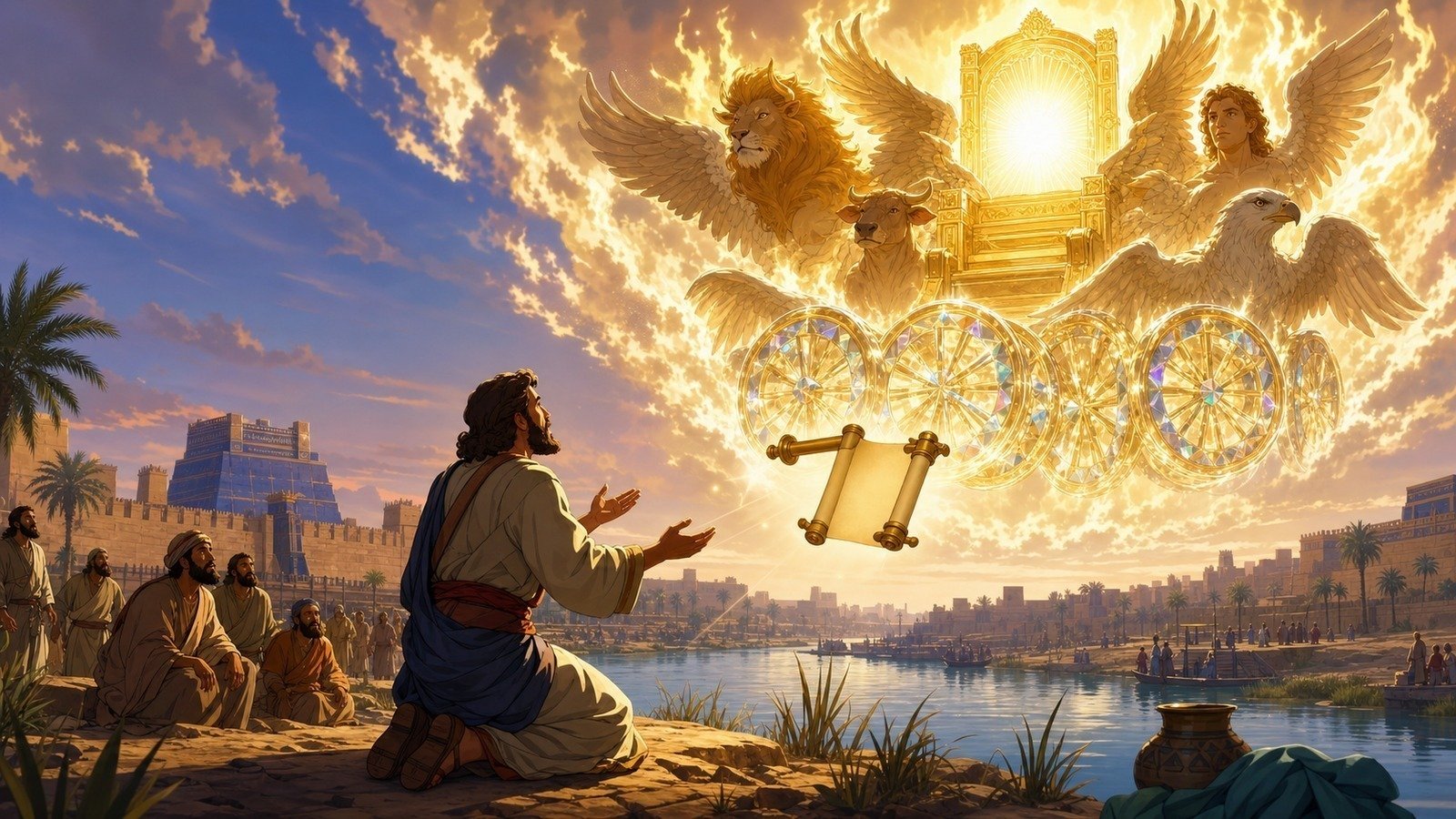
Among the Judean exiles already deported in 597 BC, the priest Ezekiel sees an overwhelming vision of God's throne-chariot by the river Kebar in Babylonia and is commissioned as a prophet to his fellow exiles, told to eat a scroll of lament as a sign of his message.
Further context
3 min readEzekiel dates his call himself, and the dating system he uses is its own statement: the fifth year of the exile of King Jehoiachin, which is 593 BC. He is counting from a deportation rather than from a reign, because as far as he is concerned the man in Babylon is still the king.
He is a priest, deported in the first wave at around twenty-five, and he is thirty when the visions begin, which is the age at which a priest entered service. He is beside the Kebar canal, an irrigation channel in southern Mesopotamia, in a settlement of deportees called Tel Abib. A priest reaches the year he should have started work in the temple and is a thousand kilometres away in a refugee camp on a ditch.
What he sees is the most elaborate vision in the Hebrew scriptures and it resists summary. A windstorm from the north, an immense cloud with flashing lightning, and in it four living creatures, each with four faces and four wings, moving like flashes of lightning and never turning as they went. Beside each, a wheel intersecting a wheel, their rims high and awesome and full of eyes all around. Above them a vault sparkling like ice, and above that a throne of lapis lazuli, and on it a figure like a man, glowing like metal, full of fire, with brilliant light surrounding him.
The vocabulary keeps stepping back from itself: the appearance of the likeness of the glory of the LORD. He is describing something he does not think can be described, and saying so grammatically.
Two features of it matter for what follows. It is mobile, which is the point: the presence associated with a building in Jerusalem is on wheels in Babylonia. And it arrives from the north, the direction the Babylonian army had come from.
He falls face down and is told to stand up, and the Spirit sets him on his feet. He is given a scroll with words of lament and mourning and woe written on both sides, told to eat it, and it tastes as sweet as honey.
The commission is bleak. He is sent to a people who are obstinate and stubborn, and told they will not listen because they are not willing to listen to God. He is made a watchman, with the responsibility spelled out in legal terms: if he warns and nobody listens, he is clear; if he fails to warn, the blood is on his hands.
Tel Abib and the Kebar canal have both been located in general terms. The canal is the Kabaru, a major irrigation channel near Nippur in southern Mesopotamia, and cuneiform tablets from the region record Judaean deportees living in settlements with Hebrew names, holding land, paying taxes and doing business. A place called Al-Yahudu, the city of Judah, appears repeatedly in that archive. The exile was not a prison camp; it was resettlement in agricultural districts, which is what makes the despair of the people he addresses a matter of identity rather than of conditions.
He sits among the exiles at Tel Abib for seven days, overwhelmed.
The vision that opens his book is the most elaborate in the Hebrew Bible and the hardest to picture. Four living creatures, each with four faces and four wings, moving without turning; beside them wheels intersecting wheels, their rims full of eyes; above them an expanse like a vault, and above that a throne of lapis lazuli with a figure on it like glowing metal and fire.
It is a description of a mobile throne, and that is the point of it. Ezekiel is in Babylon, six hundred miles from the temple, among people who assumed God was tied to a building in Jerusalem, and the first thing he sees is that throne arriving where he is.
He is told to eat a scroll, which tastes as sweet as honey, and then told his audience will not listen. He is also told he is a watchman, responsible for sounding the warning whether or not anyone acts on it.