

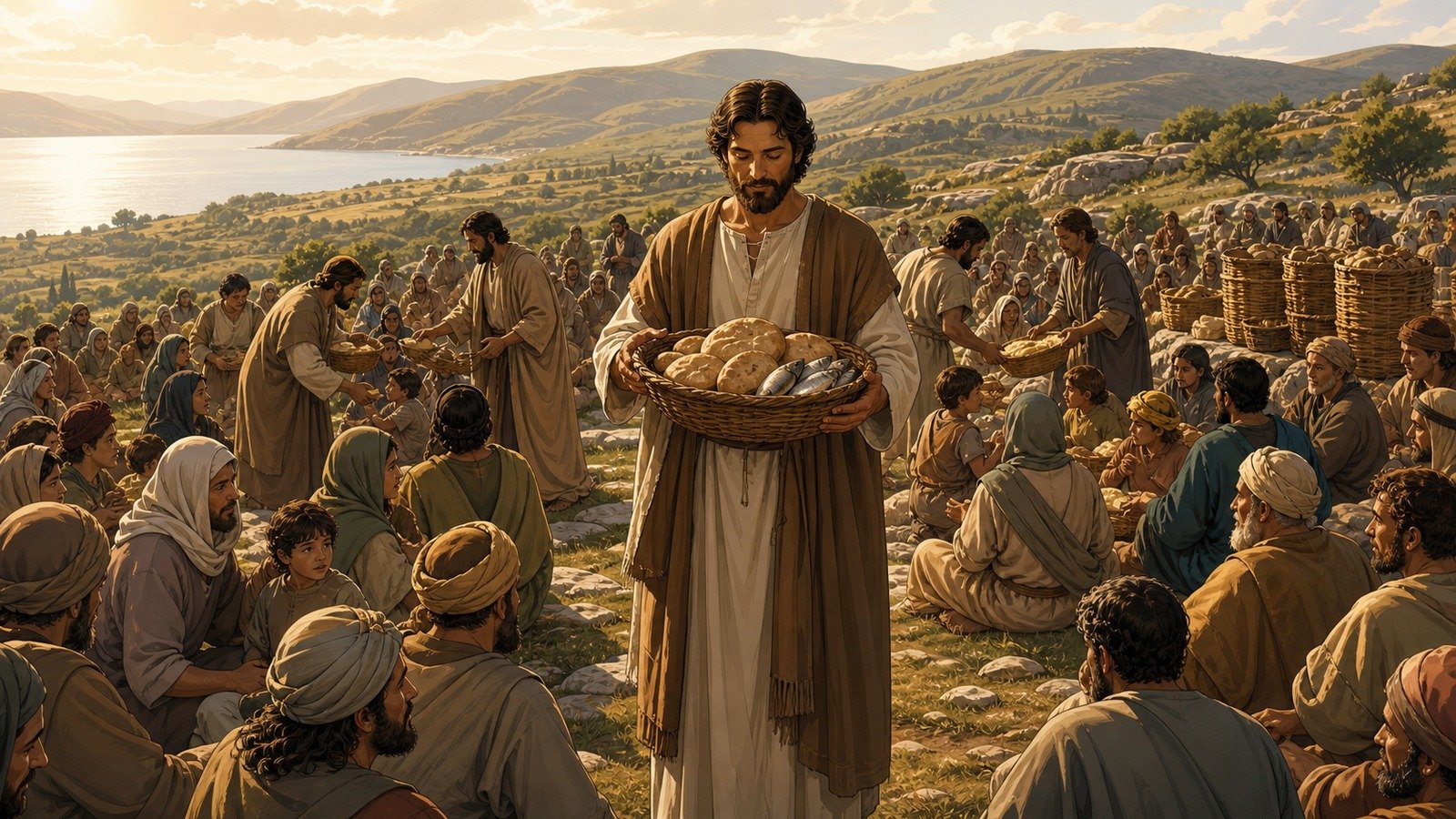
In a second mass feeding distinct from the earlier one, Jesus multiplies seven loaves and a few fish to feed four thousand people, with seven basketfuls left over.
Further context
2 min readA second mass feeding, and readers have asked since antiquity whether it is really the first one told twice. Both are preserved side by side and kept deliberately distinct, since a later conversation in the boat refers back to each event with its own numbers attached and asks the disciples to notice the difference between them.
The circumstances differ. This crowd is in Gentile territory east of the lake, and it has been with Jesus three days. The concern raised is not that the day is late but that people have nothing to eat and some have come a long distance, and if he sends them home hungry they will collapse on the way.
The disciples' question is the one that makes modern readers wince: where in this remote place can anyone get enough bread to feed them? They had watched five loaves feed five thousand not long before.
Whether that is stupidity or something more ordinary is worth a moment. The first feeding was in Jewish territory among Jewish crowds. This one is among Gentiles, and the assumption that whatever he had done for Israel would extend to these people was not obvious to a first-century Galilean.
Seven loaves this time, and a few small fish. The crowd sits on the ground, he gives thanks, breaks the loaves and hands them to the disciples, who distribute them. About four thousand men are present.
The leftovers fill seven basketfuls. The word used for basket here is different from the word in the earlier account: the first used a small wicker container of the sort a Jewish traveller carried, and this one is a large hamper, the same kind Paul was later lowered over a city wall in. Both writers keep the vocabulary distinct in every reference to each event, which is a small sign that they were not confusing the two.
Numbers have attracted symbolic readings for centuries. Twelve baskets for twelve tribes, seven for the seven nations of Canaan or the seven deacons or simply completeness. Some of that may be intended and none of it is stated.
Afterwards he gets into the boat with his disciples and goes to the region of Dalmanutha, a place mentioned nowhere else in ancient literature and never identified with any confidence. Matthew calls the same destination Magadan, which is not much better attested. Excavations at Migdal on the western shore have uncovered a first-century town with a synagogue and a harbour, and it is the leading candidate.
The three days without food is the detail that separates this crowd from the earlier one. People had stayed with him for that long in open country away from any town, which implies they had come from a distance and had run out of whatever they carried.
Whether the two feedings were remembered as one event and told twice is a question about how the material reached its written form, and it has been argued in both directions for well over a century. What can be observed is that the two are treated as distinct by the people closest to the material, that the vocabulary differs consistently, and that a later conversation depends on both having happened.