

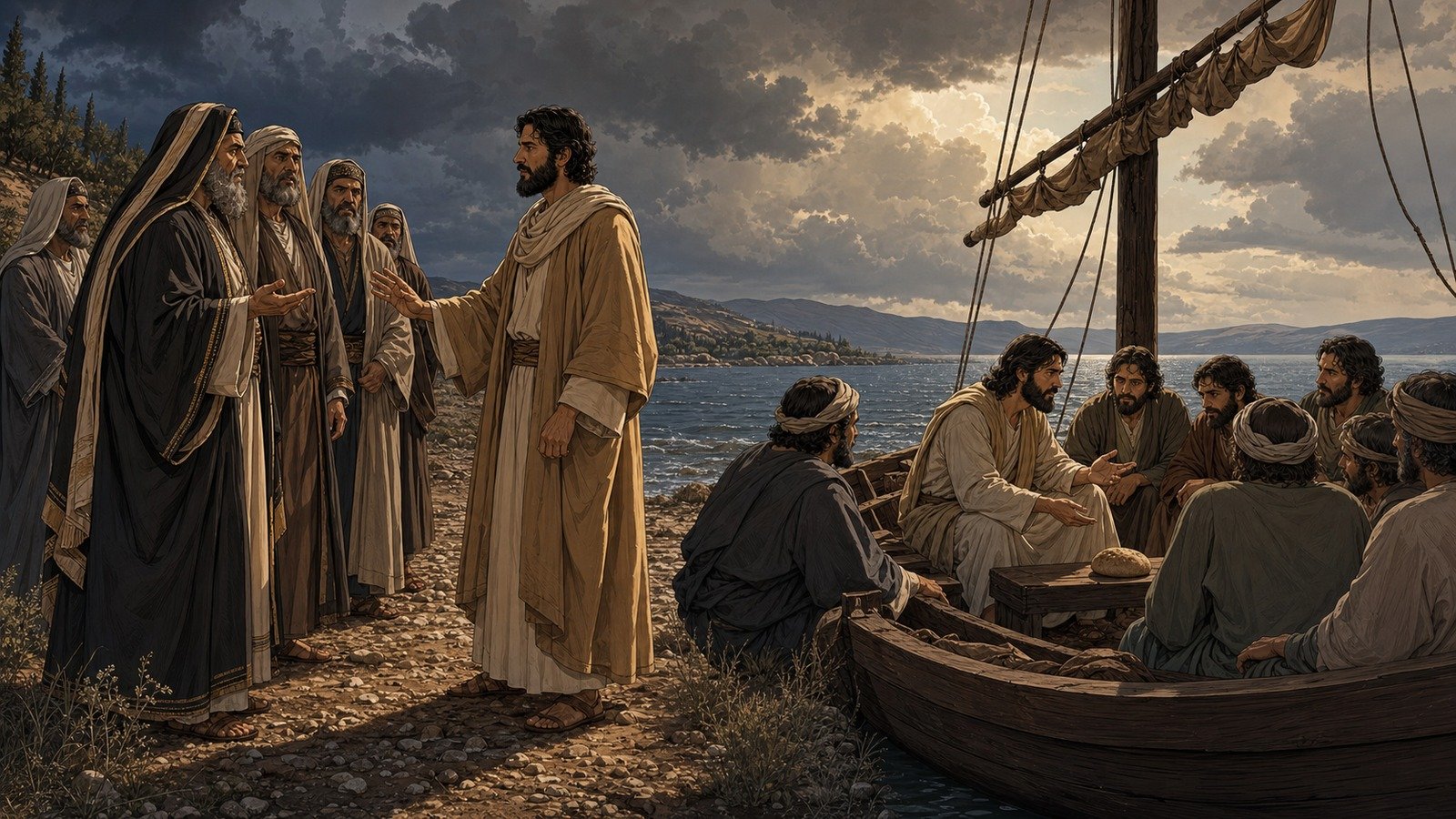
Pharisees and Sadducees ask Jesus for a miraculous sign to test him; he refuses beyond "the sign of Jonah" and warns his disciples privately against the corrupting influence, the "yeast," of both religious hypocrisy and political compromise.
Further context
2 min readPharisees and Sadducees come to test Jesus and ask for a sign from heaven.
That the two groups came together is itself unusual, since they disagreed about almost everything. The Sadducees were the priestly aristocracy, wealthy, in working relations with Rome, accepting only the five books of Moses as binding and denying the resurrection, angels and spirits. The Pharisees were a lay movement with popular support, committed to the oral tradition alongside the written law, and firm on a coming resurrection. What they shared at this moment was a problem.
A sign from heaven means something beyond healings and exorcisms, which could be attributed to other causes. Fire falling, the sun standing still, manna, something in the sky that could not be argued with.
His reply begins with weather. When evening comes you say it will be fair weather, for the sky is red, and in the morning, today it will be stormy, for the sky is red and overcast. You know how to interpret the appearance of the sky, but you cannot interpret the signs of the times.
Then a sentence with real anger in it. He sighed deeply in his spirit and said, why does this generation ask for a sign? Truly I tell you, no sign will be given to it. Matthew adds the qualification: none except the sign of the prophet Jonah.
Jonah is an odd choice. He spent three days and three nights inside a great fish, which is one obvious application, and the connection is drawn out explicitly elsewhere. But Jonah also preached to a pagan city that repented at once, without a single miracle performed, which makes the comparison sharper still for men demanding fireworks.
He leaves them and gets into the boat, and the disciples discover they have forgotten to bring bread, with only one loaf between them.
Into that he says: be careful, watch out for the yeast of the Pharisees and that of Herod. Yeast in Jewish usage was a standard image for corruption spreading invisibly, which is why it was removed from the house before Passover. A very small quantity works through a whole batch of dough without being seen.
The disciples conclude he is annoyed about the bread. The rebuke that follows is the sharpest he gives them: do you still not see or understand? Are your hearts hardened? Do you have eyes but fail to see, and ears but fail to hear? Then the arithmetic, five loaves and twelve baskets, seven loaves and seven baskets, and the question, do you still not understand?
Hardened hearts is the language used earlier of his opponents, and here it is turned on his own men.
Both parties would be gone within four decades. The Sadducees depended entirely on the temple for their position and their income, and when it burned in AD 70 they disappeared from history within a generation. The Pharisees, whose religion was portable because it lived in the law and the household, survived and became the foundation of everything that followed in Judaism.
That outcome is not commentary on the argument in the boat. It is simply what happened to the two groups who came together that day to ask for something in the sky.