

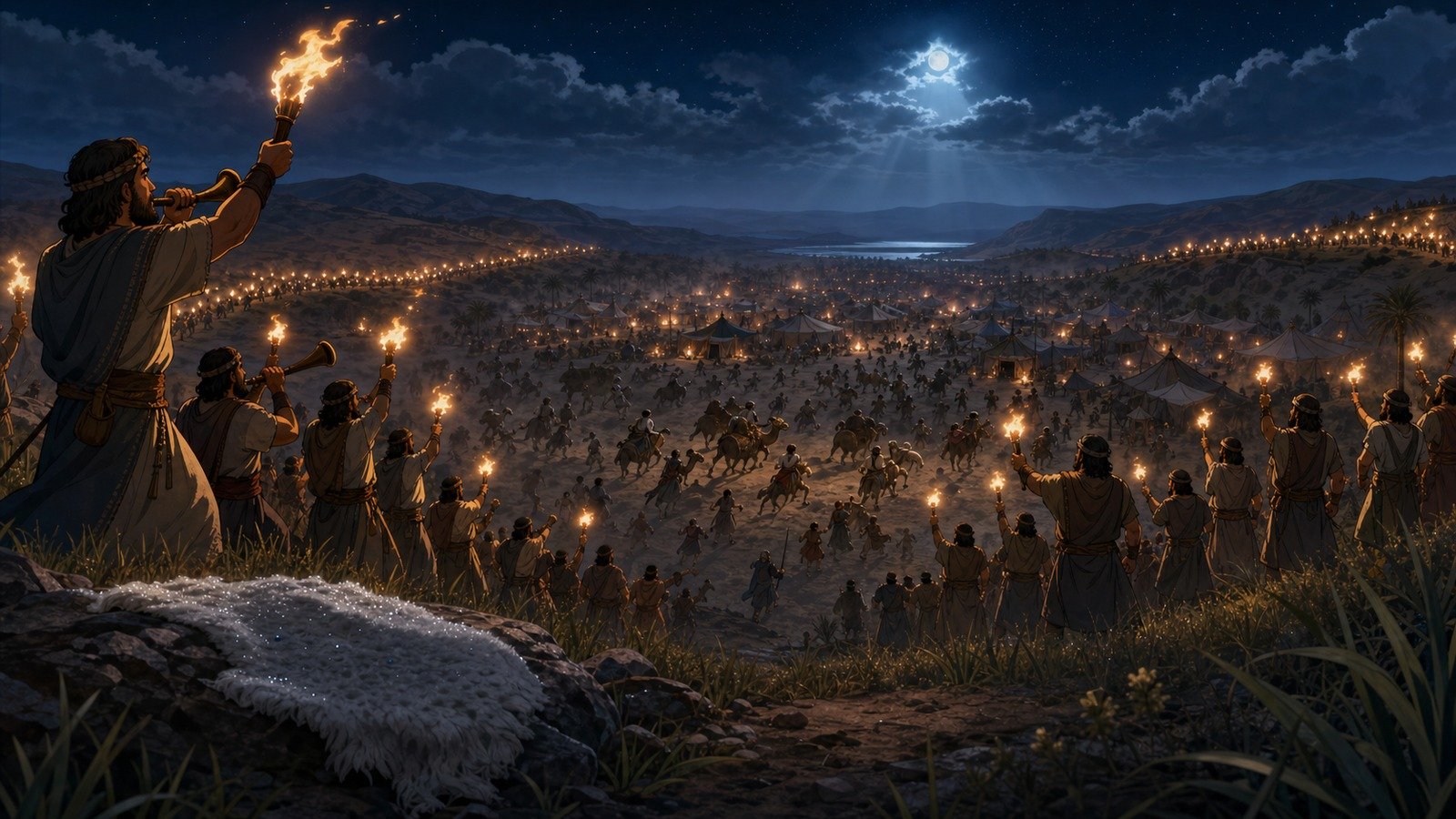
Called while threshing wheat in hiding from Midianite raiders, Gideon tests God with the fleece, then defeats a vastly larger Midianite army with just 300 men armed with trumpets and torches, so that Israel could not credit the victory to its own strength.
Further context
3 min readThe Midianites and their allies come up at harvest time every year with their livestock and their camels, described as thick as locusts, and strip the crops. It has gone on for seven years, and the Israelites are living in caves and mountain clefts. This is the first period in the region where camel-mounted raiders appear as a systematic problem, and the mobility is what makes them impossible to fight conventionally.
Gideon is introduced threshing wheat in a winepress to hide it from them, which is a poor way to thresh grain and a good way to avoid being seen, and he is greeted as a mighty warrior. His reply is a complaint: if the LORD is with us, why has all this happened to us? Where are all his wonders that our ancestors told us about?
He asks for signs repeatedly and gets them. He asks for a sign that the messenger is genuine and food is consumed by fire from a rock. He puts out a wool fleece on a threshing floor and asks for dew on the fleece and dry ground around it, and then reverses the request the following night to be sure the first was not a natural effect. He is checking his own experiment.
He is also told to pull down his father's altar to Baal and the Asherah pole beside it, which he does at night because he is afraid of his family and the townspeople. In the morning the town wants him killed, and his father defends him with an argument that is close to sarcasm: if Baal really is a god, he can defend himself.
The army is then cut down twice. Twenty-two thousand of the thirty-two thousand are sent home because they are afraid. Of the ten thousand left, all but three hundred are dismissed on the basis of how they drink at the water. The stated reason for the reduction is explicit: so that Israel cannot boast that its own strength saved it.
The attack is at night with trumpets, jars and torches. Three companies surround the camp, break the jars, blow the horns and shout, and the Midianites panic in the dark and turn on each other. Three hundred men make the noise of a very large army and never engage.
The aftermath is where it turns. The fleece is often quoted as a model for seeking guidance, which inverts what is happening. He already has an explicit instruction and a sign he asked for and received. The two fleece tests are a man trying to get out of something, checking and rechecking a decision that has already been made and explained to him, and the second test exists only because he realised the first one could have had a natural explanation. That care is admirable in an experimenter and it is not what the episode is commending.
He is offered a hereditary monarchy, and he refuses in the correct terms: I will not rule over you, nor will my son; the LORD will rule over you. Then he asks for the gold earrings from the plunder, makes an ephod out of them, and sets it up in his town, and all Israel prostitutes itself by worshipping it there, and it becomes a snare to him and his family.
He refuses a crown and then makes an idol out of the proceeds, and he has seventy sons by many wives and one more by a concubine at Shechem, whose name is Abimelech.