

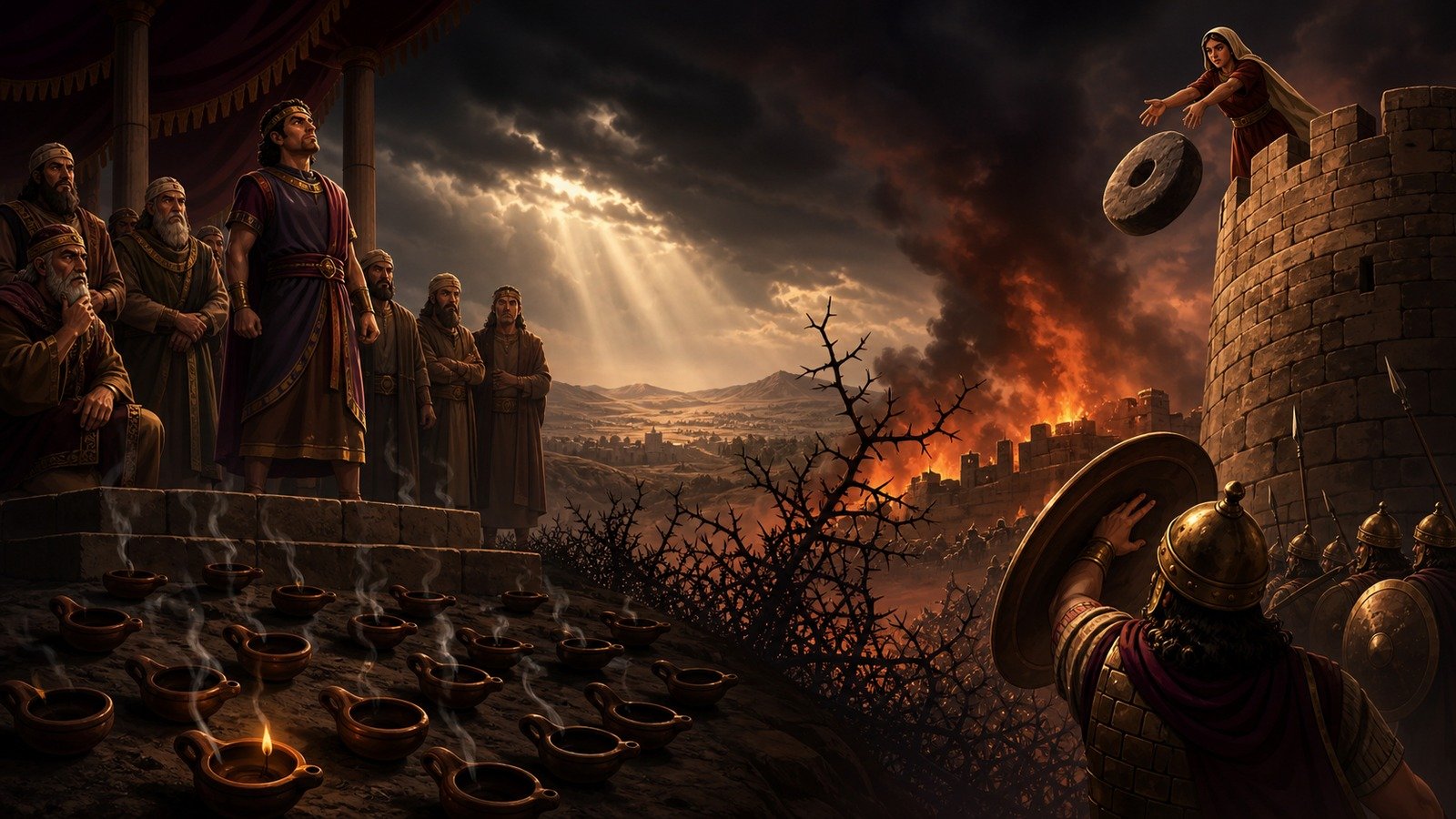
Gideon's son Abimelech murders 70 of his brothers and has himself made king at Shechem; his brief, violent reign ends when a woman drops a millstone on his head during a siege, fulfilling Jotham's earlier parable-curse against him.
Further context
2 min readGideon had refused a crown. His son Abimelech goes after one, and the way he does it is instructive about how power actually worked in that country.
Abimelech is the son of Gideon by a concubine in Shechem, so his mother's family are Shechemites and his father's household is at Ophrah. He goes to his mother's relatives and puts a question to the citizens of Shechem: which is better for you, to have all seventy of Gideon's sons rule over you, or just one? Remember that I am your flesh and blood.
They give him seventy shekels of silver from the temple of Baal-Berith, the name meaning lord of the covenant, and he hires reckless adventurers with it and murders his brothers on one stone at Ophrah. Only the youngest, Jotham, escapes by hiding.
Jotham then climbs Mount Gerizim, which overlooks Shechem and has acoustics good enough that a shouted speech from the slope can be heard in the valley, and tells a fable. The trees went out to anoint a king. They asked the olive tree, which refused because it would have to stop producing oil. They asked the fig, which refused because it would have to stop producing fruit. They asked the vine, which refused because it would have to stop producing wine. Then they asked the thornbush, which said, if you really want to anoint me king over you, come and take refuge in my shade; and if not, let fire come out of the thornbush and consume the cedars of Lebanon.
A thornbush casts no shade and burns readily, and the point lands. Jotham then runs and stays away.
Abimelech rules for three years. The relationship with Shechem sours, an opportunist named Gaal stirs up the citizens, and Abimelech destroys the city, scatters salt over it and burns about a thousand men and women who had taken refuge in the stronghold of the temple.
He then moves on Thebez and is doing the same thing there when a woman on the roof of the tower drops an upper millstone on his head and cracks his skull. His dying instruction is to his armour-bearer: draw your sword and kill me, so that they cannot say a woman killed him. It does not work, and the detail is recorded twice, here and generations later when a commander cites it as a standard example of what happens to men who go too close to a wall.
He is the first Israelite to try to rule by force and the attempt lasts three years and ends under a millstone. What his career demonstrates is the argument the whole period is having with itself. A nation with no central authority produced anarchy, and the first man to seize central authority murdered seventy of his brothers to get it and burned a city that had backed him. Neither state of affairs is presented as tolerable, and the demand for a king that arrives a few generations later walks straight into the space between them.