

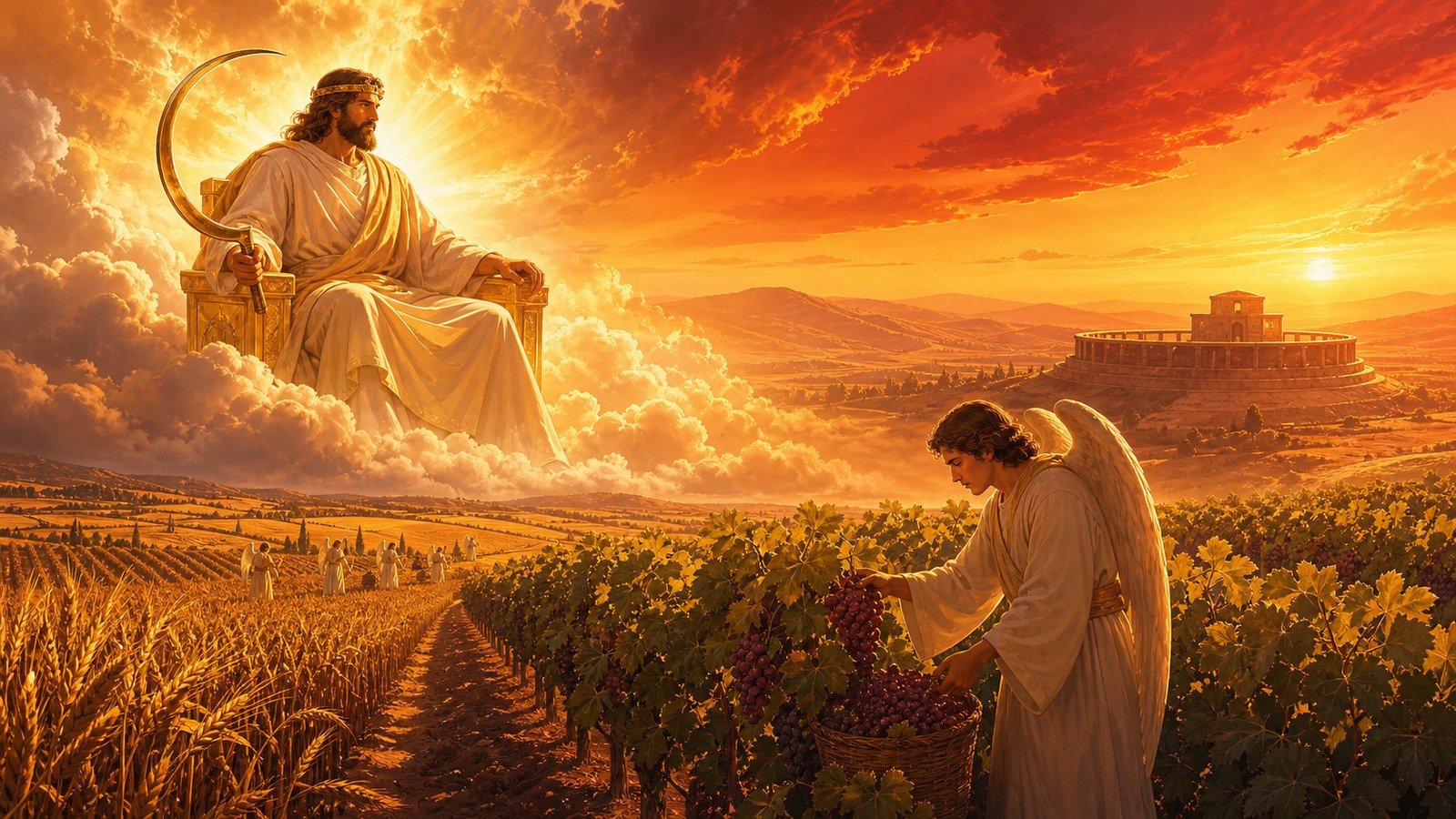
A figure "like a son of man" reaps the earth with a sickle, followed by an angel gathering grapes from the earth's vine and throwing them into "the great winepress of God's wrath."
Further context
2 min readJohn looks and sees a white cloud, and seated on it one like a son of man with a crown of gold on his head and a sharp sickle in his hand.
The description comes from Daniel, where one like a son of man comes with the clouds of heaven and is given authority, glory and sovereign power over all nations. It is also the phrase Jesus used of himself more than any other.
An angel comes out of the temple and calls to him: take your sickle and reap, because the time to reap has come, for the harvest of the earth is ripe. He swings his sickle over the earth, and the earth is harvested.
Then a second angel comes out of the temple in heaven, also with a sharp sickle, and a third comes from the altar, the angel who had charge of the fire, and calls out: take your sharp sickle and gather the clusters of grapes from the earth's vine, because its grapes are ripe.
Whether these are two harvests or one described twice is a real question, and both readings have long histories. Grain and grapes are the two harvests of the agricultural year, and elsewhere in the Bible a grain harvest can be a gathering in and a grape harvest is almost always judgement. Read that way, the first is the gathering of God's people and the second is the judgement of everyone else. Read the other way, both describe the same judgement in two images.
What follows leaves no ambiguity about the second. The grapes are thrown into the great winepress of God's wrath, and the winepress is trodden outside the city.
A winepress was a shallow rock-cut basin where the fruit was crushed underfoot, with a channel running to a lower vat, and hundreds survive in the hills around Jerusalem. Treading was hard, communal work, and the juice stained the treader to the knees. Isaiah has a figure coming from Edom with garments stained red who says: I have trodden the winepress alone.
Blood flows out of the press as high as the horses' bridles for about three hundred kilometres.
That figure is roughly the length of Palestine, and the image is deliberately unbearable rather than measurable.
Two figures wield sickles: one like a son of man, seated on a cloud, and an angel from the temple. That an angel is given the same instrument in the same scene has troubled readers who take the first figure to be Christ, and it is one of the reasons some take both harvests as judgement executed by heaven generally.
Outside the city is where the winepress is trodden, and outside the city is where executions were carried out and where the sin offering was burned. The letter to the Hebrews makes the same point about Jesus suffering outside the city gate.
Three hundred kilometres is given in the Greek as sixteen hundred stadia, which is four squared multiplied by ten squared, and in a book that counts in symbols the four is usually the four corners of the earth.