

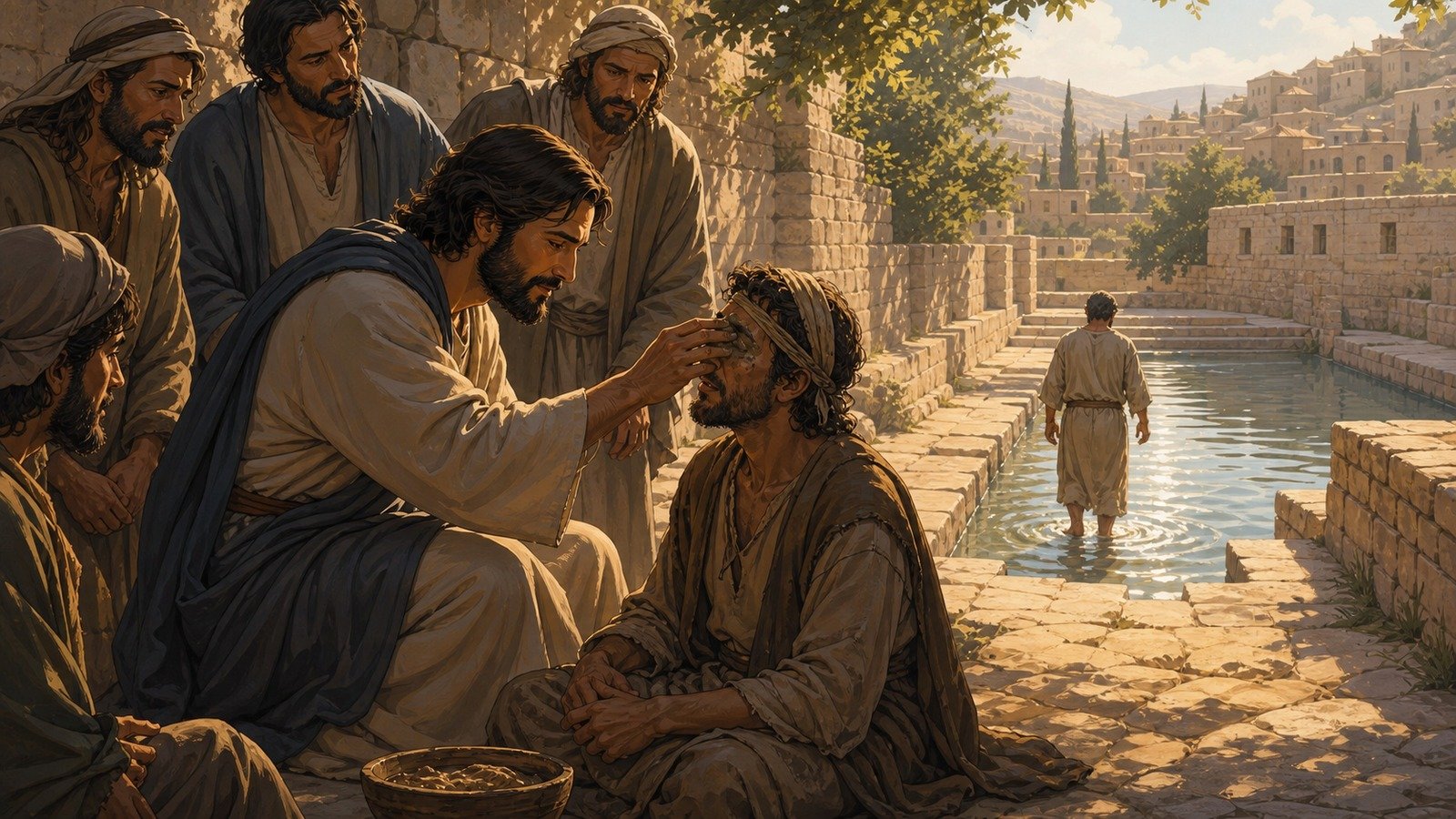
Jesus heals a man blind from birth using mud made from spit and dust, provoking a Sabbath controversy and an interrogation by religious authorities that ends with the healed man's expulsion from the synagogue and his growing recognition of who Jesus is.
Further context
3 min readWalking with Jesus, the disciples see a man blind from birth and ask a question that reveals the assumption of their world: Rabbi, who sinned, this man or his parents, that he was born blind?
The second half is conventional enough, since the law speaks of consequences reaching to later generations. The first half is stranger, because the man was born this way, and it points to a genuine line of rabbinic speculation about whether an unborn child could sin in the womb.
Neither this man nor his parents sinned, he answers, but this happened so that the works of God might be displayed in him.
Then he spits on the ground, makes mud with the saliva, puts it on the man's eyes and tells him to go and wash in the pool of Siloam. The pool was fed by a tunnel cut through solid rock in the eighth century BC to bring water inside the walls during an Assyrian siege, and the tunnel and an inscription left by the workmen who cut it from both ends still survive. The pool itself, with its steps, was uncovered during drainage work in 2004.
The man goes, washes, and comes home seeing.
Everything after that is interrogation, and it is one of the most finely observed sequences anywhere in the Gospels.
The neighbours argue about whether it is even the same man. He keeps saying, I am the man. He is taken to the Pharisees, and a complication emerges: it was a Sabbath. Kneading was among the categories of work forbidden on the Sabbath, and making mud with spit was held by some to fall under it.
They divide. Some say this man is not from God, for he does not keep the Sabbath. Others say, how can a sinner perform such signs?
They question his parents, who confirm he is their son and was born blind, and then refuse to say anything else because anyone acknowledging Jesus as the Messiah was to be put out of the synagogue. Ask him, they say, he is of age.
Expulsion from the synagogue meant exclusion from the community's worship, its charity and much of its social life in a village where everyone was known.
He is summoned a second time and told to give glory to God, a formula for demanding a confession under oath, and told they know this man is a sinner. His reply is a masterpiece of restraint. Whether he is a sinner or not, I do not know. One thing I do know. I was blind but now I see.
Under pressure he becomes bolder, and finally sarcastic: do you want to become his disciples too? They hurl insults at him and throw him out.
Then he is found and asked whether he believes in the Son of Man, and he asks who that is so he may believe in him. You have now seen him; in fact, he is the one speaking with you.
The tunnel that fed the pool runs about five hundred and thirty metres through bedrock, and the inscription cut by the workmen describes the moment the two teams, digging from opposite ends, heard each other's picks through the rock and broke through. It is one of the oldest pieces of Hebrew writing on stone.
The blind man is the only person in the Gospels who argues with the authorities and wins, and he does it without any theology beyond what happened to him. Never since the world began has it been heard that anyone opened the eyes of a man born blind, he tells them, and the logic is unanswerable in the room.