

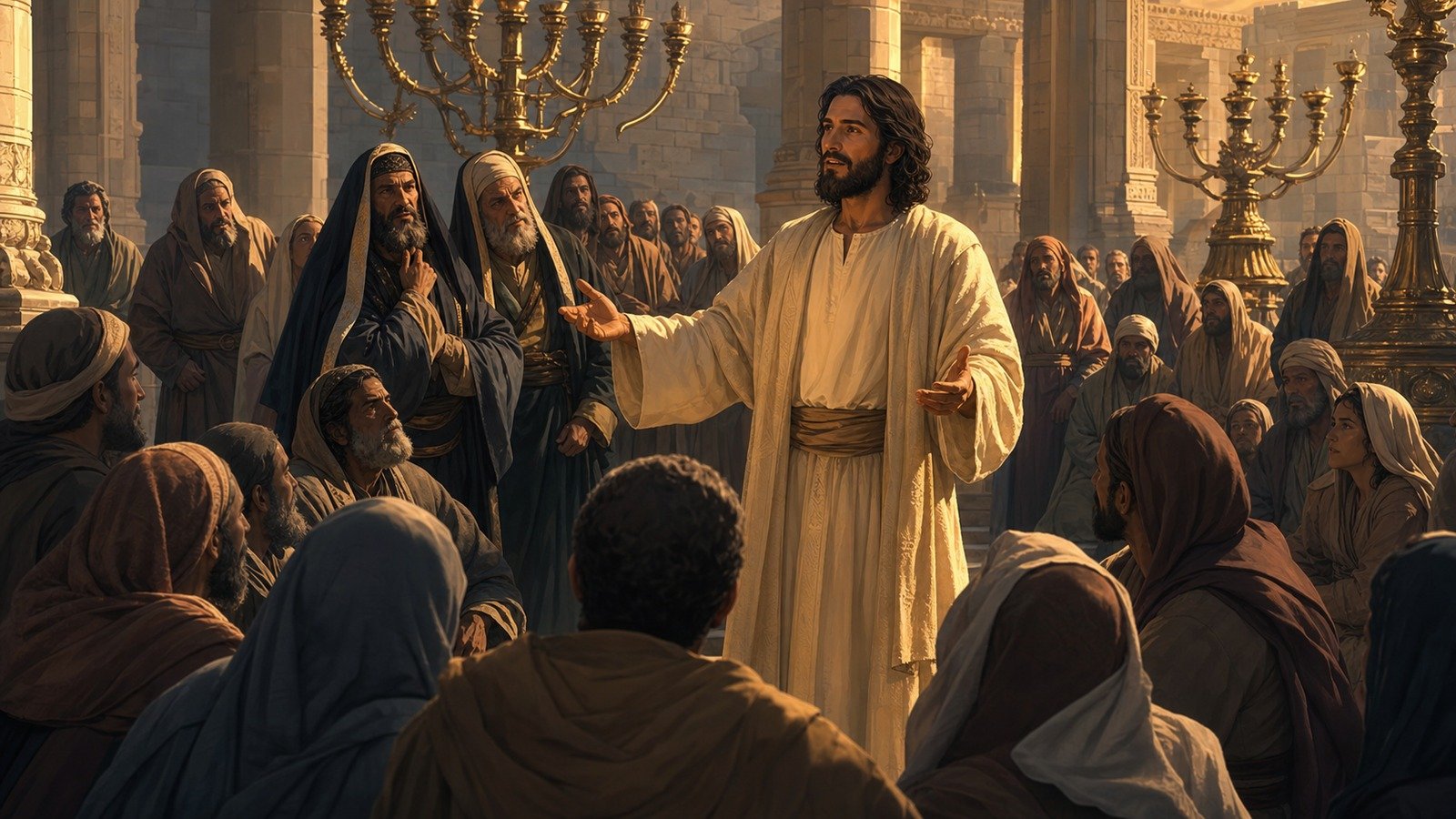
Jesus declares, "I am the light of the world," provoking a sharp exchange with Pharisees over the validity of his testimony about himself and, ultimately, over his identity in relation to God.
Further context
2 min readStill in the temple during the festival week, in the treasury area of the court of the women, Jesus says: I am the light of the world. Whoever follows me will never walk in darkness, but will have the light of life.
The setting supplies the force. Four great lampstands had been lit in that same courtyard for the festival, and men had danced with torches beneath them through the night. Standing where those lamps had burned and applying the image to himself was not a general remark about illumination.
The Pharisees object on a point of procedure: here you are, appearing as your own witness; your testimony is not valid. That is a real legal principle, and he had conceded it himself on an earlier occasion, saying that if he testified about himself alone his testimony would not count.
His answer works within the rule rather than around it. In your own law it is written that the testimony of two witnesses is true. I am one who testifies for myself; my other witness is the Father, who sent me.
They ask where his father is, which may be a straightforward question and may be a jibe about his birth, given what the village at Nazareth was prepared to say.
The exchange escalates through the rest of the conversation. You are from below, I am from above. You are of this world, I am not of this world. If you do not believe that I am he, you will indeed die in your sins.
Then a claim about Abraham, and here the argument breaks. Your father Abraham rejoiced at the thought of seeing my day; he saw it and was glad. The reply is arithmetic: you are not yet fifty years old, and you have seen Abraham?
Very truly I tell you, before Abraham was born, I am.
The grammar is deliberately broken. A person speaking correctly would say before Abraham was born, I was. What is said instead is the phrase used at the burning bush, when Moses asks for a name and is told I am who I am.
The response settles what they understood by it. They picked up stones to stone him, and stoning was the penalty for blasphemy. He hid himself and slipped away from the temple grounds.
Whatever a reader concludes about the claim, the crowd's reaction shows that nobody present took it as a modest one.
The treasury was in the court of the women, the second court in from the outside, where thirteen trumpet-shaped receptacles stood for offerings, and it was a public and busy place. Teaching there meant teaching within earshot of the priesthood.
The argument in that court runs on for a long stretch and it deteriorates on both sides. He tells them they belong to their father the devil; they answer that he is a Samaritan and demon-possessed. It is the ugliest recorded exchange he has with anyone, and it ends with stones being picked up off a temple floor that was still under construction, so the material was lying about.